

‘King of Drag’s Chase Lounge Wants to Liberate You (Exclusive)

The drag star is building a world where lesbian identity, fat liberation, and gender-bending performance can thrive — and he’s just getting started.
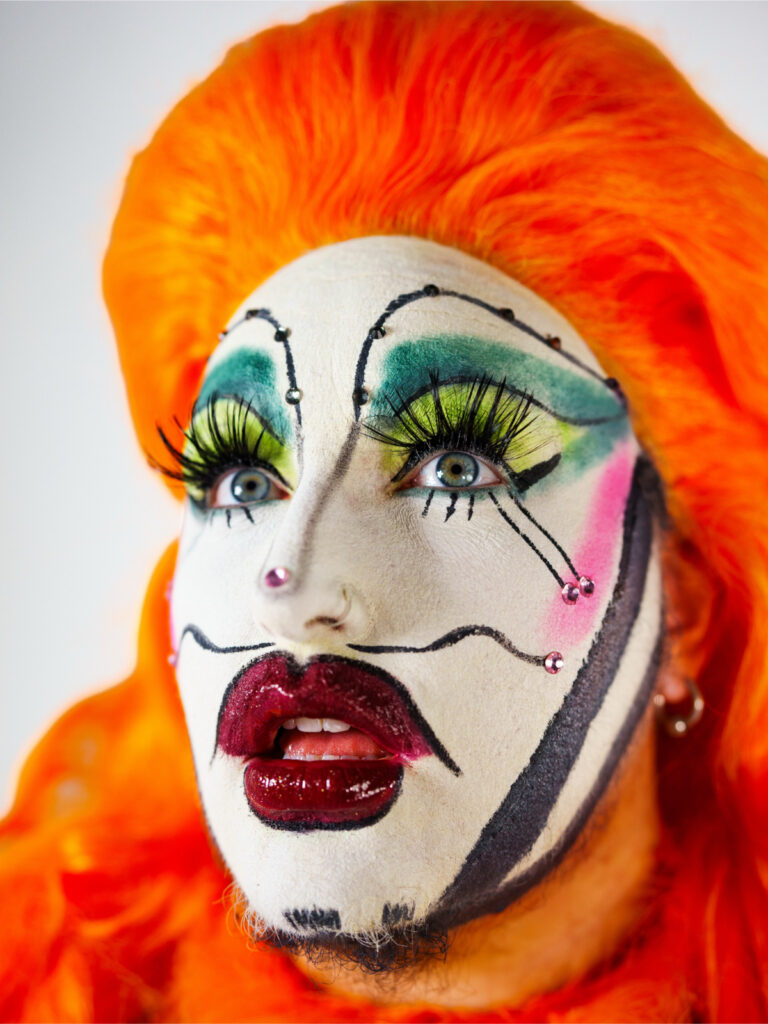
Chase Lounge didn’t burst into tears when he was eliminated from King of Drag. Those tears — powerful, cathartic, joyful — came later, when he realized what the experience had meant: being in a room with his brothers and bringing his whole, unique, distinctly Chase Lounge style of art into living rooms around the world.
“I was sad I didn’t get to do the sewing challenge because I do sew. But I felt so lucky that I got to do the comedy and the music and the acting challenge because those are like three areas where I really shine,” Chase tells GO. “Obviously it sucks to be eliminated, but I felt okay about it… I’m on antidepressants and testosterone, so it’s very hard for me to cry. So it felt good to cry in the interview. I just feel so lucky for this experience because I got to portray my art [and] I love the art of reality TV… I’m a drag artist, I love subversion and I think that reality TV is all about subversion.”
For the Los Angeles-based king, being part of this reality show was always in the cards, ever since the first season was announced. He applied for season one, but in retrospect, the timing wasn’t right. His art was still evolving, and by the time season two’s casting came around, he had a sixth sense that this time would be his moment. He intended to make the most of it.

For Chase Lounge, confrontation is key, whether it’s challenging ingrained ideas about gender, our bodies, queerness, art, or masculinity. For the trans comedian turned drag king, one of the most exciting things about Revry’s competition series is that it refuses to treat masculinity, or the drag art it inspires, as a fixed category, thanks to the variety of voices in the show’s “man cave.”
“I just love it,” Chase gushes. “I love hearing everyone’s stories. I love seeing the process of creativity. I love seeing the breath of drag. I feel like season one they did such a good job of showing classic drag king masculinity, and this season they’ve done such a good job of showing gender f*ck masculinity.” The experience served as inspiration for the drag artist, and seeing it all play back as the season airs has been meaningful. “It’s just fun to see your community represented pretty accurately on screen,” he adds.
And perhaps most excitingly, this kind of representation makes lots of space for nuance and the complexity inherent in our queer community.
“I am a trans masculine trans man, but I still use the label of lesbian,” he explains. “I think some people feel confined by that term, but for me, it’s such an expansive term and encompasses so much. And I feel like drag kinging is the same, where like people might think it means one thing, but it actually means like a million things.”
Chase’s understanding of gender and performance is inseparable from an identity he fought to claim: that of a butch lesbian. His love of and connection to being a lesbian began with his abject fear of it. “I grew up believing that lesbians were predators and like the worst thing you could be. Just lots of misogyny there because I was okay with gay men. Had no idea what trans people were, so they weren’t even really in the picture,” Chase recalls. His Catholic upbringing in the more conservative parts of Las Vegas in the 2000s led to deep repression.
The realization that he was a lesbian came slowly before suddenly hitting him like a lightning bolt. “I was driving in my car one day and was just like, ‘Oh, I can just be a lesbian. Like I don’t even have to be bisexual. Like I’m just allowed to be a lesbian,’ and I’ve identified that way since then,” he says.
In fact, he’s emblazoned that identity on his skin with a labrys tattoo inspired in part by Corky’s tattoo from Bound. “I have a lower back tattoo that says ‘butch’ in Old English lettering, and being a butch lesbian specifically is huge for me,” he says. It’s an identity he doesn’t see as conflicting with his trans identity. “I think butch butches and trans masculinity have such a rich history. I really identify with the Leslie Feinberg of it all. So, it’s been fun to bring that to the screen.”
This season, Chase also opened up about the various struggles he has faced, whether with addiction, mental health, or his journey to fat liberation. “I’m like a triple threat. I have OCD, bipolar, and ADHD. So there’s a lot going on in my brain,” he jokes.
This week’s challenge saw the kings using colors and costumes inspired by flags to tell a story. For Chase, that meant an opportunity to share his journey of healing.
“I just felt like it was really important [part of] my story because … until I got sober when I went to a residential mental health program, and … [got] my bipolar in check and [got] sober that it allowed me to finally come out and live my life authentically … mental illness and the addiction were things that were standing in the way of my authenticity,” he explains.
It was profoundly important to Chase that he tell this story for audience members who might share similar experiences. “I just wanted to be vulnerable with my cast and the judges, and ultimately the audience, and let people know that you can move through these things,” he explains.
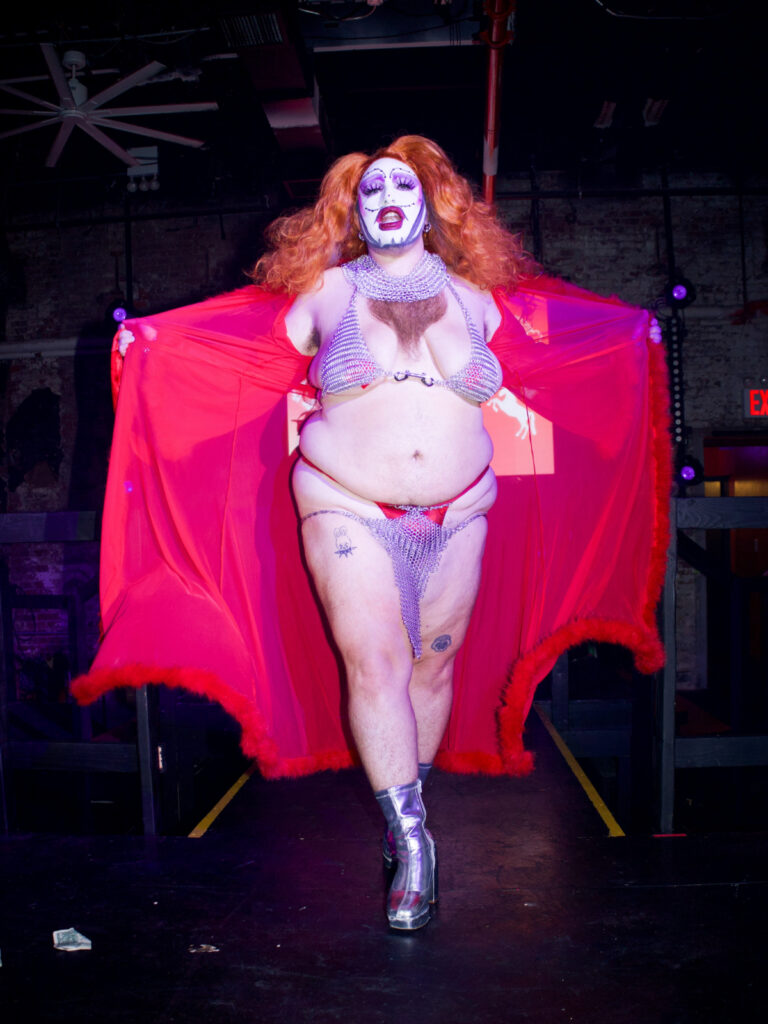
Part of the healing that followed came with Chase’s discovery of fat liberation and his refusal to make his body less visible or palatable for others.
It’s also why Chase isn’t shy about using his body to confront orthodoxy around beauty standards, body image, and prejudices about fat bodies. “When I say that my body is a confrontation, it’s almost like forcing people to engage with it because I know that a lot of people think it’s disgusting even to be so scantily clad with this body, and I just want to force people to witness, basically,” he shares.
And if you’re uncomfortable with that, well, it’s something that requires examination and unpacking, because the roots of those feelings run deeper, he explains. “If you’re not into fat liberation, I can connect the dots that you’re a white supremacist,” he says. “That’s basically like where it leads because beauty standards … are at best Eurocentric and at worst white supremacist.”
Having transitioned and gained weight after beginning to take antidepressants, Chase has a unique point of view on how thin privilege, racism, prejudice, and transphobia intersect.
“I did have thin privilege for a really long time, before I transitioned, I was a very thin, very conventionally attractive white woman, and people treated me differently. I ended up like gaining weight because of a psych med, and I was still femme at that time, and I just literally watched a privilege that I didn’t even realize that I had just been taken from me and [was] starting to be treated differently,” he recalls. “I felt like a monster.”
But a friend who was both a therapist and an eating disorder specialist introduced Chase to fat liberation, and it was life-altering. “Now I literally do not have gender dysphoria. I don’t have body image stuff anymore at all,” he says.
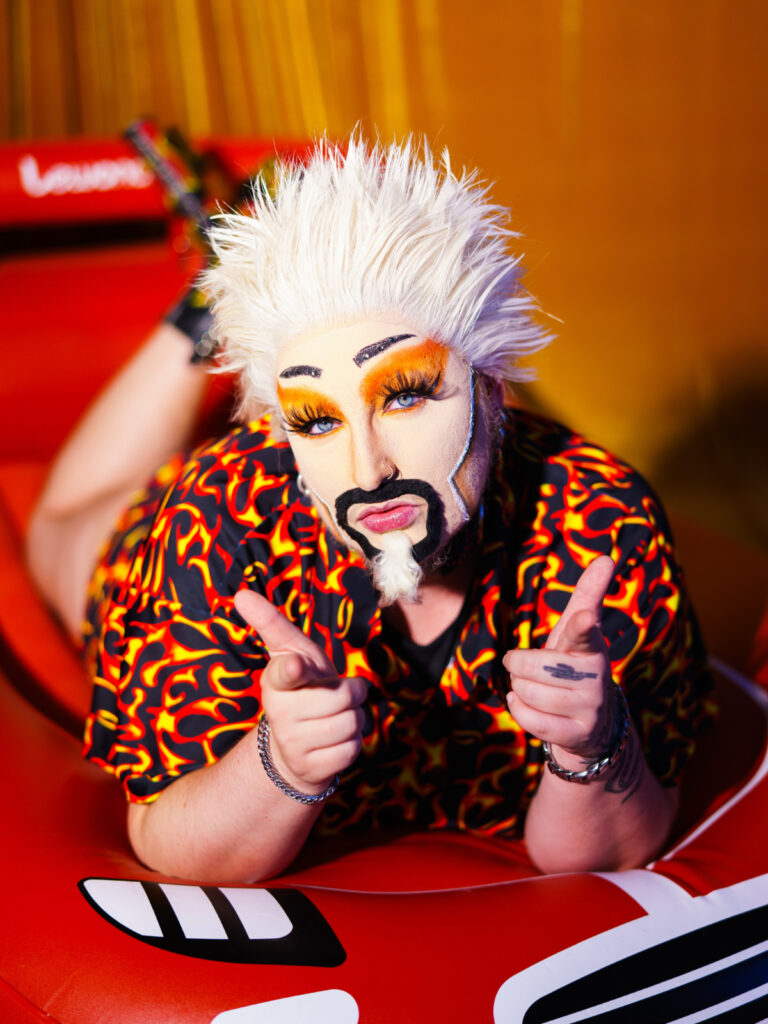
This has also given Chase the confidence to stop waiting for permission to create the queer world on his own terms or for drag venues to make room for every kind of queer expression. Instead, he’s building that world for himself and his fellow kings.
Case in point: the Pink Pony Club, an all-sapphic and trans drag show and competition he hosts at Akbar in Los Angeles and intends to take on the road. He saw a need for a sapphic and trans space, so he created one.
“It just goes back to that community piece, and there is a special type of vulnerability that comes with sapphic expression,” Chase explains.
It also gives him the opportunity to usher future kings through the door he’s opening. “Newer artists need that welcoming, supportive space, and so do established artists,” he says, adding, “I just wanted to create like a dyke fag utopia, basically.”
And Chase isn’t done pushing boundaries or evolving as an artist. His leather and kink community has played a role in his evolution as an artist and a sexual being.
“I have always been kinky, and then when my first official girlfriend and I broke up a few years ago, I was like, wait, I really need to explicitly get into kink,” he recalls. So off he went to his first play party, where he initially explored his dom side before discovering he was “very switchy.” Now, he says, he’s in his sub era.
This exploration also led him to compete for the title of Precinct Leather a couple of years ago. He competed in full drag as Chase Lounge, and while he didn’t walk away with the title, his participation marked a first for the event.
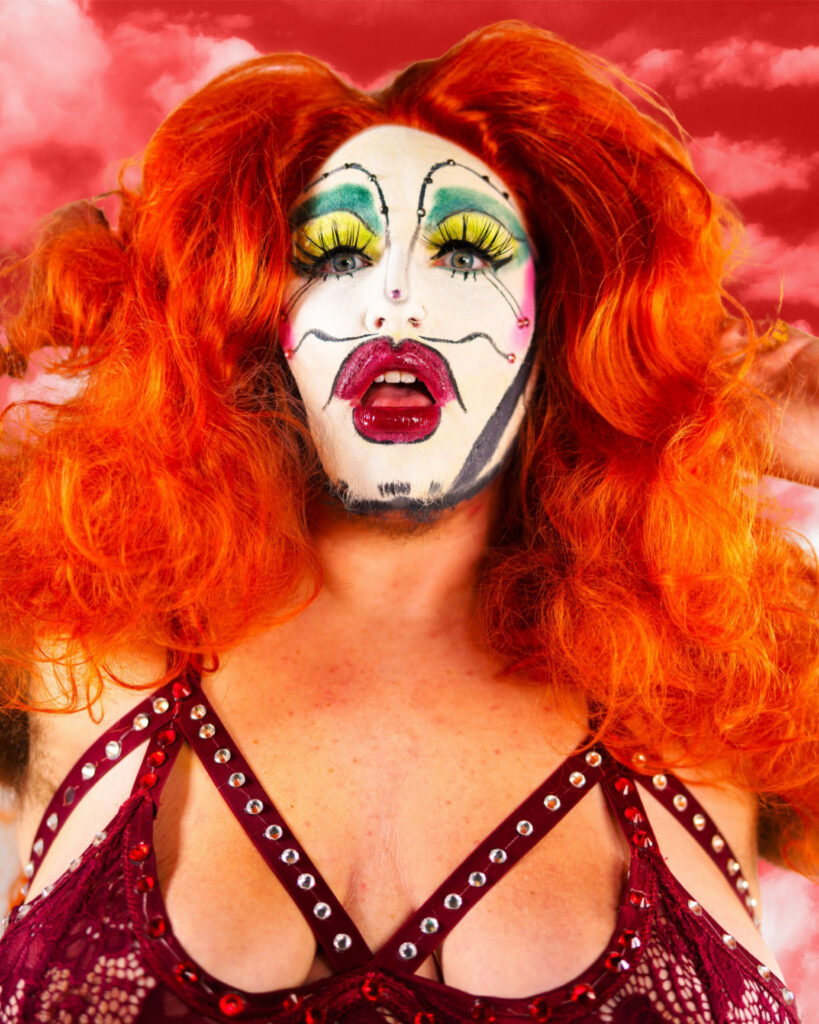
It’s also very much in keeping with Chase’s mission to make space for forms of queer expression that aren’t always welcomed elsewhere.
“I just think kink is so creative, and kink is like a huge part of my drag,” he says, explaining that its influence can be felt at Pink Pony Club showcases. “We feature a kink performance every month, so that’s been really fun to introduce.”
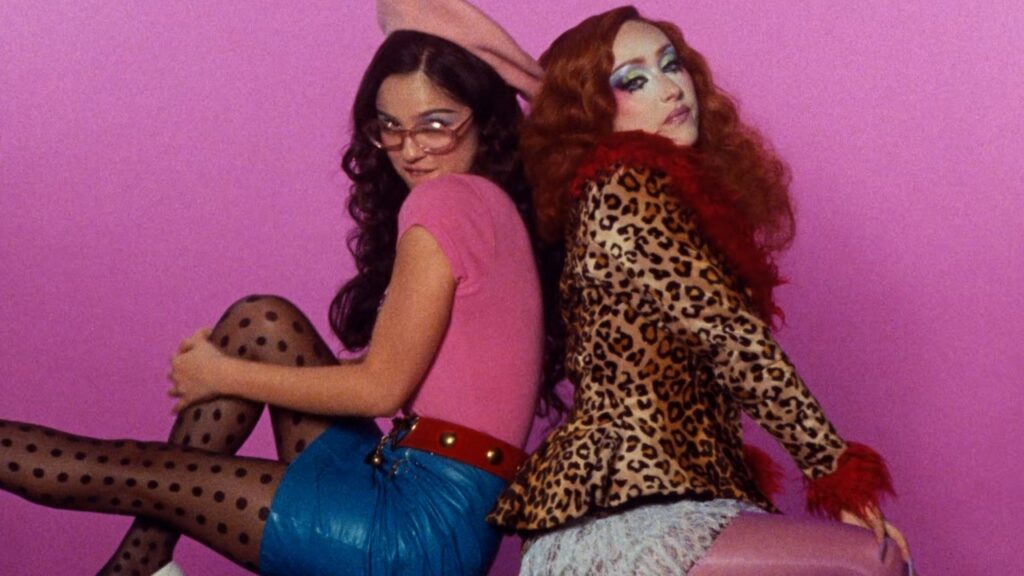
This expansive, transgressive, and experimental element of Chase’s artistry speaks to the complexity of the artist behind the persona. His creative life extends far beyond his drag, or even his time on King of Drag. He’s a therapist, a comic, a poetry zine writer, and an essayist whose work will be appearing in Vestite soon, as well as a musician whose video for the oh-so-Chase, raunchy banger “Bottom Growth Sucker” is out now.
The world truly is his oyster, despite not feeling “gay famous” quite yet. “I am really getting back into music. I’ve always written songs and stuff. And then when I moved to LA to do comedy, I was doing a lot of musical comedy and stand-up, and improv and sketch, everything,” he says. But all that went on hold during the COVID lockdowns. That was also when Chase found drag and thought, “I’m, like, over comedy.”
“Then maybe like two years ago is when I did my one-person show, and then that’s when comedy started coming back in, and I was like, ‘Oh, what if I did comedy in drag?’”
Now, he’s ready to take this new iteration of Chase Lounge bi-coastal and will be making appearances in New York in November. “I’m definitely going to be visiting my brothers and you know touring their cities and whoever will have me basically. I would love to do international [gigs]. I’m trying to do international Prides, and then I’ll be trying to book my brothers in LA as well.”
What can audiences expect from the ultimate Chase Lounge experience? Something very “raunchy,” he says. “It would just be like a fun house of transsexuality.” We wouldn’t have it any other way.