

Who Is Alice Weidel, the Lesbian Leader of Germany’s Far-Right AfD Political Party
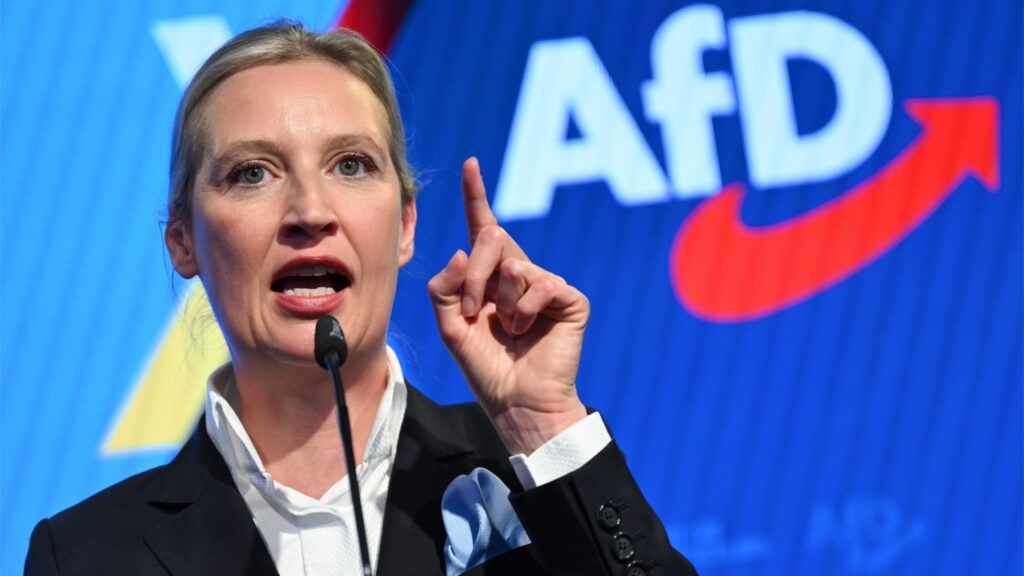
Weidel’s party doesn’t support LGBTQ+ rights.
The far-right in Germany saw a victory in the Saxony-Anhalt state election over the weekend. It’s the best a far-right party has done since before WWII.
As the Alternative for Germany (AfD) party becomes a stronger political player in the European country, eyes have turned to its co-leader, a lesbian who is married to an immigrant Swiss woman and raising two sons with her outside of Germany.
Yes, this is the same person who is now the leader of a political party that deems same-sex marriage unimportant, the nuclear family is the ideal family unit, same-sex couples shouldn’t be allowed to adopt children, and immigration must be halted. Previously, the German government had monitored AfD for suspected extremism.
Who is Alice Weidel?
Weidel was born in West Germany and raised Roman Catholic. The AfD leader went on to study business and economics in college, and earned a PhD in economics, focusing on China.
Her grandfather was a judge in Nazi Germany and appointed by Adolf Hitler — something she’s claimed in interviews was never discussed growing up.
She joined AfD in 2013, the year it was founded, and rose through its ranks, becoming a leader in 2015 and co-party chair in 2022. Last year, she stood for the party in the general election, where the party secured over 20% of the vote, becoming the second most powerful party in Germany’s parliament.
What are AfD’s Politics?
Weidel has consistently said the AfD is not far-right or extremist; however, other political parties have sworn to a “firewall” against joining the party to govern because of its policies and what it promotes.
In a “Vision 2026” election plan — a similar manifesto to Project 2025 — the party in the state of Saxony-Anhalt wants to enact policies similar to those of President Donald Trump.
It also seeks closer relations with Russia, according to Sky News, and would support deporting war refugees from Ukraine so long as the war caused by Russia’s invasion of Ukraine stays in the country’s eastern region.
The children of refugees would also be placed in separate classrooms in schools to ensure they are aware they are only temporarily in Germany.
The party — and Weidel — has repeatedly supported the idea of re-migration, effectively deporting those who were not born in Germany.
It also said it would try to restrict public displays of Islam, including how mosques can be decorated, as well as banning the call to prayer.
How does Weidel’s identity relate to AfD’s beliefs?
Weidel says her identity doesn’t affect her politics as an AfD member and lawmaker. The New York Times reports she’s said she’d destroy wind turbines and fire gender studies professors.
“I am not queer,” Weidel said in an interview last year, according to the paper, using the English word, “but I am married to a woman I have known for 20 years.”
She’s been with her wife Sarah Bossard since 2009, according to PinkNews. Bossard was born in Sri Lanka and adopted by a Swiss couple.
The women have two children who were adopted, even as Weidel and her party promote the nuclear family of a heterosexual married couple as the ideal image of the family. She also splits her time between Berlin and a small village in Switzerland, where Bossard lives with their children.
Weidel has been able to seize and expand support within the party, across Germany, and even from right-wing forces outside of Germany.
In an interview with Elon Musk last year, she said that her party was unlike the Nazis and “not right-wing,” labeling Hitler and his party as socialist communists, even though under Nazi rule thousands were killed for being socialists and communists.
The next federal-level election in Germany is in 2029.