

Birthright Citizenship Upheld as Supreme Court Rejects Trump’s Challenge to 14th Amendment
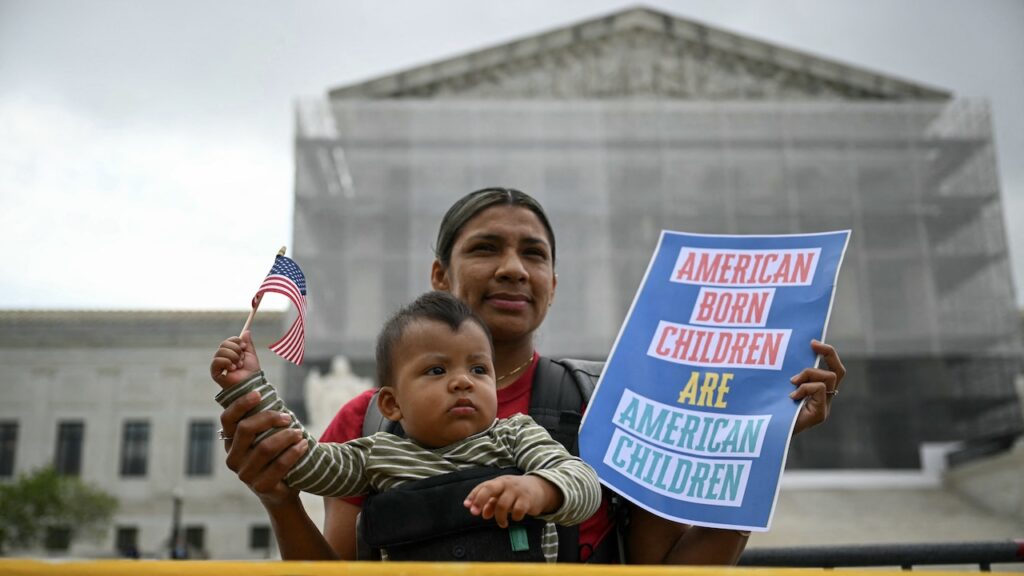
The decision upholds more than 100 years of legal history by preserving the 14th Amendment’s guarantee that most children born in the U.S. would automatically be citizens.
This story was originally reported by Candice Norwood of The 19th. Meet Candice and read more of their reporting on gender, politics and policy.
The U.S Supreme Court upheld more than 100 years of legal precedent on Tuesday that affirmed the 14th Amendment’s guarantee of birthright citizenship to children born to undocumented immigrants and those with temporary status.
The court’s majority rejected the Trump administration’s reinterpretation of the citizenship clause of the 14th Amendment, which reads in part: “All persons born or naturalized in the United States, and subject to the jurisdiction thereof, are citizens of the United States and of the State wherein they reside.”
In oral arguments on April 1, the Trump administration questioned whether noncitizen or temporary status immigrants have an allegiance to the United States, and argued that citizenship should depend on families establishing a “permanent domicile and residence” in the country. In its challenge to the administration, Cecillia Wang, national legal director for the American Civil Liberties Union (ACLU), argued that establishing a permanent domicile was not the focus of the citizenship clause of the 14th Amendment.
Since 1868, birthright citizenship has been granted to most children born in the country, except for those born to foreign diplomats, hostile military members and on foreign public vessels. Native American children were excluded from birthright citizenship until the Indian Citizenship Act of 1924 established that right.
Thirty years after the ratification of the 14th Amendment, the Supreme Court extended birthright citizenship rights to the children of immigrant parents in the landmark case, U.S. v. Wong Kim Ark, which ruled in favor of a man born in California to Chinese parents.
Through the decades, birthright citizenship has been considered by many scholars, immigrant rights advocates and everyday Americans to be one of the nation’s foundational promises. But on the first day of Donald Trump’s second term, he signed an executive order challenging these protections for children born to parents without citizenship or permanent legal status. In response, the ACLU filed a class-action lawsuit on behalf of a group of parents and children who would be affected by Trump’s order.
An estimated 250,000 babies are born on U.S. soil to immigrant parents without authorization each year. Narrowing the scope of birthright citizenship would have threatened to expand the number of people living in the country without authorization for generations. According to projections published by the Migration Policy Institute and Penn State, an additional 2.7 million people would be unauthorized by 2045, and 5.4 million additional people by 2075.