

Fewer Girls Are Identifying as Bisexual, According to New Data. But No One Knows Why
While conservatives have pounced on the news and said it shows queer identities aren’t legitimate, researchers say it’s much more nuanced.
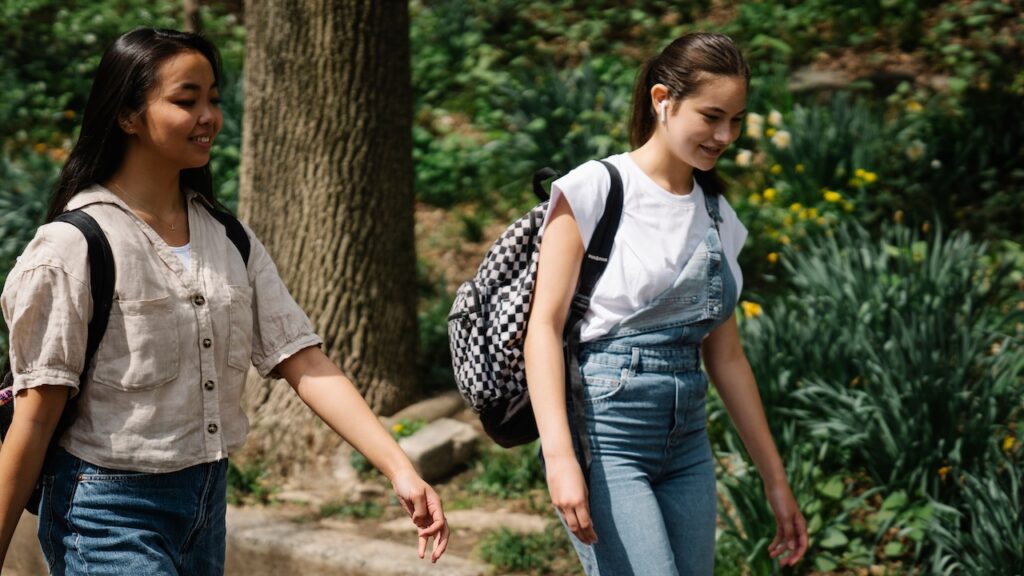
In a recent Substack article, psychologist Jean M. Twenge dove into data on how young people identify their sexual orientation. Pulling data from the Centers for Disease Control and Prevention, she found that there was a marked decline in how ninth-grade girls identified: They dropped in identifying as bisexual by 13 percent.
Twenge noted the change because she told the New York Times, “pretty much every other indicator for a very long time was going in the direction of more same-sex relationships, more acceptance of same-sex relationships, more identification.”
She added, “It’s a reversal of very longstanding trends.”
According to Twenge’s analysis, the percentage of lesbian and bisexual-identifying teen girls ages 14 to 18 fell from 30% in 2021 to 17% in 2025.
“The decline [in identifying as lesbian, gay, or bisexual] appears to be driven almost entirely by girls. Identifying as LGB dropped from 27% in 2023 to 22% in 2025 among girls, and from 9% to 7% among boys … The previous increase in identifying as LGB was also larger among girls, with a 128% increase (more than doubling) from 2015 to 2021 among girls and a 99% increase (doubling) from 2015 to 2023 among boys,” she wrote.
She continued: “The decline is by far the largest among 9th grade girls, where identifying as LGB dropped from 30% in 2021 to 17% in 2025, nearly cutting the numbers in half … The changes among (for example) 12th grade girls are much smaller, from 26% in 2021 to 28% in 2023 and 25% in 2025.
Twenge pulled data from the CDC’s Youth Risk Behavior Survey, which is conducted every two years in high schools across the U.S. The survey did not ask respondents about their gender identity because of Trump’s anti-trans executive order declaring only two sexes.
In the weeks since Twenge’s post was published, conservatives have latched onto the data, saying that essentially this is due to the hollowing out of DEI in the years under the Trump administration.
“Amazing what happens when you cut the Department of Education and USAID,” Terry Schilling, the director of the American Principles Project, wrote on X, formerly Twitter.
Comments on his post include, “What people claimed was social contagion was in fact social contagion” and “It was all a phase.”
The Times notes that others have said that the numbers actually show how anti-LGBTQ+ laws and rhetoric have caused teens to be too scared to come out and identify as queer.
Twenge said it’s more complicated than either of those conclusions.
A researcher at American University and the Williams Institute, Andrew Flores, said that it was hard to gauge the data because the drop was only seen in ninth-grade girls. Flores said that while there was an uptick in high schoolers identifying as heterosexual, that could have been due to the ninth-grade girls. Other identities stayed relatively the same.
Others noted that the data needs to be observed to better understand what’s actually happening.
Phillip Hammack of the University of California, Santa Cruz, told the paper, “I think this is something we need to watch precisely because these are young people who are starting to experience these questions about their gender and sexuality in such a hostile moment.”
Twenge pointed out that other research has shown that girls’ sexualities change more over their lifetimes.
“Their sexuality just changes more,” Twenge told the paper. “And I think that’s exactly what’s showing up here in both the increase and the decrease. But why it’s so big for the ninth graders, I don’t know.”