

From Coming Out to Don’t Ask Don’t Tell: Barney Frank’s LGBTQ+ Rights Legacy
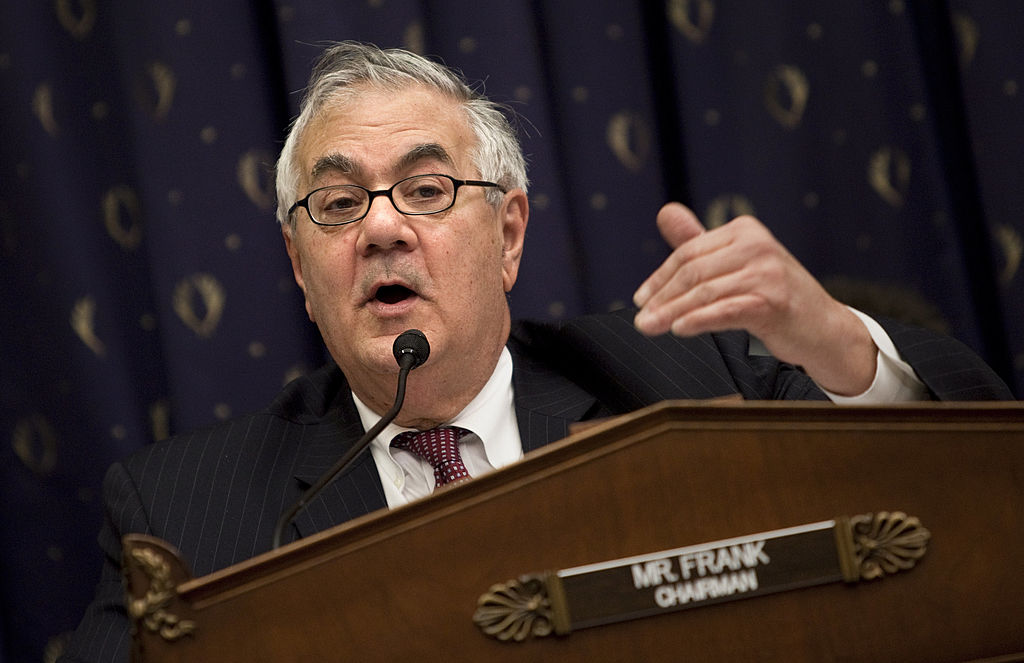
Barney Frank died earlier this week. He was 86.
Photo by Brendan Smialowski/Getty Images
Former U.S. Rep. Barney Frank of Massachusetts died Tuesday, May 19. He was 86 and had been in hospice care for congestive heart failure. The Democratic lawmaker served in Congress for 32 years and became a leading voice for LGBTQ+ rights. He was the most prominent gay political figure in the U.S. for decades.
Frank called for a greater government response during the height of the HIV/AIDS crisis, pushed for the end of Don’t Ask, Don’t Tell, and worked to create stronger anti-discrimination and hate crimes laws.
In 1987, Frank became the first member of Congress to voluntarily come out. In an interview with the Boston Globe, Frank said, “If you ask the direct question: ‘Are you gay?’ the answer is yes. So what?”
In 2008, Frank and then-U.S. Rep. Tammy Baldwin, who were then the only two LGBTQ+ members of Congress, created the House of Representatives LGBT Equality Caucus. Today, it’s become the Congressional Equality Caucus with 193 members, including 12 out LGBTQ+ members.
Four years after the group’s creation, Frank became the first congressperson to marry someone of the same gender, his husband James Ready.
While in the House, Frank chaired the Financial Services Committee during the 2008 recession and co-authored the Dodd-Frank Act, which put tougher scrutiny on Wall Street banks. He helped pass the Matthew Shepard and James Byrd Jr. Hate Crimes Prevention Act, which gave federal hate crime protections to LGBTQ+ people.
He retired in 2013, though he returned to the House floor in 2022 when the Respect for Marriage Act passed.
During his time in Congress, Frank was “one of the most influential lawmakers in Congress on issues far beyond equality,” the Human Rights Campaign notes.
Shortly before his death, Frank had been promoting his book The Hard Path to Unity: Why We Must Reform the Left to Rescue Democracy, which is set to be published later this year. In interviews about the book in The Atlantic, CNN, and elsewhere, he criticized the Democratic Party for its support of trans rights. Frank had previously drawn criticism in 2007 when he stripped trans protections from the Employment Non-Discrimination Act, arguing the bill needed to be narrowed to pass. It didn’t pass.
Katelyn Burns noted Frank’s record on trans rights and his recent interviews in an op-ed. “In his dying days, Frank made sure to remind us of his view that the way forward for Democrats is leaving trans people behind,” she wrote.
Queer politicians and rights groups still mourned Frank’s passing, with many calling him an iconic lawmaker and LGBTQ+ rights leader.
“Barney was candid, outspoken, quick-witted and downright funny, and he always had his eye on making progress. He was willing to take on anyone who was in his way, regardless of who they were – I should know, I was one of the many who on occasion got an earful from him. But I, and anyone else who spent time with him, were lucky to watch him in action and learn from him,” Wisconsin Sen. Tammy Baldwin said in a statement. “Barney was a masterful legislator, savvy and strategic, and always thinking of the long game … Barney was a giant whose shoulders the movement for LGBTQ rights stands on. Our country is a better, more just, more equal place because of him, and he will be sorely missed.”
Congressional Equality Caucus Chair U.S. Rep. Mark Takano of California remembered meeting Frank in the early 1980s and how the congressman campaigned with him when Takano ran for the House.
“I followed his journey for years, including the part he played in moving the bill providing redress to Japanese Americans interned during World War II forward, and watched how his constituents stuck by him after he came out — even at a time when the United States was still deeply homophobic — because they knew he would never stop fighting for them. Barney proved that what mattered most was the work you did for others. I truly believe that we are closer to a more equal world because of Barney Frank,” he said in a statement.
Before his death, Frank told GBH News that he was able to become a gay-rights trailblazer because he had an opportunity to do so, using a surfing analogy inspired by his husband.
“If there are waves, [my husband is] very good at taking advantage of them,” Frank told the station. “That’s how I feel about gay rights. I came along in American history when people were ready to deal with that.”