

A New Era On The Ice
The rise of the New York Sirens, the PWHL, and a booming women’s hockey scene. Three of the team’s out queer players talk record-breaking attendance, “Pizza Rats,” and the inclusivity shaping the culture of a young league.
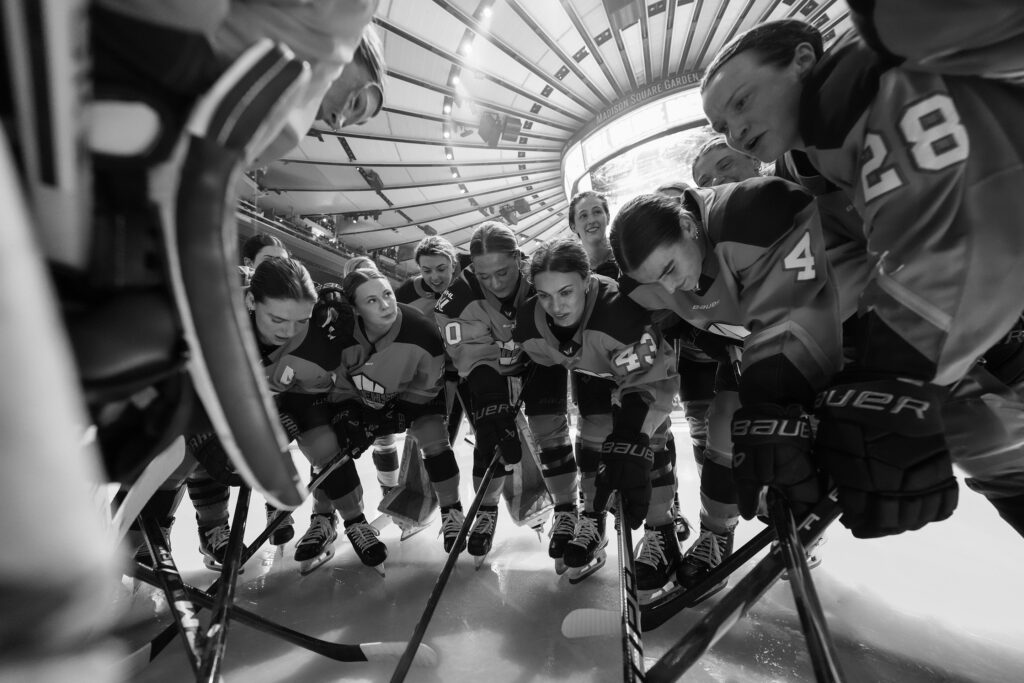
Featured Image: The New York Sirens huddle at their Madison Square Garden game this April. Photo courtesy of PWHL/New York Sirens.
Once on the sidelines of mainstream culture, hockey has had an explosive year, expanding beyond the rink and into the cultural zeitgeist. According to The Express Tribune, searches for “ice hockey lessons” have surged by 367 percent since January. Between highlight reels of metal blades carving across ice to fan edits pulled from the queer hockey romance Heated Rivalry, what was once a niche winter sport has skated into pop culture. At the 2026 Olympic women’s hockey finals, that momentum transcended when Team USA edged out Canada in a nail-biting overtime gold medal game, showing that women’s hockey isn’t just gaining attention, it’s commanding it.
“Three years ago, this league didn’t exist,” says New York Sirens captain Micah Zandee-Hart.
On the crest of this changing tide, the Sirens faced off against the Seattle Torrent in April to the tune of 18,000 screaming fans at the iconic Madison Square Garden. The game set a new U.S. attendance record for the Professional Women’s Hockey League (PWHL). As Billie Jean King stepped onto the ice for the ceremonial puck drop, the moment carried the quiet gravity of history meeting its own reflection. A lifelong advocate for visibility and equity in women’s sports, King paused and said, “I’m just so happy I’m alive to see this.” What unfolded wasn’t just a game. It was proof that women’s hockey isn’t passing through arenas anymore, it’s claiming them.
For Zandee-Hart, that shift is something she’s watched evolve over time. As the only captain the Sirens have ever known, she has remained a constant presence through the team’s short but rapidly evolving history. In the 2024-2025 season, the Canadian defender led the team in ice time, averaging 26 minutes per game. This season, she remained a constant presence, appearing in every game and continuing to shoulder the weight of being the team’s foundation. But what stays with her isn’t the minutes on ice, it’s the crowd.
“Seeing someone in my jersey and thinking that someone took their hard-earned dollar, and spent it not only on a Sirens ticket, but on representing me as a person and a player, always gives me chills,” she says. “It reminds me of how loyal and passionate our fanbase has been and how our attendance numbers will go up.”

(R) Sirens captain Micah Zandee-Hart. Photo by Michael Chisholm/Getty Images.
In the stands, that loyalty is loud and impossible to miss. “It was so exciting! I was shouting from the rooftops,” says 26-year-old Jenna Travis, a Sirens season ticket holder who watched the Madison Square Garden game from the glass. A familiar figure in the stands, Travis is often recognized by their signature “wee-woo” hat, a construction helmet customized with a spinning siren light that flashes.
“I’d love to see a lot of our fans that made it to Madison Square Garden hop across the river to the Prudential Center,” they say, referencing the New Jersey stadium that the Sirens typically call home. “And I’d love to see the Sirens play again at Madison Square Garden. I’m honestly just so proud of how this team has played.”
It’s the same kind of energy that has come to define the PWHL’s fast-growing fanbase. In New York, Sirens fans have taken on the
name “Pizza Rats,” a nickname that the fans originally called the team. They bring homemade signs reading “LET’S GO LESBIANS,” posters riffing on Heated Rivalry featuring Jaime Bourbonnais and her partner Emily Clark who plays for Ottawa Charge, bedazzled jerseys, turquoise Mardi Gras beads, handmade bracelets, and chants such as “Wee woo! Wee woo!” and “Ozzy Ozzy Ozzy! Oi Oi Oi!” that ripple through the arena.
Like Zandee-Hart, assistant captain Bourbonnais has watched the buzz around women’s hockey build with each passing season, growing alongside it as she’s embraced more of a hybrid role, blending steady, reliable defense with a more active offensive presence. What has shifted, she says, is not just the level of play, but the feeling inside the rink itself, and how far that feeling now travels.
“I feel like women’s hockey, luckily, is a space where people do feel really welcomed, and people come into the rink and they can just be
themselves,” Bourbonnais says. “It’s really special to be able to look up at the crowd and see a lot of queer fans and just see them be able
to be themselves, and feel like they’re in a place that they belong.”
Married couple and longtime Seattle Torrent fans who host the podcast Gloves Off Seattle, Patti Rakoci, 59, and Meagan RakociMcDonald, 45, made a last-minute decision to travel to New York to see their team play against the Sirens at the Garden. Their connection to hockey predates the league itself, shaped by years of following the National Hockey League (NHL) before the PWHL was formed in 2023. Even in a building where they were rooting for the other team, they said the atmosphere felt immediately welcoming.
“While we were sad our team lost, we were really happy that New York won because it felt like an appropriate and monumental game,” says Patti.
“People just automatically feel it when we get together in these spaces, whether we know each other or not, we’re among friends. And it’s safe,” Meagan adds.
All season long, living rooms, bars, and local venues throughout the city have turned into mini-rinks of their own. In February, Henrietta Hudson hosted a gathering organized by Women’s Sports Rally, a social club founded by Caroline FitzGerald, that celebrates women’s sports, builds fan communities, and amplifies their social and economic impact. When the Sirens faced off against Montréal Victoire in March, watch party attendees got to enjoy free pizza, a Queer Kiss Cam photobooth, specialty cocktails, and raffles for game tickets. Players from the New York Exiles, New York’s professional women’s rugby team, also came out to celebrate, creating a night full of laughter and solidarity across women’s sports.

(R) Billie Jean King at MSG puck drop. Photo by Chloe Brenna.
For the Garden matchup, Women’s Sports Rally hosted a pregame social at TALEA Beer Co., where Sirens fans gathered before heading into the arena together. Through RSVPs, they coordinated ticket blocks in the lower bowl, turning a historic game into a shared experience, with friends, new and old, seated side by side.
For Bourbonnais, these spaces reflect something larger than a single team or season. “We’re here to stay. Women’s hockey, women’s sports
have been around forever, but they haven’t always been celebrated like they are now,” she says. “This game just shows that we’re at a point now where we’ve made such a name for ourselves, and we’re not going anywhere. We’re just going to continue to grow. We want to be recognized for how great we are. Women in general deserve to feel celebrated in sport.”
That recognition is showing up in the numbers—the PWHL has seen a 17 percent rise in attendance, drawing more than 450,000 fans across 61 games. The Sirens exist within a league where visibility carries added weight, with four openly out players on their roster and just 36 out players across the league—yet queer players and fans alike are increasingly shaping the identity and culture of the sport.
Zandee-Hart, who has been with her partner, Micheline Metzner, for 11 years after meeting in high school through hockey, described the Sirens environment as one rooted in visibility, pride, and belonging. “We love to celebrate badass queer women, and that’s both on and off the ice, in terms of our players and our fanbase as well,” she says. “It’s such an inclusive space, and we want to celebrate everyone. We want everyone to come to our games.”
For Sirens forward Kristýna “Kalty” Kaltounková, that visibility is something she’s carried with her from the start. “Being a queer athlete has helped me not worry much about what other people think, although my parents would say I have had that in me before realizing my sexual orientation,” she says. “I think being at peace and happy with my sexuality makes me a strong human being, not afraid to show who I truly am, even if it means some people may not like that.”
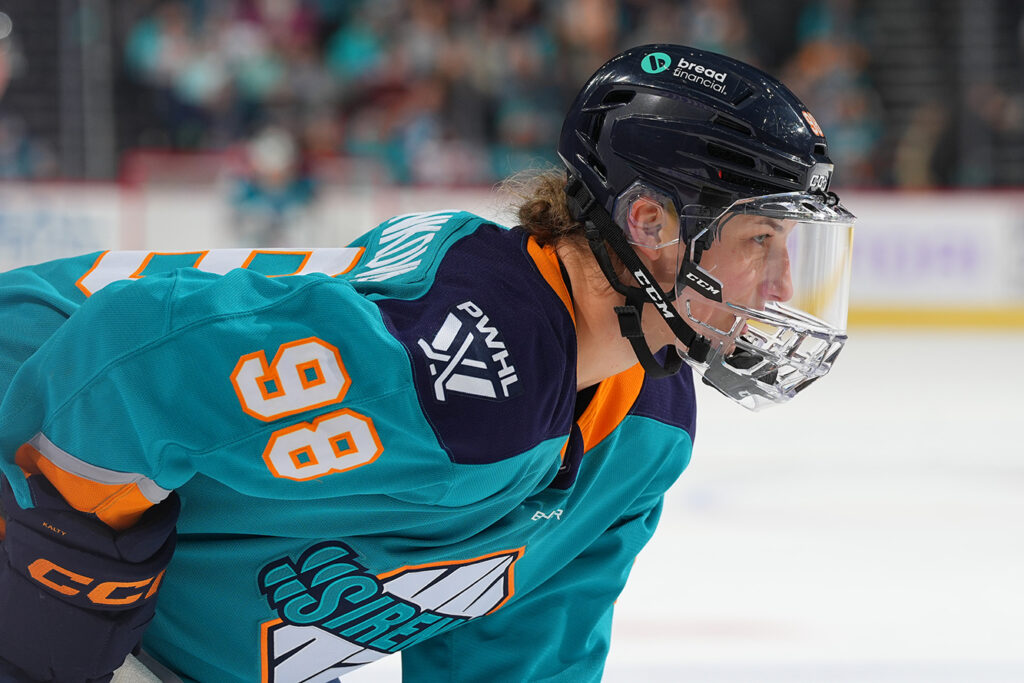
One of the youngest players in the league and its most recent first-overall draft pick, Kaltounková represents a new generation stepping into the PWHL. And on the ice, she’s made an immediate impact. This most recent season, the Sirens’ rookie class helped reshape the team’s offensive presence. Forward Sarah Fillier set a league record for the fastest two goals by the same player and became the first in league history to complete a hat trick with an overtime winner, while 2025 third-overall pick Casey O’Brien has contributed up front, co-leading the team with 18 points.
Kaltounková has emerged as a presence not just in New York, but on the international stage as well. At the 2026 Winter Olympics, she scored her first goal for Team Czechia just 90 seconds into her second game.
“Stepping on the ice at the Olympics was an incredible honor every game. I felt the strong support from our fans, which was awesome, but it made it even more special to have my family and close friends in the stands for the first game, and also all the other games,” Kaltounková reflects. “I think it is important to learn from every experience and take things with me moving forward. While the Olympics were for sure another amazing learning experience and fun opportunity, to me, the work with the Sirens does not change much. It means no matter what, going out there and giving it my all, in games and practices, making myself and hopefully my teammates better.”
As new players like Kaltounková step into the league, she’s doing so alongside a growing group of fans who are discovering the Sirens and the PWHL for the first time.
The moment Julie Tran, 29, walked into the Garden, she could feel the difference. She’d been to a men’s hockey game before, but this, with her girlfriend Jean Qi, 30, felt new. “The energy of just walking into that stadium was so good,” Tran says. “We didn’t even want to sit down in our seats. Afterwards, we were like, ‘Are we hockey fans?’”
By the end of the night, it wasn’t just a game that stayed with them, but the feeling of being part of something bigger. “To know that it was a sold-out show, to know that there is a limited amount of hockey teams, it was honestly amazing to see the support that was in the crowd with people waving their towels and screaming,” says Qi. “We even talked about buying jerseys afterward. It felt worth the $80 to invest in.”

(R) Sirens on the ice at MSG. Photo by Bruse Bennett/Getty Images.
But even as that sense of excitement turns first-time fans into long-term supporters, the league itself is still navigating what it takes to sustain that growth. While the league has made progress, players’ salaries serve as a bitter reminder of how much work remains. The 2025-2026 PWHL cap is $1.34 million, minimums are $37,131, and only a handful of players earn six figures—far below the National Hockey League’s $95.5 million cap and $3.5 million average salary.
“The fact that we do not make millions of dollars for getting up in the morning, going to do a workout, a practice, a game, traveling for games, being away from our loved ones for the majority of the year, or anything else associated with being a professional athlete. Yet, we still show incredible dedication, passion, and love for the sport,” says Kaltounková. “There is so much more to a women’s hockey game than just watching a bunch of girls battling for a puck, trying to score, or laying a hit on someone. It is the story behind every player that got them where they are, despite so many uncontrollable factors stacked against them. That is pure love.”
When the New York Sirens took the ice at the Garden, it was a moment that carried the energy of the city, the pride of a team built on inclusivity and grit, and the voices of a fiercely supportive fanbase, many of them queer fans, who helped shape the culture around it from the start. In that shared space, the game became a sign of how deeply women’s hockey has taken hold, and how much further it is still poised to grow.
Kayley Cassidy is a journalist and writer based in NYC. Her work is influenced by her passion and advocacy for LGBTQ+ issues.