

15 Women’s Pro Athletes And Coaches Who Support Trans Athletes
Sophie Cunningham’s comments don’t represent many of the decorated voices in women’s sports. These Olympic medalists, World Cup champions, Hall of Famers, and league legends have all publicly supported trans athletes in sports.
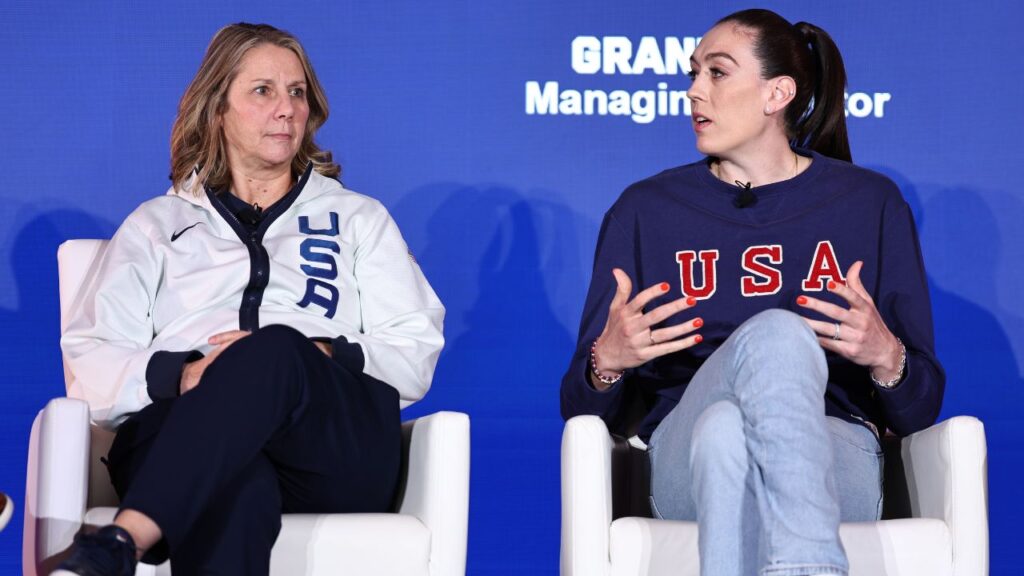
Featured Image: Photo by Dustin Satloff/Getty Images for the USOPC
If you’ve only followed the headlines lately, you might think Sophie Cunningham’s anti-trans comments reflect a broader consensus in women’s sports. For the most part, they don’t. Many of the most accomplished athletes, coaches, and advocates in women’s sports have publicly supported transgender inclusion. From WNBA champions and Hall of Fame caliber players to Olympic gold medalists and World Cup winners, these figures have used their platforms to argue that transgender athletes deserve dignity, respect, and a place in sport.
Here are some of the biggest names in women’s sports who have spoken out in support of trans athletes.
Sue Bird
Few basketball players have a resume comparable to Sue Bird’s. The former Seattle Storm point guard is a four-time WNBA champion, 13-time All-Star, five-time Olympic gold medalist, and the league’s all-time assists leader. She was not simply present for the WNBA’s growth—she helped define it.
She has consistently used her platform to advocate for transgender inclusion. In January 2026, she joined the American Civil Liberties Union’s (ACLU) More Than a Game campaign, which supports transgender youth facing state bans on school sports. Explaining why she participated, Bird said she knows “how much it means for kids to get to play sports” and rejected the idea that women are protected by excluding transgender people. “I believe in exposing the lie that women are protected when we turn against each other,” she said. “Today, tomorrow and every day, I am on the side of equality for all, including our trans siblings.”
Her advocacy extends beyond organized campaigns. On the April 2026 episode of A Touch More, the podcast she co-hosted with then-partner Megan Rapinoe, they discussed the International Olympic Committee’s decision to reintroduce mandatory SRY gene testing for women athletes. Reacting to the policy, Rapinoe criticized the idea that womanhood can be reduced to a biological checklist. “We already know that biology, as much as we want it to be just nice and clean and tight and perfectly in one category and another, it’s not. We know that,” she said. Warning that the policy would subject women to invasive scrutiny, Rapinoe questioned whether officials were simply trying to define “a certain type of woman,” adding, “That’s really the whole game here.”
Megan Rapinoe
On that note, Megan Rapinoe is a two-time FIFA Women’s World Cup champion, Olympic gold medalist, Ballon d’Or winner, and one of the most influential advocates in modern sports. Like Bird, she has consistently used her platform to defend transgender athletes. In a 2022 interview, Rapinoe said she was “100 percent supportive of trans inclusion” and criticized how misinformation had come to dominate the conversation. She later signed letters opposing federal sports bans and joined the ACLU’s More Than a Game campaign.
Just this month, she appeared on The View, arguing that the attacks on transgender athletes are part of a broader effort to roll back women’s rights. “They’re using this as a wedge issue.” She also warned that proposed sex-testing policies would disproportionately target Black girls, adding, “Black girls are gonna get questioned more and they’re gonna get questioned first.” For Rapinoe, the debate has never been about protecting women—it’s about deciding which women get to belong.
Cheryl Reeve
Let’s hear from one of the architects of modern women’s basketball: Cheryl Reeve. The four-time WNBA champion became the winningest regular-season coach in league history in July 2026, adding that record to her existing mark for playoff victories. She is also the only person to win WNBA Coach of the Year four times.
Reeve has never bought into the idea that transgender athletes are competing for an unfair advantage. Speaking at a 2021 Human Rights Campaign press conference, she dismissed that argument as “simply a false narrative,” saying it unfairly “diminishes the athlete overall.” Instead, Reeve argued the opposite: “Trans inclusion makes our sports, our teams, and our communities stronger.”
She’s continued speaking out in the years since. In a July 2026 interview with Minnesota Public Radio (MPR), she said the escalating attacks on transgender people are “sort of sickening,” arguing that lawmakers are manufacturing a problem that “really [isn’t] a problem.” Instead, she emphasized the value sports provide to all young people, saying, “Exclusion is never the answer, separate isn’t equal, and trans lives matter,” adding that transgender youth “have every right” to the teamwork, leadership, and sense of belonging that sports provide.
Napheesa Collier
The Lynx franchise star is a five-time All-Star and WNBPA vice president who finished second in MVP voting in 2025 after averaging a career-high 22.9 points per game. She also earned First Team All-WNBA and First Team All-Defensive honors that season.
Collier also joined Reeve at the Human Rights Campaign event, who echoed her call for the NCAA to oppose anti-trans legislation. Collier described transgender inclusion as “crucial for the health, safety and wellbeing of transgender kids” and urged the NCAA to “withdraw all athletic competition from states considering harmful and anti-transgender sports bills.”
Breanna Stewart
Breanna Stewart is already among the most accomplished players in WNBA history. The Liberty forward is a three-time champion, two-time league MVP, two-time Finals MVP, and Olympic gold medalist. She was also selected for the WNBA’s list of its 25 most dominant players.
She has long advocated for transgender inclusion in sports. In 2018, she partnered with Athlete Ally to call on Power Five universities to publicly adopt the NCAA’s transgender participation guidelines ahead of Transgender Day of Visibility. Rejecting one of the most common justifications for anti-trans legislation, Stewart said, “The ‘safety’ of women and girls remains one of the most inaccurate and unjustifiable arguments for why anti-trans efforts are advocated for in this country.” She concluded by calling for “laws and establishing policies that are inclusive of the transgender community and afford them every opportunity to succeed both in sport and in society.”
Candace Parker
Candace Parker retired as one of the greatest all-around players women’s basketball has seen: a three-time WNBA champion, two-time MVP, Finals MVP, Defensive Player of the Year, and Olympic gold medalist.
In 2020, Parker joined Billie Jean King, Megan Rapinoe, and more than 170 other athletes in filing a friend-of-the-court brief against Idaho’s law barring transgender women and girls from participating in women’s school sports. The athletes argued that excluding trans students undermines the equality and access that women athletes have spent generations fighting to secure.
Brianna Turner
Leave it to one of the WNBA’s most outspoken advocates. A two-time WNBA All-Defensive First Team selection and 2019 All-Rookie honoree, Turner has always used her platform to champion social and racial justice and LGBTQ+ athletes, including in support of transgender women in women’s sports. The former first-round draft pick has also been a leader off the court, serving on the Women’s National Basketball Players Association executive committee while helping negotiate a historic new collective bargaining agreement.
In April 2026, Turner brought that advocacy to the pages of USA TODAY, penning a first-person opinion essay urging readers not to use women athletes to justify excluding transgender women from competition. Drawing on more than 15 years of experience, Turner wrote, “I’ve played with and against people who are transgender and undoubtedly people with intersex variations, and I’ve never experienced any unfair advantages. I saw these players as my fellow athletes, not my enemies.”
She urges to “…not use the names of women athletes to target, shame or exclude transgender women,” she wrote. “Transgender women are women. Women with intersex variations are women. I welcome these women—and all women—onto my teams.”
Turner also appeared alongside Sue Bird and Megan Rapinoe in the ACLU’s More Than a Game campaign.
Becky Sauerbrunn
Becky Sauerbrunn is a two-time FIFA Women’s World Cup champion, Olympic gold medalist, and former USWNT captain widely regarded as one of the greatest defenders in women’s soccer history.
Since we’re on the topic of brilliant essays—in 2023, Sauerbrunn wrote an op-ed for the SpringField News-Leader responding to proposed legislation in her home state of Missouri. She rejected the idea that transgender athletes threaten women’s sports, writing “Playing alongside trans athletes has only made me appreciate what it means to be a woman even more.” She continues, “Trans women playing women’s sports is not a threat to women’s sports.” Sauerbrunn goes on to argue that lawmakers were manufacturing a controversy while ignoring the real issues facing female athletes. “The biggest threat to women’s sports is a lack of investment and resources, unequal pay, abuse, harassment and limited access for girls in low-income communities,” she wrote. “Trans kids playing sports is not a problem.” Sauerbrunn later signed a 2023 open letter opposing H.R. 734, federal legislation that sought to exclude transgender and intersex girls and women from school sports nationwide.
Dawn Staley
Hall of Famer, three-time Olympic gold medalist, and championship-winning coach Dawn Staley has built one of the most dominant dynasties in college basketball at the University of South Carolina.
During a press conference ahead of the 2024 NCAA national championship game—one day after her undefeated Gamecocks defeated NC State in the Final Four—Staley was asked whether transgender women should be allowed to compete in women’s sports. Rather than sidestep the politically charged question, she answered without hesitation: “I’m of the opinion that if you’re a woman, you should play. If you consider yourself a woman and you want to play sports, or vice versa, you should be able to play.” When reporters asked whether that included transgender women, Staley replied simply: “Yes. I know I’m going to catch some flack for this.”
Billie Jean King
The icon. The legend. The blueprint. Billie Jean King did not merely dominate tennis—she transformed women’s sports. The 39-time Grand Slam champion co-founded the Women’s Tennis Association, founded the Women’s Sports Foundation, fought for equal prize money, and helped create the professional infrastructure women athletes still benefit from today. Few people have done more to advance opportunities for women in sports.
King has consistently argued that transgender athletes deserve the same opportunities she spent decades fighting to secure for women. In 2020, she joined Megan Rapinoe, Candace Parker, and nearly 200 fellow athletes in supporting a friend-of-the-court brief challenging Idaho’s anti-trans sports law. “There is no place in any sport for discrimination of any kind,” King said. “I’m proud to support all transgender athletes who simply want the access and opportunity to compete in the sport they love. The global athletic community grows stronger when we welcome and champion all athletes—including LGBTQI+ athletes.” More recently, she told DIVA magazine, “I don’t think people have any idea of how hard it is for trans people. Just listen to their stories. Listen—not tell them.”
Alex Morgan
Alex Morgan is a two-time FIFA Women’s World Cup champion, Olympic gold medalist, and former USWNT captain whose influence stretches far beyond her goal-scoring record.
In 2023, Morgan publicly supported teammate Becky Sauerbrunn’s op-ed opposing Missouri legislation targeting transgender athletes. Speaking to reporters ahead of the SheBelieves Cup, she said the U.S. women’s national team wasn’t one to “shy away from hard conversation or taking a stand for what’s right.” With matches scheduled in Florida and Texas—two states that had enacted laws targeting transgender youth—Morgan said the team needed to “continue to step it up” and have “internal discussions” about playing in those states. Her comments made clear that Sauerbrunn wasn’t speaking alone, but reflected a broader culture of advocacy within the USWNT.
Tobin Heath and Christen Press
The ultimate soccer power couple. Tobin Heath and Christen Press are two of the most decorated players in U.S. women’s soccer history. Between them, the two-time FIFA Women’s World Cup champions have earned Olympic medals, countless club honors, and helped define an era of USWNT dominance. Since retiring from international play, the pair have continued shaping conversations around the game as co-hosts of The RE-CAP Show.
Their advocacy has extended beyond the pitch. Through their platform, Heath and Press have celebrated transgender visibility and partnered with organizations promoting greater inclusion in sports. During a 2025 episode of The RE-CAP Show, the couple invited LGBTQ+ advocate and influencer, E.R. Fightmaster, reflecting on why women’s sports have historically embraced marginalized communities.”Women’s spaces are going to be more empathetic to everybody else,” she said. “Sports is one of the only industries that is very divided in gender, and, in a lot of ways, gender binary.” For the couple, inclusion isn’t separate from women’s sports—it’s one of its defining strengths.
Stefanie Dolson
Out WNBA star Stefanie Dolson supports trans women with her whole chest. Literally. The Seattle Storm center arrived at the July 28 game against Cunningham’s team, the Indiana Fever, wearing a “Trans Rights Are Human Rights” T-shirt.
That same night, Cunningham’s anti-trans supporters — the self-described “gender abolitionist” groups Women Are Real, Brandi Kruse, and Known Heretic — organized a rally to celebrate Cunningham’s recent remarks against trans athletes in women’s sports.
Natalie Nakase
Golden State Valkyries Head Coach Natalie Nakase didn’t equivocate when she was asked about trans women in sports during a press conference on August 2, 2026, following the Valkyries vs. Toronto Tempo game.
She was asked if Sophie Cunningham’s comments about protecting young women by keeping trans women out of professional sports, and the subsequent protests for and against her, were good for the league. Nakase made her support of trans women clear.
“For me, sports is about belonging. It’s about inclusivity. It’s about allowing everyone to be their authentic self,” said Nakase. “I’m big on that just because I have been criticized for my height, for my ethnicity. I’ve been in those: “You shouldn’t belong here” [conversations] many times, and for me, I don’t want that space, especially Golden State, to ever feel like that. So I’m all about women, little girls deserving to play, and that includes trans women. So I’m all about inclusivity.”
The U.S. Women’s National Team
Support for trans people has not come exclusively from a handful of individual USWNT players. The team has repeatedly made collective gestures and statements affirming LGBTQ+ inclusion.
During the 2023 SheBelieves Cup, U.S. and Canadian players wore wristbands reading “Defend Trans Joy” during a match in Florida, where legislation targeting transgender residents was advancing.
The USWNT Players Association later released a direct statement declaring: “Trans rights are human rights.” The union said the women’s soccer community should be safe, inclusive, and welcoming and promised that its advocacy for LGBTQ+ people would continue.
400+ Athletes Signed an Open Letter Supporting Trans Athletes
And it doesn’t end just yet. In April 2024, more than 400 current and former NCAA, professional, Olympic, and Paralympic athletes sent the NCAA an open letter urging it to protect transgender athletes. Signatories included WNBA figures Sue Bird, Brianna Turner, Layshia Clarendon, and Cheryl Reeve, along with USWNT and NWSL players Megan Rapinoe, Becky Sauerbrunn, Tierna Davidson, Alana Cook, Lynn Williams, Samantha Mewis, and Sam Coffey.
We’re just scratching the surface. Across locker rooms, leagues, and generations, countless women athletes have publicly supported transgender inclusion, choosing solidarity over exclusion and opportunity over fear. Women’s sports have always been about expanding access, challenging barriers, and creating space for those who were once told they didn’t belong. Judging by the champions on this list, that legacy is still very much alive.