

Vivian Jenna Wilson Calls For Better Healthcare, Not More AI and Robots,
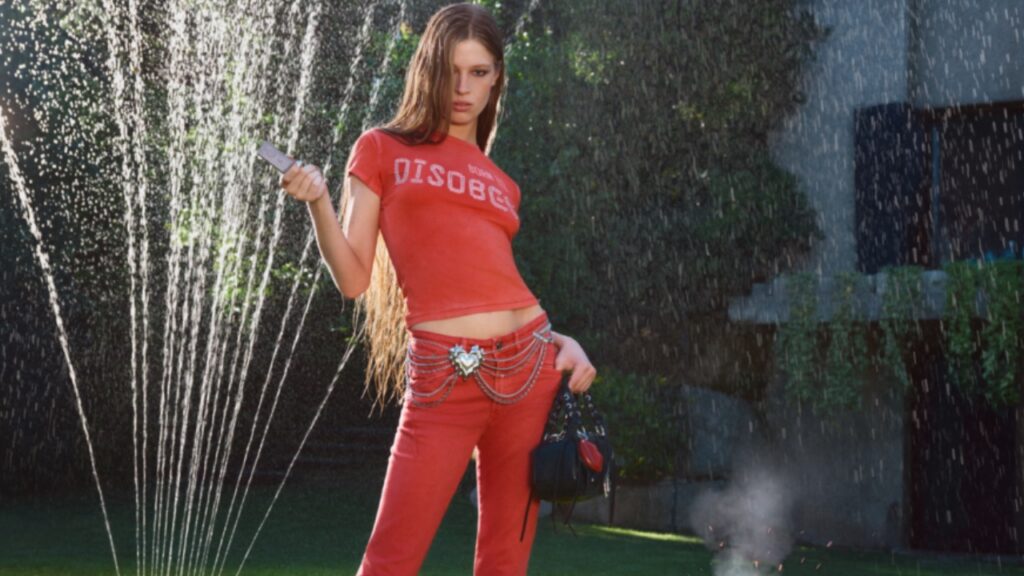
The model and activist stars in Desigual’s latest campaign, where she questions government funding and takes on AI, social media and the pressure to perform perfection—while making a case for a little more “disobedience.”
Vivian Jenna Wilson has never been one to follow the script. So when fashion brand Desigual asked her to star in its Fall/Winter 2026 campaign, “Born to Disobey,” the pairing felt less like a casting decision and more like a meeting of minds.
The campaign opens with Wilson alongside DESI 84, a humanoid robot that is, to put it mildly, not having its best day. It malfunctions, struggles to do what it is told and generally proves that perhaps perfection is overrated. Wilson, meanwhile, does what Wilson does best: refuses to play along.
“Some things aren’t meant to be fixed,” she says at the end of the campaign film.
It’s a fitting thesis for a brand whose entire visual language has long been built around the idea that fashion should not behave itself. Desigual, translated to different in English, was founded in 1984 by Thomas Meyer, and is currently headquartered in Barcelona. It has made color, prints, denim and unexpected combinations central to its identity. For “Born to Disobey,” that ethos gets a decidedly technological twist: What happens when human instinct meets something programmed to obey?
When asked to describe what audiences were about to see before the campaign film premiered, Wilson offered perhaps the queerest answer possible: “We do a little bit of looking not straight.”
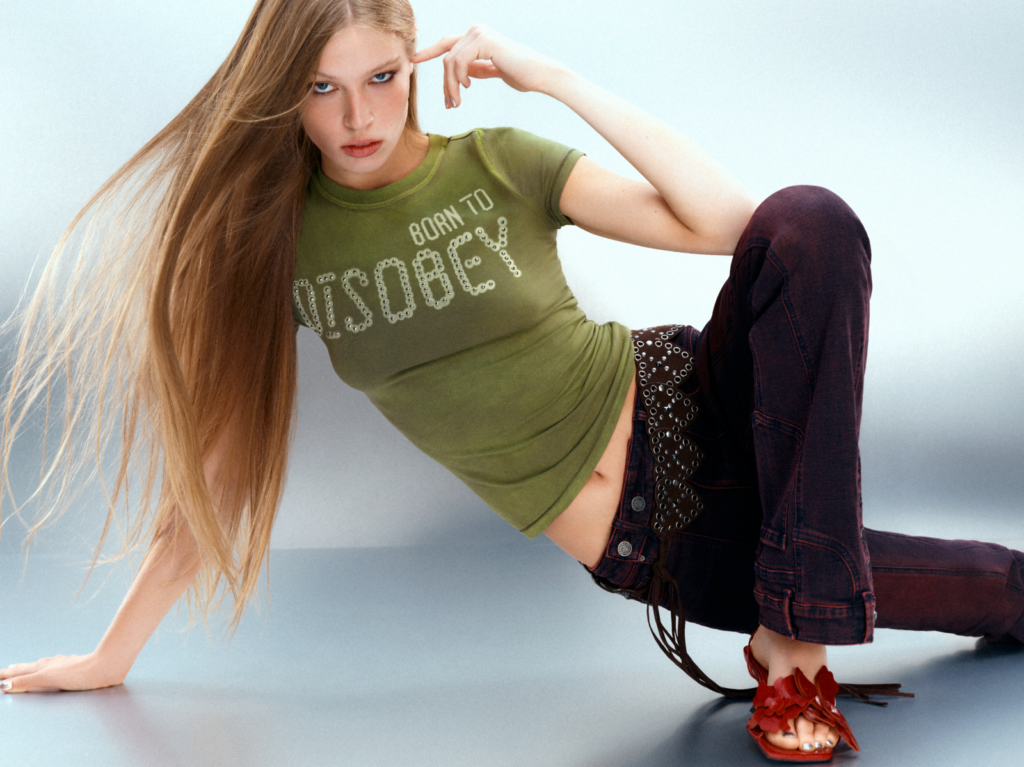
The film is funny, surreal and intentionally dysfunctional. And can we take a second to admire these looks? Hair is by Rubén Mármol, makeup is by Lisa Machalik and the film was creatively directed by Alex Sanhueza.
Beneath the robot antics is a more pointed question about the place technology should occupy in our lives—and what, exactly, we are sacrificing in the name of progress.
At the campaign’s New York presentation, Wilson was asked where she thinks society could redirect the enormous amount of energy and resources we have.
“We tend to pour a lot of money into advancing military technology [and] I’m just questioning…what if we can put that [into] public transportation or healthcare or education.” She continues, “I feel like we can make society [better]. Instead, we have…AI and robots.”
It is a surprisingly earnest thought tucked inside an otherwise playful campaign about a malfunctioning robot. And that tension is part of what makes “Born to Disobey” work: the clothes are exuberant, the film is absurd, but the questions underneath are real.
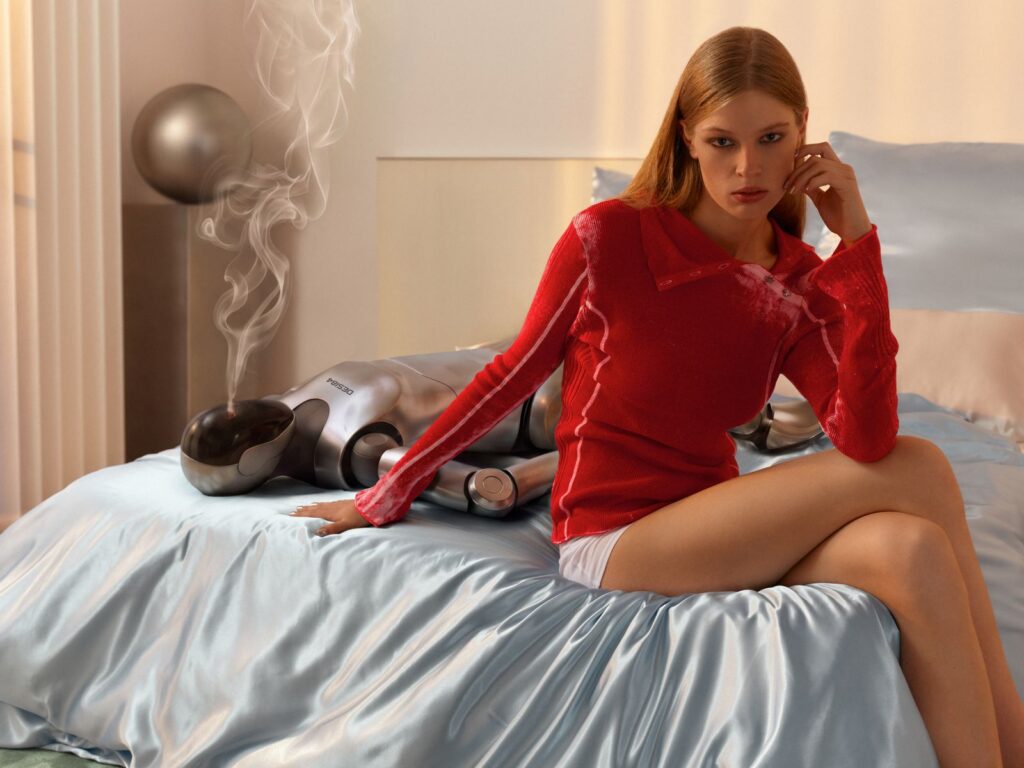
Wilson is equally skeptical of the way technology has reshaped how people understand themselves and one another. “My relationship with technology…it’s hard to say that it’s good and bad,” she said, pointing to the fact that her generation grew up alongside an increasingly pervasive digital world. “I think in general we all [don’t have] the healthiest relationship with technology.”
That complicated relationship extends to social media, where Wilson sees both liberation and limitation.
“It’s a very nuanced conversation. It’s much easier to find the people who are willing to engage… But at the same time, it has…allowed people to laugh at any sort of real consequences for their actions…so I definitely think it’s been a mixed bag in general,” Wilson tells GO.
For Wilson, authenticity online is complicated precisely because social media is, by definition, a performance. What people post is a version of themselves—one they have selected, edited and decided to make public.
That idea dovetails neatly with the larger philosophy behind “Born to Disobey”: refusing to let an algorithm, a social expectation or an invisible set of rules dictate who you are supposed to be.
And according to Wilson, that can mean something as simple as letting yourself be embarrassing.
“I think everyone needs to stop following these super rigid rules of social regulation,” she said when asked what her generation needs to disobey. “Be cringy. Have fun. Be wild. Stop trying to be so perfect and clean. Be a little bit unclean.”
The collection itself leans into that refusal to be polished in the conventional sense. Denim is reconstructed and reshaped; vivid reds sit alongside botanical and animal-inspired prints; proportions shift between fitted silhouettes and more fluid volumes. The clothes invite the wearer to play with them rather than simply put them on.
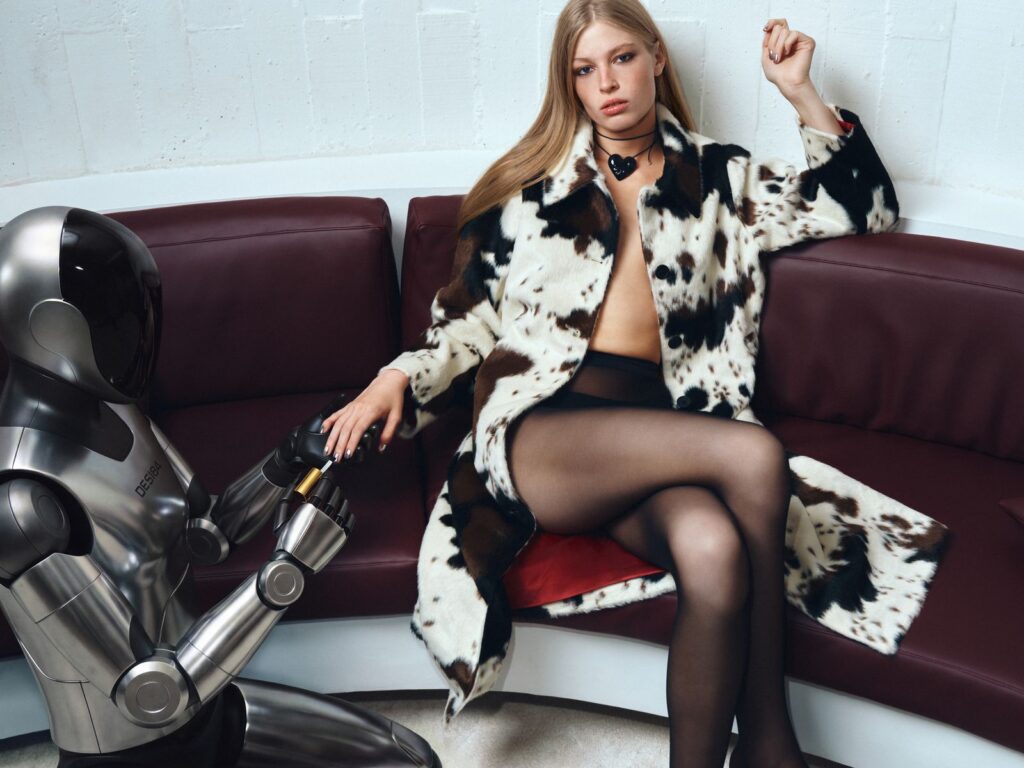
Wilson’s favorite look from the collection was a cow print jacket—tactile and impossible to ignore. She also singled out a denim jacket and praised pieces that can be shifted and styled in different ways.
“I love a piece that you can sort of shift on the go,” she said, noting that changing how a garment is worn can give it “an entirely different position.”
That sense of movement is central to Desigual’s idea of disobedience. The brand isn’t asking its wearer to simply reject fashion rules; it is asking what happens when those rules stop mattering in the first place.
And Wilson is suited to the assignment.
Her career has increasingly moved between modeling, acting and online culture, where the expectation to package oneself into a perfectly legible identity can feel nearly unavoidable. Yet her answer to that pressure is less about constructing a better version of yourself than it is about questioning why you need to construct one at all.
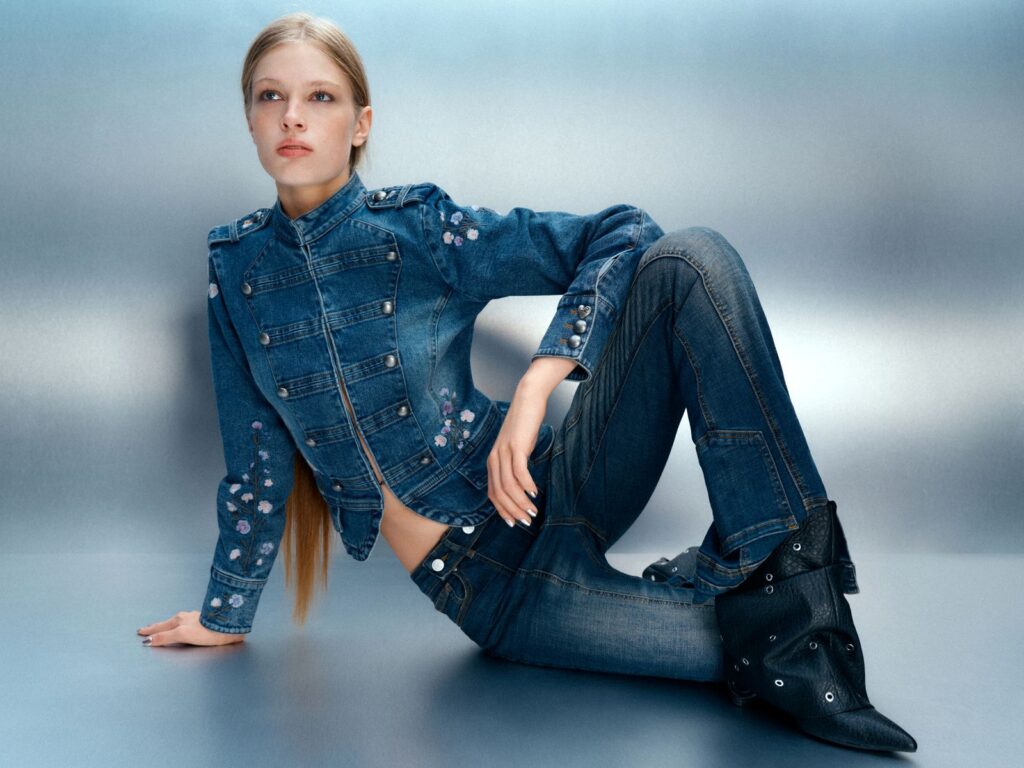
Even her own relationship with fashion reflects that philosophy. She loves denim, a material that can be endlessly manipulated, styled and reinterpreted. And when asked how she hopes to continue shaking up modeling, her answer was refreshingly simple: “Do my best…and just keep going.”
That might be the real meaning of “Born to Disobey.” Not rebellion for rebellion’s sake, but the freedom to question the systems—digital, cultural, sartorial—that tell us who we should be.