

The WNBA’s New Pay Deal Is Huge—And Still Not Enough
WNBA players secure a historic pay increase—but compared to the NBA, the gap still has a long way to close.
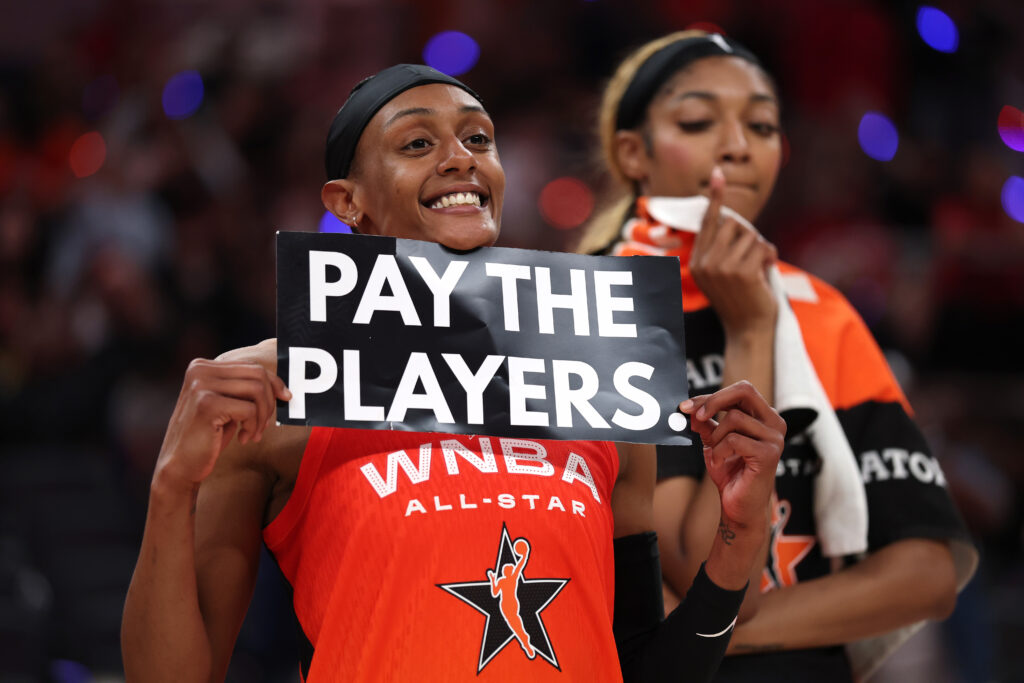
Featured Image: Steph Chambers/Getty Images
After 17 months of negotiations—and with just 51 days before tip-off—the WNBA and the WNBPA (Women’s National Basketball Players Association) have reached a verbal agreement on a new collective bargaining agreement. The season is expected to start on time, which is cute, but let’s be clear: the real headline is that WNBA players dragged this league—gracefully and relentlessly—toward paying them what they’ve been owed. And yes, there’s paperwork to back it up. WNBPA released a statement via instagram.
Negotiations stretched for over a year, shaped by increasing pressure from players who have grown more vocal about compensation, working conditions, and revenue sharing. Leaders like Napheesa Collier were among those publicly pushing for movement, applying pressure to league leadership, including commissioner Cathy Engelbert, and calling for greater transparency. That tension extended beyond negotiations—onto social media, into interviews, and onto the court during All-Star Weekend, when players wore shirts reading: “Pay Us What You Owe Us.”
While full terms of the agreement have not yet been formally released, early reporting points to a significant financial shift. According to ESPN, the salary cap is expected to rise from roughly $1.5 million to around $7 million per team, with average salaries projected in the range of $500,000 to $600,000 and minimum salaries increasing to over $300,000. Supermax contracts are expected to start at approximately $1.4 million, alongside a revenue-sharing model reported to approach 20 percent.
Even with these increases, the disparity between the WNBA and the NBA remains stark. NBA players earn roughly $11.9 million on average, compared to about $100,000 to $130,000 in the WNBA under the previous system. Top NBA players make upwards of $50 million per season, while WNBA supermax salaries have historically ranged between $250,000 and $500,000.
Rookie pay highlights the gap even more clearly. Victor Wembanyama entered the league earning over $12 million, while top WNBA rookies have historically earned under $80,000. The case of Paige Bueckers has become a particularly striking example—she reportedly earned $4.8 million in NIL deals during college, yet under the previous WNBA pay structure, top rookie salaries fell well below six figures, while alternative leagues like Unrivaled have offered deals exceeding $300,000.
At one point during negotiations, a proposal circulating online that players might receive free streaming access to WNBA games became a source of frustration and humor in equal measure, underscoring how far apart both sides appeared at certain moments.
The length of negotiations reflects deeper structural disagreements. Players pushed for a larger share of league revenue, improved travel and working conditions, and greater recognition of their growing cultural and commercial impact. The league has pointed to revenue differences—roughly $10 billion for the NBA compared to about $200 million for the WNBA—as context for its position, though players have increasingly challenged how that disparity is used to justify compensation gaps.
The issue is not just gendered but racial. As Angel McCoughtry said in a 2024 Forbes interview, “Black women deserve to be paid equally as well. Not just women, but Black women. We talked about women. Now you have Black women. We already know the racial injustice within our community with Black people,” highlighting how pay inequity disproportionately affects Black women in a league where they make up the majority of players.
The agreement marks a major step forward, but it also reframes expectations. The WNBA is growing—viewership, sponsorships, and cultural visibility are all on the rise. This deal begins to reflect that momentum, even as it leaves open a larger question about why it took this long for compensation to begin catching up with impact.