

The U.S. Supreme Court Meets Today To Consider Hearing Case That Could Take Down Same-Sex Marriage – What You Should Know

A county clerk was ordered to pay emotional distress damages to two men after refusing them a marriage license – she asked SCOTUS to review that decision, and to overturn marriage equality altogether.
Featured Image: via Getty Images (credit, Douglas Rissing)
Today, the U.S. Supreme Court justices will meet privately to consider whether to take on the case brought by Kim Davis which would bring under it’s review, one of the most consequential civil rights rulings of our lifetime: the legal right for same-sex couples to wed. Davis, a former Kentucky county clerk, made headlines in 2015, after refusing to issue marriage licenses to gay couples following the landmark Supreme Court ruling in Obergefell v. Hodges that made marriage equality the law of the land. As a result, she was ordered to pay emotional distress damages to two men. Davis asked SCOTUS to review that decision, and beyond that, to overturn marriage equality altogether.
Kim Davis’ Questionable Quest To Seek Refuge In The First Amendment
As we reported in August, back in 2015, when Kim Davis cited “God’s authority” and defied the law, David Moore and David Ermold filed a lawsuit against her, alleging that she had violated their constitutional right to marry. A U.S. District Judge ordered Davis to issue the license, but when Moore and Ermold returned to the Rowan County Clerk’s office, she refused again.
Married four times herself to three husbands, Davis was put behind bars in contempt of court. Six days later, she emerged from jail to the unauthorized use of the song, “Eye of the Tiger” and a crowd of like-minded zealots, earning the praise of high-profile conservatives and martyr status.
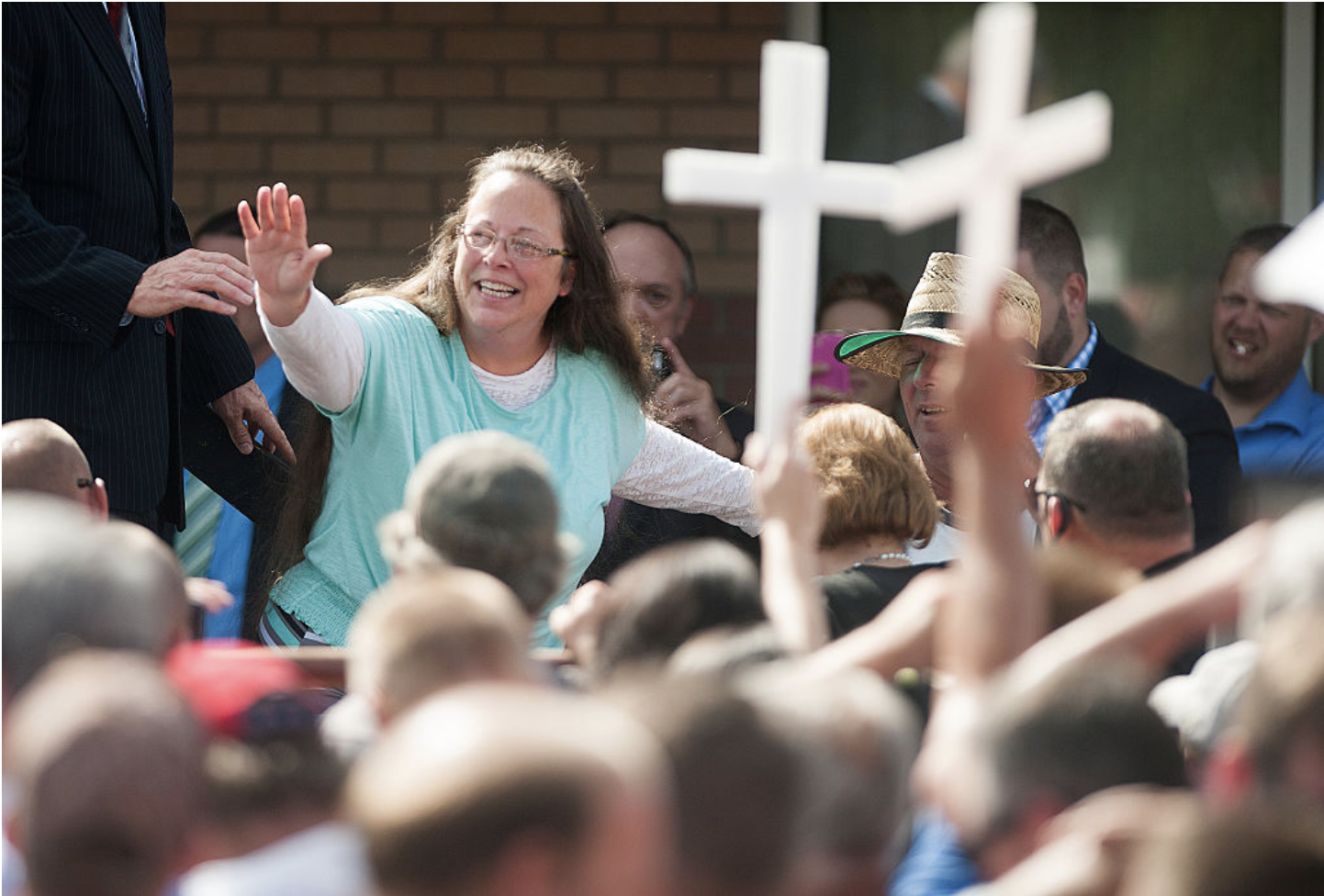
Image: Sept. 8, 2015: Kim Davis waves to supporters at a rally in front of Detention Center (Photo by Ty Wright/Getty Images)
Moore and Ermold eventually won $100,000 in financial damages; in return, Davis appealed and claimed her own “emotional damages” for having been ordered to pay the couple whose rights she had violated, plus $260,000 for attorneys fees. That appeal was rejected by the 6th Circuit earlier this year. So on July 24th, backed by evangelical-based Liberty Counsel, in a Petition for Writ of Certiorari, Davis asked SCOTUS to review that decision. She filed a brief, seeking “First Amendment accommodation of her religious beliefs.”
It’s been ten years since marriage rights were extended to same-sex couples across the United States. And ten years since Davis, as her counsel puts it, embarked on her quest for refuge in the First Amendment. Today marks the first time that the high court will meet to consider whether to take on a case that could reverse the milestone decision in Obergefell v Hodges.
Is this a four-alarm fire?
According to Joshua Rovenger, Legal Director, GLAD LAW, the meeting itself should not be cause for alarm. “The fact that it has been scheduled, that it’s on for discussion, tells us nothing about how seriously four – let alone a majority of justices – are viewing the case.” He says that meeting is normal practice and consistent with every other case where a party is asking for Supreme Court review. Each year, 7,000-8,000 appeal requests come before the Court and they choose only about 1% of them. Four of the nine Justices must vote to accept a case, and five to overturn marriage equality (should SCOTUS be willing to take on that question).
It would be easy to fear the worst. We saw that the Court was willing to shun precedent when it torched reproductive freedom in 2022, overturning Roe v. Wade and returning abortion decisions to the states in Dobbs. We’ve seen some recent tendancy toward the “history and tradition” legal standard. The majority of the Court is conservative (six to three) – not to mention the relentless and calculated drive, à la Project 25, to roll back legal protections for LGBTQ+ rights in general.
But Rovenger isn’t worried. Here’s why:
#1 The Davis case is quite narrow. “The central issues in the case are not actually about whether Obergefell should remain the law of the land. It’s about whether emotional distress damages were appropriate against Kim Davis after she instructed her office to repeatedly deny marriage licenses and therefore violate clearly established law.”
The plaintiff in the case is trying to “shoehorn” the Obergefell question into that narrow issue. But it would really be anomalous for the court to take up such a significant question in the context of a such a narrow vehicle, and one that has implications beyond just marriage equality, he explains.
#2 “Reliance interests” – marriage equality has worked. “Looking at how marriage equality has operated over the past decade nationally, and two decades in certain states, we’ve seen that is has been good for society generally, and for children,” Rovenger says. There are concrete “reliance interests” at stake – how people now structure their lives around property, finances and children, etc. This would mitigate against overturning something that has worked well, he adds. Indeed, there are 1.6 million Americans who are married right now to a person of the same sex, and hundreds of thousands have children.
Recently Justice Amy Coney Barrett gave an interview to The New York Times, in which she touched on those “concrete reliance interests,” and indicated that “for legal doctrine to take account of them would be quite challenging.”
#3 Public support. “What we’ve seen over the past decade is that marriage equality has robust bipartisan public support. It’s working,” Rovenger tells GO. “There’s really no reason right now for the Court to get into the issue.”
When will SCOTUS decide if they will hear the case?
While many will be understandably sitting on pins and needles, we likely won’t know for awhile. The Court typically does not decide to hear a case unless they’ve met at least twice. Rovenger expects it will be at least two weeks until they issue a grant or denial. Typically, if the justices grant a case, they issue the written order on Fridays; if denying it, word comes on a Monday.
What signals to look for?
“So there’s a world in which they grant the questions specific to the actual facts of the case and not the Obergefell question,” Rovenger tells us, “in which case that would be a pretty clear signal that they weren’t considering the broader Obergefell question, and instead, were just going to consider whether the emotional distress damages were appropriate in the case… “
“There’s also a world in which they grant review on all of the questions, including whether to retain Obergefell. And if they did that, they would set a briefing schedule so that the parties and amicus, various parties on the outside, could also file briefs. They would set oral arguments and then would [ultimately] render a decision.”
While there’s been recent reporting that Jim Obergefell himself is currently “worried” that the precedent his case set is now facing a “scary path” – and there’s no denying the forces at play that seek to undermine our hard-won protections – we might take heart in knowing that there’s a reason why the 6th District Court of Appeals dismissed Kim Davis’ First Amendment argument in the first place: “Although Davis’s assertions are novel, they fail under basic constitutional principles.”
And whichever way this goes, we have an army of advocates to meet the moment.