

The Truth About Masc-For-Masc Love: Four Couples Share Their Stories
No femme? No problem. These masc-for-masc couples talk to us about love, attraction and dealing with societal conformities.
Two femmes together are cute. Two studs together are confusing. But why? If queerness is supposed to be about breaking binaries, why do we still cling to them when it comes to who we date?
Talk to any masc woman or masc-presenting person and you might hear a familiar story: “Most mascs only date femmes.” Or worse— “I’d date another masc, but they’re all DL.” I wonder if they feel there is a masc shortage, as well?
Still, there’s a quiet fear beneath that—not just of rejection, but of how it looks to want someone who mirrors you. For some, being openly masc-for-masc feels like breaking an unspoken rule: that one of you still has to play the “femme” role.
But the real question isn’t “Who wears the strap?” It’s why that question even still matters.
GO spoke with four couples navigating masc-for-masc attraction; exploring love, identity, judgment, and what it really means to see yourself reflected in who you desire.
Megan and Meagan

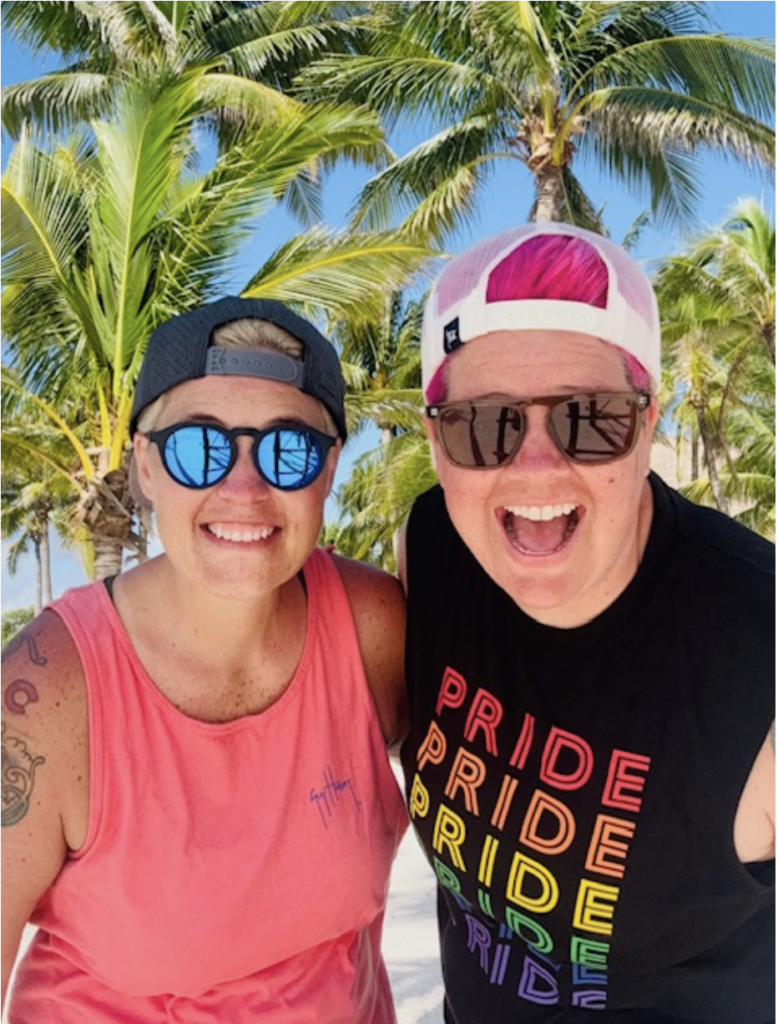
When Megan (she/her) met Meagan (she/her) back in 2010, neither of them could’ve guessed they’d eventually become masc-for-masc role models—or TikTok icons. Based in Denver, Colorado, the couple has over half a million followers, drawn to their mix of playful banter, everyday domestic moments, and genuine chemistry. They dated briefly in their 20s (“three weeks,” Meagan laughs, “because I wasn’t ready for a relationship, I was still in my ‘explore’ era”), broke up, stayed friends, and somehow circled back seven years later. This time, it stuck. They’ve been together for six years and officially tied the knot in 2020.
“It’s very lesbian of us,” Megan jokes. “Full circle moment.”
For them, masc isn’t about gender performance, it’s about presence. “To me, it’s just a more masculine presentation—maybe in how you dress, maybe in how you act,” Megan says. “Like opening the door for someone, taking charge. But I’m just a helpful person. I want people to feel comfortable and welcomed.”
Meagan adds that masculine presentation is a spectrum. “It’s such a wide range that a lot of people could fit into. It’s not a tight box. It’s broad, which is what makes it freeing.”
That freedom extends into their marriage. The two laugh off the assumption that masc couples need to assign roles according to the domestic “who does what” binary that can creep into queer relationships too. “We don’t have roles,” Meagan says. “We both know the house needs to be cleaned, groceries need to get done—we just do it, or we do it together. I’ve never felt like I had to act a certain way or take on a role just because we’re both masc. It just works, because we balance each other.”
@megan_married_meagan Rudeness in its highest form #masc4masc #lesbiansoftiktok #marriedlife #wlw #lgbtcouples @Thegoodmeagan ♬ Mission Impossible Theme (Movie Trailer Mix) – Dominik Hauser
Megan adds, “I’ve never felt like I had to carry the burden of anything just because we present a certain way. Our videos might exaggerate us competing over stuff, but honestly, we’re both really hands-on with everything — cleaning, cooking, all of it.”
Through their playful TikToks, the couple has inspired other masc-presenting women to rethink what love can look like and who it can be with. “We had a comment once that said, ‘Because of your content, I realized it’s okay for me to date another masc,’” Meagan recalls. “They said they’d even met someone because of it. That’s when it hit us, people really thought this was off-limits.”
Representation (or lack thereof) is something they think about often. “The media just doesn’t really show masc-for-masc couples,” Megan says. “Everything has to fit into a box that appeals to what society expects. Two feminine-presenting women together? That’s what people are used to. A masc and a femme? That’s what looks ‘balanced.’ But two mascs? You just don’t see it.”
Meagan nods. “Yeah, I think that’s exactly why our content took off the way it did. People saw something they hadn’t really seen before, and they were curious, like ‘Wait, what is this?’ We weren’t expecting it to blow up, but looking back, it makes sense. It’s just not out there.”
They both agree the visibility gap is still glaring, even on queer dating shows. “We’ve watched all the Netflix ones,” Megan laughs. “And we’re always like, ‘Where’s the masc-for-masc couple?’ It’s out there in real life; it just needs to be normalized.”
Social media, they say, has been the biggest force in changing that. “Platforms like TikTok have been huge,” Meagan explains. “You see people putting out content that shows real masc-for-masc relationships: couples dancing, traveling, just living their lives. It helps normalize it.” Megan adds, “It shows that it’s not some weird or toxic dynamic. It’s just two people who love each other.”
Their own relationship hasn’t faced much pushback. “We haven’t really experienced negativity,” Megan says. “Maybe we’re oblivious,” she laughs. “Or maybe we just don’t care.” Still, they admit timing helped. “Getting together in our mid-to-late 30s made a difference,” Meagan notes. “If we were in our 20s and out in queer bars more, it might’ve been different. But now? We’re settled. Happy.”
If there’s one message they want to send to younger masc women, or anyone questioning what they’re “allowed” to want, it’s simple: “Stop looking at everyone else,” Meagan says. “Do what feels right to you, even if it takes time. Don’t put your relationship in a box.”
Megan nods beside her. “Be happy. Go against the norm if that’s what feels real. If someone doesn’t accept it, that’s their problem, not yours.”
Sydney and Chavi

When Sydney (they/them) moved from Texas to Los Angeles for grad school, they changed their Hinge location early to preview the LA gays. Amid the usual glossy West Coast profiles, one message stood out: a long, nerdy paragraph from Chavi (she/her), a nursing student from New Jersey. “I looked at her page and thought, ‘Who is this cornball?’” Sydney laughs. Later, they realized she’s actually cute. Turning off their race preferences to explore what LA had to offer also led Sydney into their first interracial relationship, a new experience after only dating Black women and non-binary folks.
Since that first exchange, the two have been nearly inseparable. They began talking in May and made things official in July, skipping the casual ambiguity LA is famous for.
Both identify as masculine-presenting, but their relationship—and their journeys to that identity—are layered. For Sydney, being masc is deeply tied to both comfort and survival. “I grew up femme, but I was always being hyper-masculinized,” they explain. “I’ve got an athletic build, I’m Black, and people read me a certain way. Also, being autistic, I never understood gender in the first place—I never identified with it. Being masc just felt like home base. It’s where I can dress for my shape [and] I like being visibly queer.”
Chavi’s path looks different but mirrors that sense of relief. Having grown up Orthodox Jewish, she wasn’t even allowed to wear pants. “It was all long skirts and long sleeves,” she says. “Even when I left the religion and started dressing feminine, it didn’t feel right. I was doing it because that’s what I thought I was supposed to do.” Eventually, masculine presentation became an act of freedom. “It feels natural now. I could never go back.”
She describes finding a balance: “I went through a little hyper-masculine phase, trying to fit a certain idea of what a lesbian should be. But I slowly found my happy medium.” She now presents masculine because none of the restrictions of her upbringing exist anymore.
Together, they talk openly about masculinity and attraction within queer spaces, especially how “stud culture” and racialized gender expectations complicate it. Sydney points out that in many Black lesbian circles, “stud for stud” dating is often stigmatized. “A lot of studs emulate the most toxic men they’ve met,” they say. “They carry that same energy—controlling, male-centered. I’ve had studs tell me dating another stud is weird, like we both can’t be masc. I’m like, ‘Do we both not have vaginas?’”
For Sydney, that mindset is part of a larger cultural policing within Black queer spaces. “I’ve met a lot of studs [who] are conservative. They view their relationship dynamic as if they are a man with a wife.” At the same time, they see a broader pattern in queer communities. “It [is also] a masc issue because you see hella femme for femme couples. We all watched The L Word—femmes were dating femmes left and right in that show, there were barely any macs. That’s why Shane was getting so much damn play. Mascs themselves are kind of rare.”
Sydney contrasts this with the freedoms they see in white queer spaces. “I honestly see femme for femme couples more in white people. They can date who they want to date, be gay, how they want to be gay, and no one bats an eye.”
Chavi nods in agreement: “There’s more freedom to just exist without having to fit a role.”
Sydney continues, “Being in an interracial relationship has shown me that…there’s a way to explore attraction and identity without being policed.”
Jesse and Kenzie

Jesse (she/her) and Kenzie (she/her) describe being “masc” as more than just a style of clothing, but rather a way of presenting themselves to the world. “I feel like that has more to do with it than, like, ‘Oh, I’m in baggy clothes and gonna dress the part,’” Kenzie explains. “It’s more of a personality thing for me. It’s how I carry myself, how I act.” Jesse nods in agreement. Growing up, she always considered herself a tomboy, preferring to hang out with guys rather than girls, and that early self-concept shaped her understanding of what it means to be masc.
The pair met in what Kenzie calls an “embarrassing” way. During her “Hey Mama’s phase,” they matched on Tinder, and Kenzie asked for Jesse’s Snapchat, simply looking for friends. “Here we are, like a year and a half later,” Kenzie laughs. That initial connection quickly grew into a deeper understanding of each other’s experiences as masc women navigating queer spaces. Both recall a subtle but real sense of competition within the masc community that complicated early attraction. “There’s always the need to compete,” Jesse says. “Instead of accepting the attraction, it was just like, ‘Yeah, whatever.’ I had to unlearn that.” Kenzie adds, “I interpreted the [competition] with other mascs the wrong way. I didn’t want to compete with you—I just wanted to be with you.”
For Kenzie and Jesse, their relationship defies stereotypical roles often assumed in masc-femme dynamics. “Whoever had the worst day is going to be babied all night,” Kenzie says when asked about relationship roles “That’s it.” Jesse agrees, emphasizing that outside perceptions often misunderstand masc-for-masc relationships. “Between us, I haven’t even thought about stereotypes since we’ve been together,” she says.
Being a masc-for-masc couple also brings its own kind of visibility, along with frequent curiosity from others. “A big thing is that we’re always being hit on by femmes,” Kenzie says. “We’ll be at the club together, and a femme will say, ‘Oh my God, please say you’re single.’ I’m like, ‘No, my girlfriend’s behind me.’ And then they ask her, ‘Who’s behind me?’ And she’s like, ‘No, that was my girlfriend you were just talking to.’ It’s not expected at all, ever.”
@jechieee heard we were missed 😉 #masc4masc #wlw #fyp #pride @z ♬ Red Wine Supernova – Chappell Roan
Their friends’ reactions were initially a mix of surprise and curiosity. “It’s like, ‘Oh my gosh, I had no idea,’” Kenzie recalls. But for the couple, those external reactions are secondary to the comfort and trust they’ve built together. They also speak to the broader Nashville queer scene, which they describe as both small and sometimes rivalrous. Venues like East Nashville’s LGBTQ+ spaces, including Broadway National and the Lipstick Lounge, offer a more welcoming and affirming community. Still, they emphasize that masc-for-masc relationships remain underrepresented and misunderstood. “It definitely needs to be more normalized,” Kenzie says.
They also touch on the evolving perception of masc women in the media. “It’s become more accepted for masc women to show emotion than it used to be,” Kenzie notes. “Like, when you’re masc and had a rough day, it’s okay to curl up in the corner. It didn’t used to be that way.”
Over a year into their relationship, Kenzie and Jesse are thriving. They are proud to exist authentically as a masc couple, happy in a space that they’ve carved out for themselves. “It’s just rare to find people who are like, ‘Oh yeah, whatever,’” Kenzie says. Jesse laughs, adding, “We’ve got that. We just get to be us.” For them, love isn’t about fitting into pre-set roles or competing with other mascs—it’s about shared trust, joy, and the freedom to just exist.
Rose and Jay
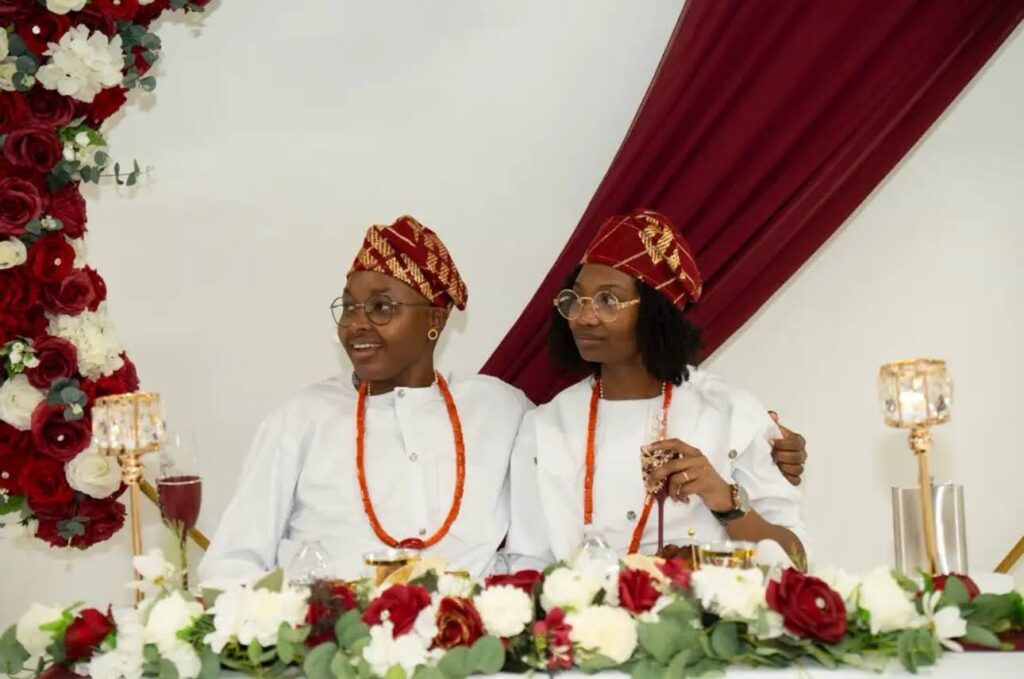
Rose (she/they) and Jay’s (they/them) story begins in peak queer fashion: two people “just looking for friends” on Bumble, swiping through the Houston area with zero expectations. Rose was visiting from Chicago and hoping to meet people beyond her family. But the friend-search quickly slipped into the classic gay friends-to-lovers pipeline. And Jay—who’s originally from Nigeria—was one of her very first matches.
Neither expected romance. “I wasn’t particularly looking for a partner,” Jay says. But after the first hangout, they “kind of knew this would be a journey.” Rose, easing out of a previous relationship, took her time, but the feeling was mutual. “They were cool as f*ck,” she says. “I just knew this was a person I’d have fun with.” They met in September 2023 and tied the knot this year.
When asked what masculinity means in their lives, both of them immediately push back on the idea that “masc” is a gendered role at all.
For Rose, it’s simply authenticity: “I’ve been told I’ve been boyish, or tomboyish…at some point I was like, ‘Well, if I’m good at it, I’m good at it. I am who I am.’ That’s what masc is. It’s just being me.”
Jay agrees: “It’s not a gender. It’s just how I express myself…some of my qualities express themselves in masculinity, or in a form that people say is masculine. It’s my expression of whatever is inside of me.”
Rose also speaks to safety. Growing up in Chicago required a certain armor. “You have to have some sort of tough persona so that people leave you alone.” She explains she becomes “a little bit more masculine” when she and Jay are out, partly because she wants Jay to feel protected. Jay echoes that the instinct is mutual: “These are things that are already built into us…it just comes out in moments like that.”
Both of their attraction to masc partners wasn’t a planned identity; it evolved through lived experience.
Rose says, “I’ve always had an attraction to women, period. It didn’t matter what box you came in.” As a demisexual, emotional connection always came first.
Jay shares a more winding path. Though they dated a masculine-presenting person when they were younger, most of their adult relationships were with femmes. But something wasn’t clicking: “Even though I present very masculine, I have so many feminine qualities that I want catered to. I didn’t feel like I got that from my [past] relationships”.
Dating Rose shifted that. “I don’t have to be so tough around you,” Rose tells Jay during the interview. “I can be as big of a baby as I want to be, and you [cater] to that.”
@rr_jaay For the queer Nigerians and studs who thought they couldn’t have this, here it is. 🥰🥰 #fyp #wlwcouple #healthyrelationship #studonstud #wlwtiktok ♬ original sound – Isaac🥶
Unfortunately, they’ve both felt judgment from fellow queers.
Rose explains that growing up, even among other studs, she always questioned why people policed who studs could date. “They would say things like, ‘Oh, that’s another stud.’ I’d be like, ‘You’re a lesbian. You realize what that means, right?’” She laughs at the absurdity, but the pattern was real: people acted like liking studs made you “weak,” which she points out makes absolutely no sense. “[You’re] already gay!”
Then there was the night at the lesbian bar.
A stud danced with Rose on the floor—harmless fun— but when they all returned to the bar, the person asked who she was with. When she pointed to Jay, the dancer recoiled. “A stud? You like studs, bro? That’s a little weird.”.
Jay’s experience hit even closer to home. When they told their friend they found studs attractive, the friend reacted with discomfort—“Don’t touch me, that’s weird.” It took time, understanding, and growth to move past that hurt.
As for masc-for-masc visibility evolving in media, Rose believes “…it’s been getting a lot more visibility. It’s not something that I saw growing up.” Rose and Jay’s TikTok intentionally leans into representation: “Just being that representation a lot of people need.”
Jay agrees. “When people like you are shedding light on topics like this…over the next few years it’s not going to be a topic that’s seldomly talked about.”
They hope that other mascs recognize that “…this is just love. That’s just what it is.”
In the end, masc-for-masc love doesn’t have to be niche, a rebellion, or a contradiction. It’s simply queer people choosing each other without apology. If anything, these couples remind us that real freedom comes when we stop performing queerness and start living it.