

Shelf-Censored: Book Bans Don’t Start With a Bonfire

A queer Librarian reveals the quiet creep of censorship in communities — and how to stop it before it spreads.
I spent several years working in public library spaces in the rural South, first as an assistant and later as the manager of a small, rural branch of a library system. It sits in an unassuming, quiet town where everybody knows your name, your family tree, and your attendance record at the local Baptist church.
Though my role at the library was one that I loved, I eventually left as I realized I had transformed into a complicit gatekeeper of the silent censorship that had crept and overgrown the library stacks like a Virginia creeper vine left untended.
When you work in a rural Southern town, the pressure isn’t always a loud protest at a board meeting. It is the weight of a hundred unspoken expectations. It’s the grandmother who asks, with a thin-lipped smile, why we have “those kinds of books” in the young adult section. It’s the way a local donor, the one whose family funded the new children’s collection, looks at you when they see a Pride display. In these spaces, censorship doesn’t occur with a bonfire or a dramatic public ban. It happens in the margins, in the quiet, and in the managerial decisions we make to keep the peace.
QUIET IN THE LIBRARY, PLEASE
The first line of attack isn’t the outright banning of books. It’s quieter. Instead, the library never buys them in the first place. We call it collection development; however, when used this way, it functions as a cautious, self-imposed limitation.
I learned early on that if I wanted to keep my budget, I had to be strategic. I wouldn’t reject a book about LGBTQ+ history because of its subject matter. After all, that would violate the policies I swore to uphold. Instead, I would find a reason to prioritize what would be classified as a more relevant title based on community needs. Maybe the reviews weren’t glowing enough, or perhaps the format didn’t fit our current shelf capacity. It was a sensible and, if needed, defensible decision that effectively kept certain voices out of our stacks. By not purchasing materials that might trigger a controversy, I was preventing the conflict before it could even start.
STRATEGIC RECLASSIFICATION
When a book did make it into the building, the most common tool for managing it was reclassification. If a book became the subject of whispered complaints, we wouldn’t pull it from the shelves. After all, pulling it would be censorship, and we didn’t participate in censorship. We would move it to a more age-appropriate section.
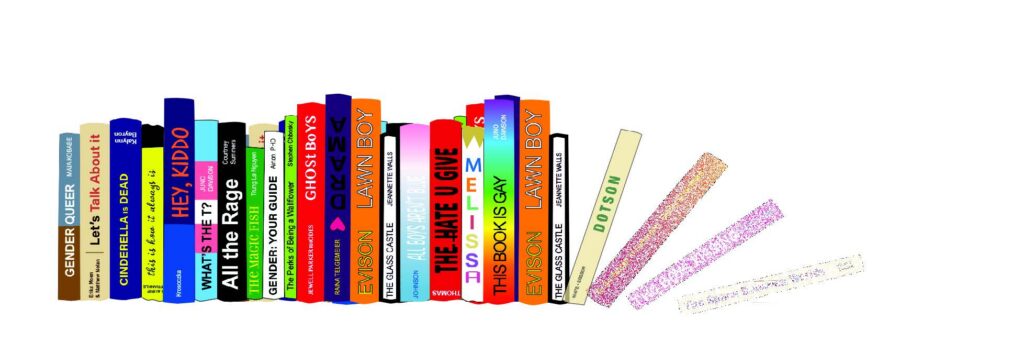
Sure, it may be a young adult novel about a LGBTQ+ teenager, and reclassification meant it was in adult fiction. Yes, it effectively put it out of reach for the very age group that it was written for, but it wasn’t a ban, we’d tell ourselves; the book was still there. However, a 15-year-old is significantly less likely to wander into the adult fiction section to look for a specific title than they are to find it on a display in the teen section.
Similarly, we could use labels, mere administrative shifts in the catalog system, that would make certain items harder to find for casual browsers. We created barriers that were invisible to the general public but perfectly effective at discouraging access to controversial themes.
WE’RE ON DISPLAY
The lobby display is the heartbeat of a library, but in my branch, it was a minefield. I quickly learned that while I was technically free to curate what I wanted, the social cost of a provocative display was high. If I put up a Pride display in June, there was a palpable tension, and the collective buzz of disapproval would begin immediately. With a similar tone for Black History Month and Women’s History Month, I rarely set up overt displays.
To mitigate this, I developed a practice of neutrality. I would include a few LGBTQ+ titles, but I would buffer their existence with the latest thrillers and Amish romances. Among the sheer volume of titles, the message was diluted. It wasn’t quite a display, and it wasn’t quite hiding the books, but it certainly wasn’t an act of advocacy. It was a way to survive the month without a formal challenge being filed.
We told ourselves we were…keeping the peace
BETWEEN A ROCK AND A STONEWALL
The hardest part of this job was the internal conflict. I am a member of the LGBTQ+ community, and I was actively participating in limiting intellectual freedom. I became an expert at reading the room. I knew which board members would back me and which would fold under the pressure of a single angry phone call from a single member of a single church group. I knew that my peers and staff, many of whom were local and deeply embedded in the community, were also engaging in self-censorship to avoid being labeled as activists or radicals.
We told ourselves we were serving the community by keeping the peace. We told ourselves that if the library lost its funding or its local support, it wouldn’t be able to provide any services, and that would be a greater loss than the absence of a few specific books. The cold reality is that every time I chose not to order a book, every time a title was moved away from its intended audience, I was choosing who belonged in our town, and that was not my choice to make.
SELF-REFLECTION ON SELF-CENSORSHIP
Censorship in the modern, rural American library isn’t always the loud, violent act of book burning that we fear. It is a quiet, administrative performance. It is the librarian who looks at an order list and thinks, “I’ll order more diverse titles next time.” It is the manager who decides that a closed display case is a safer home for a book than an open shelf. It is a phone call instead of an email. It’s the infamous slippery slope.
Looking back, I realize that my pragmatism was an excuse and just a form of gatekeeping. By trying to keep everyone happy, I ended up silencing the very people who most needed the library to be their refuge. I protected the institution, yes, but I sacrificed the principle of intellectual freedom that the institution was built to uphold. And in a town where the social pressure is constant, it is all too easy to mistake silence for safety.
WHAT WE CAN DO TO CHANGE THE NARRATIVE
It can be easy to lose a sense of hope, but some things can be done. Here’s how to push back from an insider’s perspective.
Sign up for a library card: Sign up for a library card and use it.
Power in numbers: Funding is often tied to circulation statistics and patron requests. When you search for diverse titles, place holds on them, and consistently check them out, you are signaling to the administration that there is a demand for these stories. Most library websites have “Suggest a Purchase” forms. Use your library’s website to specifically request LGBTQ+ titles and other underrepresented voices.
Get with the programs: Libraries are home to book clubs, children’s storytimes, summer reading, arts and crafts programs, concerts; the list literally goes on! Look beyond the shelves. There are e-books, audiobooks, online accreditation courses, outreach services, internet access, and so much more to the library than the physical books on the shelves! If a book isn’t available in your library system, inquire about interlibrary loans. This puts the title into the library’s tracking system and proves there is an active interest in that material.
Show up for the library: Attend board meetings. These are public forums where policies are decided, and budgets are approved. When you only show up to complain, the board hears only one side. Show up to express your support for inclusive collections and intellectual freedom; let them know that a significant portion of the community values a diverse library.
Become a library advocate: Join your local “Friends of the Library” group. These organizations are often the financial and social backbone of the branch. By being an active member, you can influence the library’s mission and help create a culture where the staff feels empowered to resist the pressure of self-censorship.
The library belongs to you. If you don’t use it to advocate for the stories that matter to you, those shelves will eventually be filled only by the books that no one dared to challenge. Librarian Jo Godwin once stated, “A truly great library has something in it to offend everyone.” Demand that your library stay open to the world, and you will ensure that it stays open to everyone.
For the safety and privacy of the author, names and specific identifying details, including location, have been withheld or generalized. The events and experiences described reflect the author’s firsthand account.