


In Blow to Trans Rights, Supreme Court Rules States Can Ban Trans Girls From Sports Teams
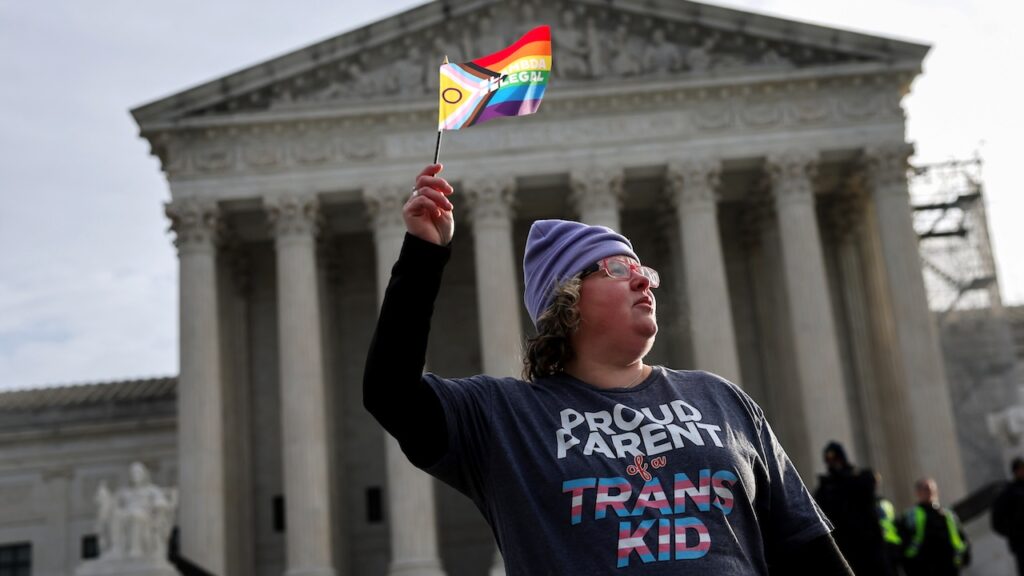
The decision upholds laws in West Virginia and Idaho that bars trans girls from participating in girls’ sports teams.
The Supreme Court ruled Monday that states may ban trans women and girls from participating in women’s and girls’ school sports programs.
The Supreme Court heard arguments in two consolidated cases, Little v. Hecox and West Virginia v. B.P.J., earlier this year that challenged state bans on transgender athletes’ participation. Lawyers for the plaintiffs Lindsay Hecox, a now-24-year-old from Idaho, and Becky Pepper-Jackson, a now-15-year-old student, argued that Idaho’s and West Virginia’s laws, respectively, violated Title IX and the Equal Protection Clause of the Constitution.
Lower courts found the Republican-backed bans likely violate Title IX and the Constitution’s Equal Protection Clause by discriminating “on the basis of sex.”
What the Supreme Court Actually Ruled in the Trans Athletes Cases
The court said that West Virginia and Idaho did not violate the Constitution’s Equal Protection Clause by maintaining female sports teams for cis girls and not allowing trans girls to participate.
Conservative justices rejected the legal and constitutional claims made by the athletes. And while so did the liberal justices, they argued that the claims should have been allowed to continue in lower courts. Justice Sonia Sotomayor, in a dissent, said that Pepper-Jackson should have been able to pursue her claims under equal protection.
Writing the majority opinion, Justice Brett Kavanaugh wrote that states “may maintain women’s and girls’ sports for biological females.” He ended his opinion saying that trans athletes still should be respected.
“No student-athlete on either side of the issue, whether a biological female or transgender, deserves to be ostracized or vilified,” he wrote.
Related: Supreme Court Takes Up Transgender Sports Bans This Week In Landmark Cases
The ruling does not require states that do not have anti-trans sports laws to ban trans athletes.
Inside the Legal Fight Over Title IX and Transgender Athletes
Idaho was the first state to ban trans participation in school sports in 2020, but now 27 other states have done the same. That’s even when only a few trans girls actually participate in school sports programs. Pepper-Jackson, for example, was the only trans student athlete in West Virginia. She played shot put and discus.
“Someone has to do it. Someone has to do this for all of us,” Pepper-Jackson told ABC News earlier this year. “Otherwise, these laws and bills are just going to stand.”
Pepper-Jackson transitioned in third grade and, with the help of puberty blockers, has not undergone male puberty. Her mother, Heather Jackson, disputes claims that Pepper-Jackson has any athletic advantage.
“She has testosterone from her adrenal glands just like every female out there, but that’s the only testosterone she has,” Jackson said. “She’s actually not the biggest person on her team. There’s people taller than her; there’s people shorter than her. She’s just an average female teenager.”
Monday’s ruling effectively ends her high school sports career, the New York Times notes.
Hecox, who had wanted to try out for a women’s sports team at Boise State University, quit playing sports out of fear of harassment amid the growing anti-trans sentiment across the country and on the federal level. She attempted to withdraw from the case.
The decision follows 2025’s Skrmetti ruling, which upheld restrictions on gender-affirming care for minors. The Trump administration has backed state bans and has repeatedly gone after trans rights. President Donald Trump even signed an executive order looking to prohibit trans women from participating in women’s sports. A June 2025 Gallup survey found 69 percent of Americans believe transgender girls should only play on boys’ teams.
Monday’s decision is the latest among several consequential cases for LGBTQ+ rights in the country. In March, the court ruled that a Colorado law banning conversion therapy probably violated a religious therapist’s free speech rights. It also sided, earlier this month, with Christian parents who wanted to force California schools to inform all parents of a student’s sexual orientation or gender identity.
LGBTQ+ Groups Respond to the Decision
LGBTQ+ advocates warned that the ruling could be used to further attack trans people, especially trans youth.
“The Supreme Court’s ruling on transgender youth participating in school sports is at odds with the fundamental principles of fairness, freedom, and family that define our country and our communities. By allowing sweeping restrictions on a very small number of transgender students who simply wanted to participate in sports alongside their peers, the ruling creates an unnecessarily unfair playing field,” GLAAD president and CEO Sara Kate Ellis said in a statement on social media. “Personal freedom and opportunity are best served when our legal protections expand access and guarantee safety for everyone. Today’s decision unfairly strips the rights of a few and threatens the ability of every girl and woman to play the sports they love.”