

Queer Road Trip From Madrid to Marseille: A Lesbian Travel Adventure
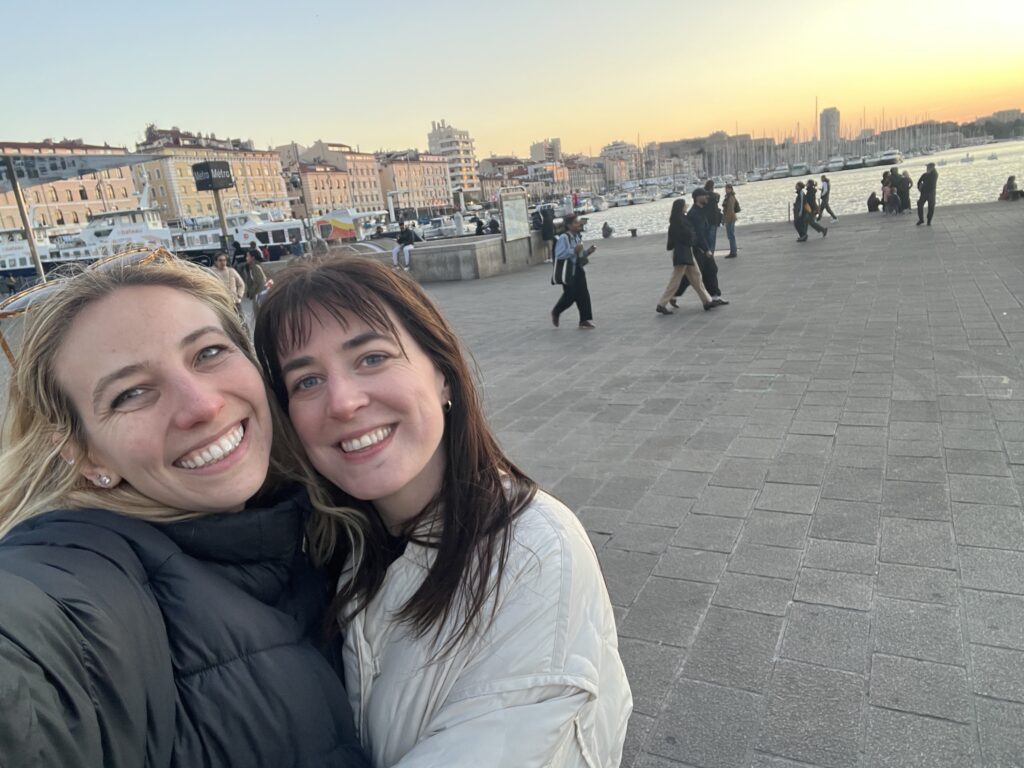
There we were, two girls and a dog about to venture out on our own queer hero’s journey from Madrid to Marseille…
(L to R) Alexia & Kathy in Marseille. Featured image courtesy of Alexia Garcia
I’ve lived in Spain for almost eight years, but I hadn’t really considered the importance of getting a Spanish driver’s license until recently, when we realized it would make sense for me to share more of the driving with my girlfriend. I found myself right back where I had been at 16, studying for a theory exam and sitting in driver’s ed with a teacher far stricter than the parents who first taught me.
Much like queer time—rarely linear, often delayed because many of us first try to follow the straight path before realizing it isn’t ours—moving to a new country comes with its own set of bureaucratic rites of passage, small humiliations, and unexpected returns to beginner status. No longer someone who had been driving for more than a decade, there I was sitting behind the wheel with shaking hands as I prepared to take my Spanish driver’s test.
And like many worries that end up being larger in our heads than in reality, I passed on the first try. Now, freshly licensed to drive in Europe, we decided to take an inaugural road trip for spring break from Madrid, Spain to Marseille, France.
The journey is about 11 hours, so we decided to do it over two days. Flying would certainly be easier, but our Labrador, Dotty, is too big to meet the EU pet travel requirements, making driving the obvious choice.
So, there we were, two girls and a dog about to venture out onto the open road. We joked that we were on our own queer hero’s journey.
Sun, water, and wind in Costa Brava
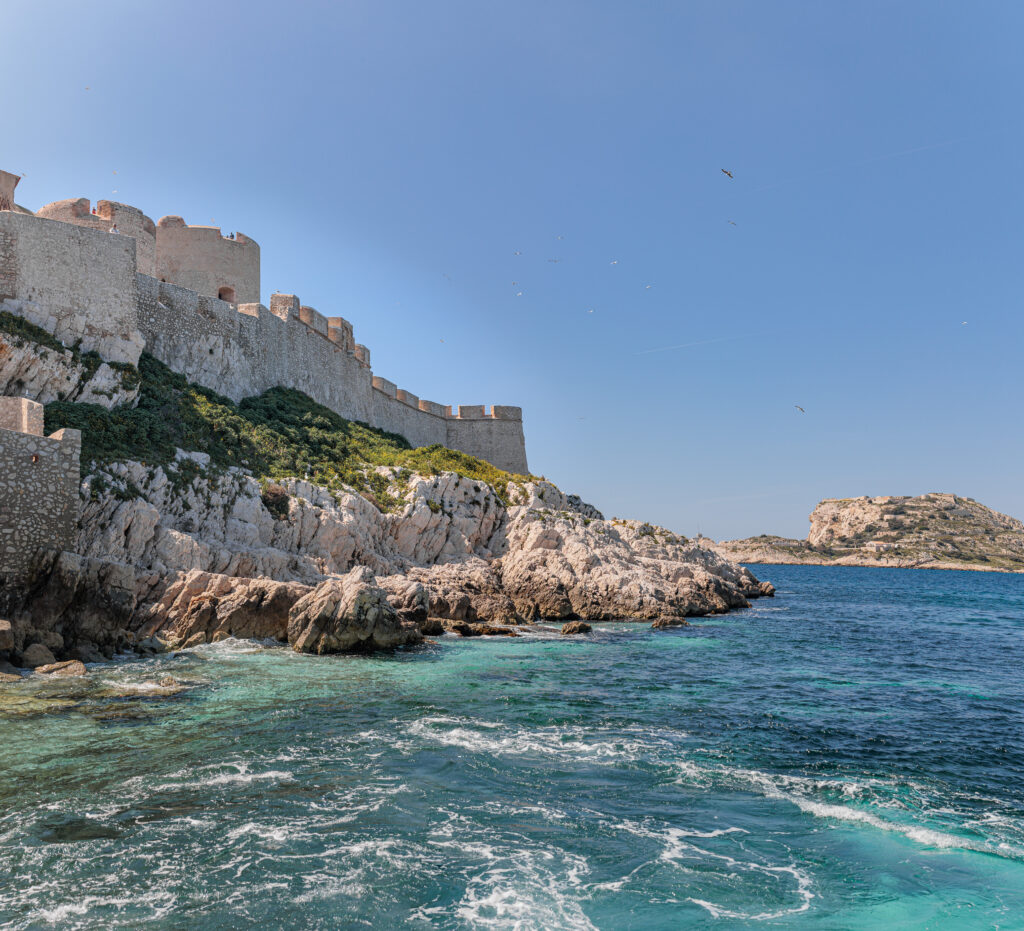
Our first stop was the Costa Brava, on Spain’s northeastern Mediterranean coast, where dramatic cliffs meet the sea. The Costa Brava is in Catalonia, a region of Spain where local identity and culture persisted under General Francisco Franco’s dictatorship. Catalan is widely spoken, and the regional flag is visible throughout the area. As conscientious travelers, we learned a few key phrases: “Bon dia” for “good morning” and “adéu” for “goodbye.” Using them (we like to believe) earned friendly smiles as we walked along the beach the morning before continuing our road trip for another six hours.
That said, this was no peaceful seaside stroll. We were met with a full-on windstorm. The coastline looked cinematic—outdoor furniture skidding across the sand as employees chased after it. We clutched our hats and squinted through mini sandstorms, but the usual crowds were gone. The beach was ours. We hiked to Cala del Pi, a nearby cove with clear turquoise water framed by big rocks and small pines. Dotty burned off some energy chasing sticks and splashing in the sea before we piled back into the car and were on the road again.
C’est Marseille
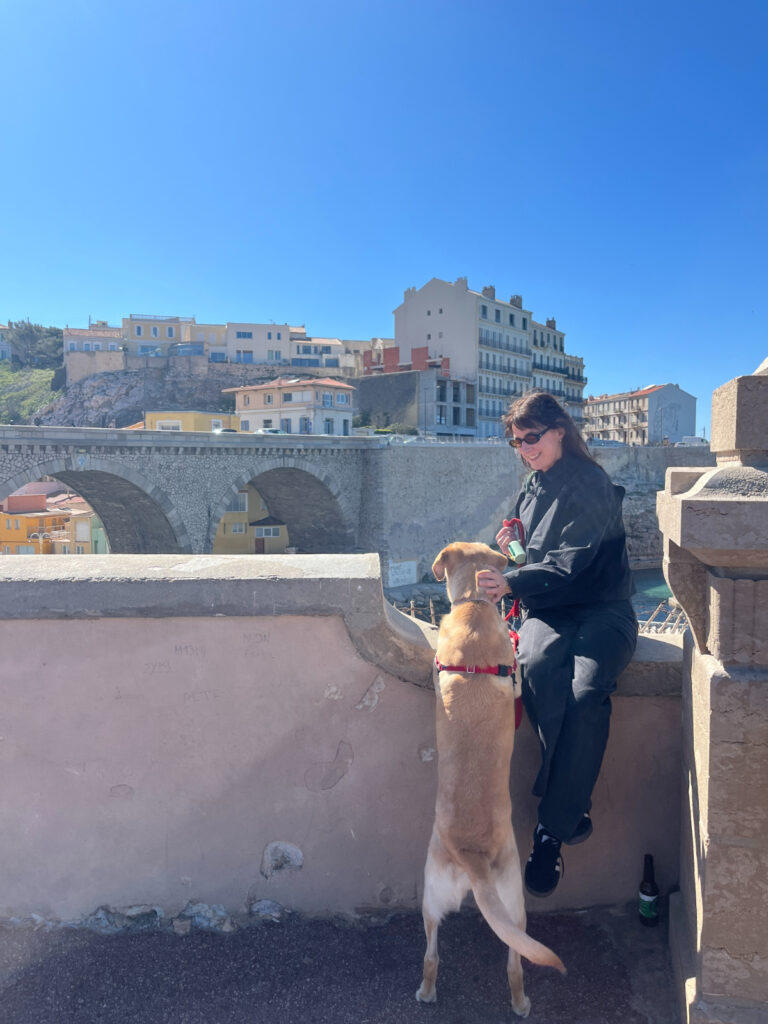
Neither of us had been to Marseille before, but we knew it as a city full of life. It’s incredibly diverse, a little chaotic, and proudly unruly in the way port towns tend to be—with a queer scene to match.
As we approached the city, the road opened up to a sweeping, panoramic view. Marseille spilled out before us in layers of sun-faded buildings, the deep blue of the Mediterranean stretching wide, and pale hills rising behind it all. Signs for the beaches began to appear, and the highway twisted and dipped, pulling us through tunnels until one final stretch spat us out into the Old Port.
We arrived in the city as stressed as one could imagine. Driving in Europe, I must say, has its own challenges. The roads are simply smaller, the speed limits higher, and motorcycles soar in and out of lanes as you’re trying to understand the confusing indications as delivered by Google Maps. All that to say, these driving conditions are ripe to make even the strongest of couples shake with stress and argue in frustration. Luckily for us, we survived the first test of our hero’s journey, and, if anything, we came out stronger.
Our First Evening
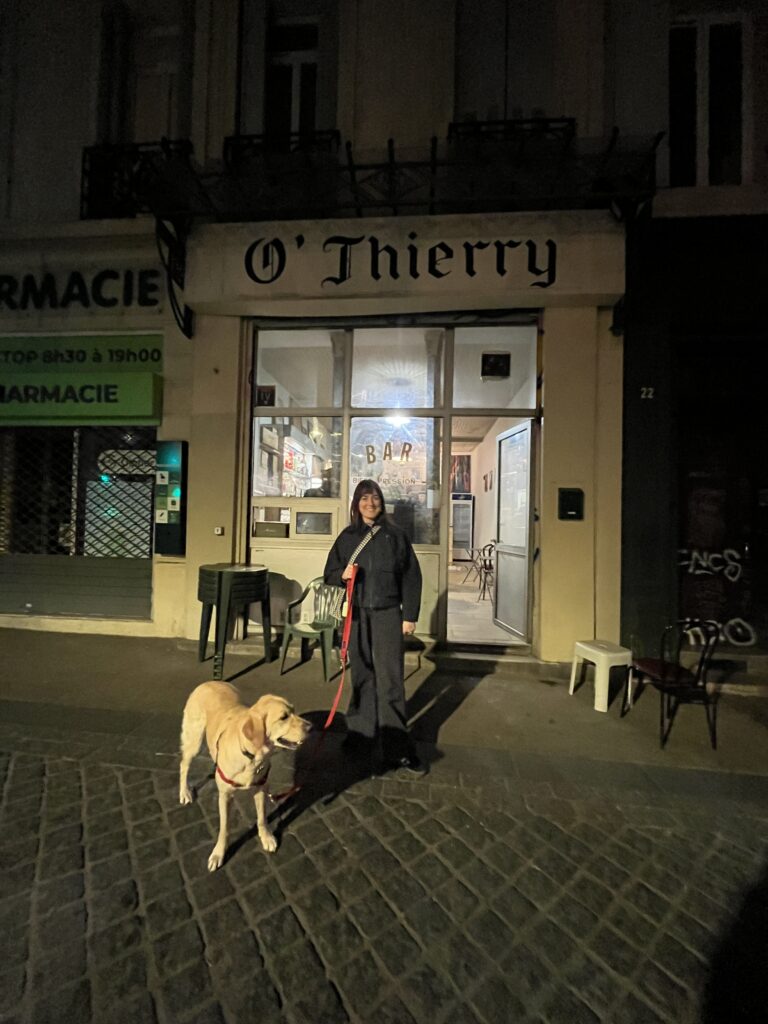
Once the car was parked, we knew the trip would only improve from there. Armed with a list of recommendations from friends who had lived in the city, we headed first to Bar O’Thierry in the Noailles neighborhood. Marseille felt lively for a Sunday. People played music in the streets, teens rode two at a time on electric scooters, and vendors stayed open late selling bars of soap—one of the city’s most famous exports.
Tired from a long day of driving, after one drink at O’Thierry’s, we got Tunisian takeout at Le Saf Saf to eat in our hotel and walked home along the city’s port. From spice shops to Algerian bakeries, to the chaos of a Sunday evening, we felt immediately that the city was going to treat us well.
A Morning Walk with a Side of Pain au Chocolat
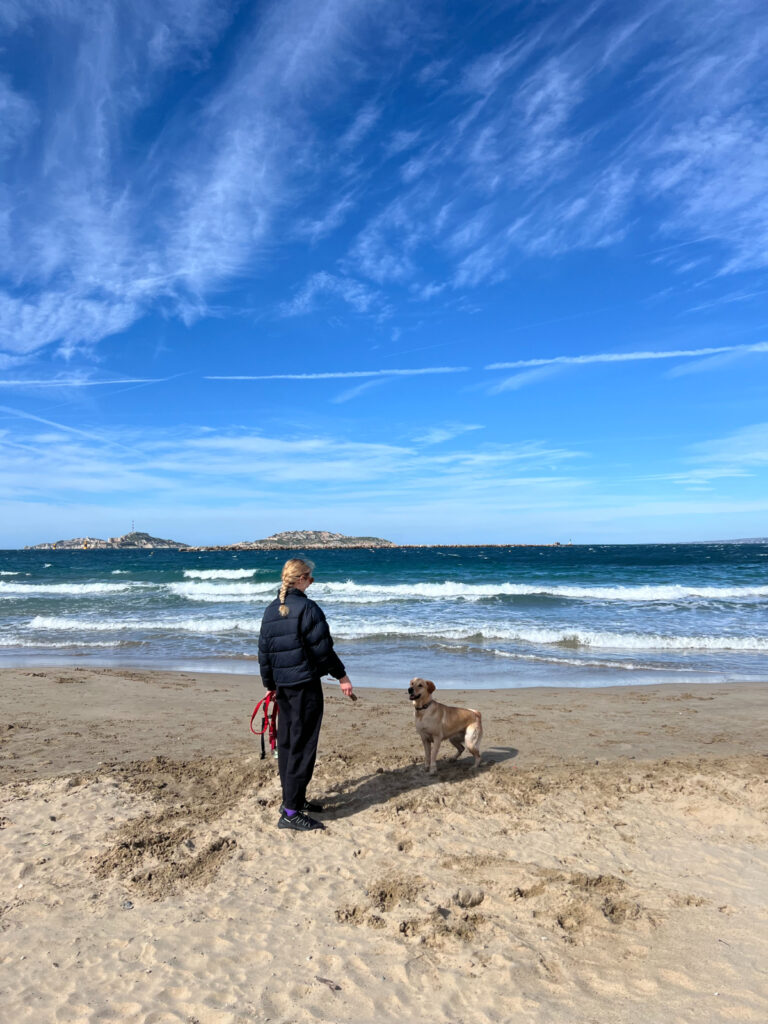
Our first full day in Marseille was as lovely as you’d expect. We woke up, picked up French pastries, and walked our dog to the nearest beach, La Plage des Catalans, a city beach that was surprisingly empty. We quickly learned from the other dog owners that the beach is typically packed, but the wind, named “Mistral” by the people of Marseille, blew with such force that the typical beachgoers stayed home. For the dog owners, this worked in our favor, since dogs normally aren’t allowed on the beach. Dotty ran in and out of the water, carried sticks, and played fetch alongside her French companions. This became our morning routine for the week: a pastry and a walk to the beach, made possible by the Mistral.
Before visiting any city, we watch the city’s episode of Anthony Bourdain: Parts Unknown to get a sense of the local culture and cuisine. We learned that, beyond seafood and pastis—the anise-flavored spirit closely associated with Marseille—the city is also known for its range of cuisines shaped by its diverse residents. From dishes from the Maghreb region of North Africa to Vietnamese food, Lebanese restaurants, and Japanese ramen spots, Marseille is a city best experienced through its food.
On our walk back from the beach, we stumbled upon a Lebanese restaurant named Mouné and immediately made a reservation. It became one of the highlights of the trip. The food stood out: hummus drizzled with beets, daal topped with swiss chard prepared to accommodate our vegetarian diet, and orange blossom ice cream to close the night.
The co-founder and owner, Serge, was a pleasure to talk with. After dinner, he stepped outside for a cigarette and shared his perspective on the city’s political and cultural moment. We talked about gentrification, histories of immigration, and how people in Marseille are organizing to keep the city inclusive amid shifting geopolitical dynamics. It’s not every day you get dinner alongside conversations about postcolonial theory and French politics. We’d recommend it to anyone looking for a strong meal and a queer-friendly, inclusive environment.
The Mothers of Marseille
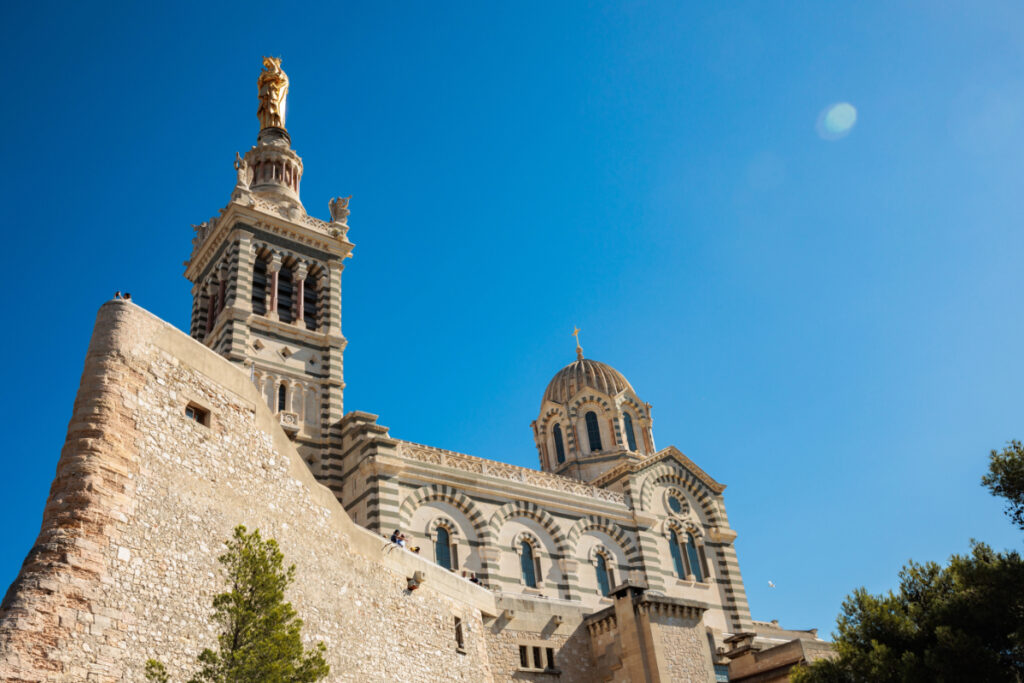
Marseille is overlooked by a church at the top of a hill, Notre-Dame de la Garde. And if you’re like me, you may not have realized that “Notre Dame” translates to “Our Lady.” At a museum, we found a postcard titled “The effect of the Mistral wind on Marseille,” showing a toppled Notre-Dame, which felt accurate given the wind that week. One morning, we changed our routine and hiked to the top to look out over the city alongside Mother Mary. Of course, the Basilica is beautiful, and the views from the top are unparalleled, but a complementary experience really enhanced our understanding of the role that “Our Lady” plays in Marseille.
Friends recommended that we visit the Museum of European and Mediterranean Civilisations (MUCEM), not only because of the setting—a former military fort on the seafront connected to newer architecture—but also because of an exhibition running during our visit titled “Bonnes Mères,” or “The Good Mothers.”
The exhibition explored different forms of mothering across the Mediterranean. It covered French feminist movements fighting for reproductive choice, highlighted queer mothers, and showed how lesbians formed families, even during periods when legal access to reproductive care was limited. The exhibition offered a thoughtful look at what “mothering” has meant across cultures and within Mediterranean queer communities. We photographed parts of it and sent them to our mothers so they knew we were thinking of them. And I have to say, it shifted our understanding of the city. Sometimes it’s a bit off-putting to have the city be defined by intense Catholic imagery.“Protected by Mother Mary,” watching over the inhabitants, came to feel more like “ mothering itself,” but as seen through an inclusive and diverse lens, at the heart of Marseille.
Unforeseen Gems
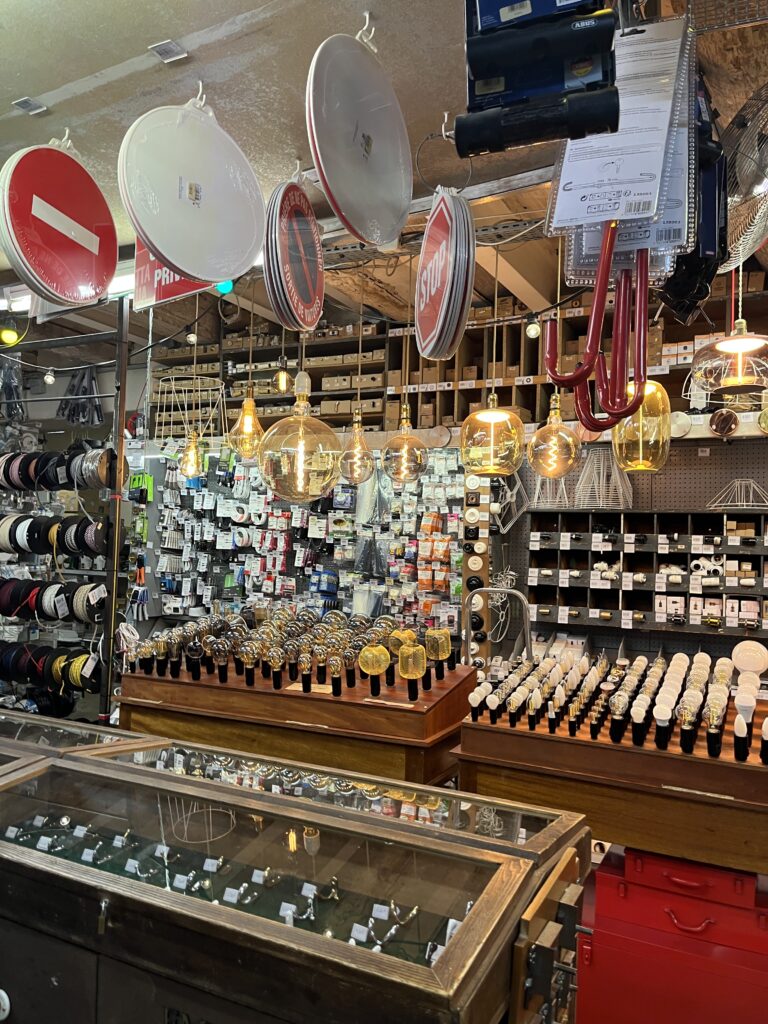
Thanks to the long list of recommendations from our network of queer friends, we had a few other must-sees that surprised us with how much we enjoyed them. The first was Maison Empereur, described as a hardware store that doubles as a museum. Whether you’re a Home Depot dyke or a lesbian who appreciates vintage glassware, this shop has something for you. We spent hours exploring the multi-story store, which sells everything from fine knives and Le Creuset cookery to workwear and chic French rubber bands. If you’re in Marseille, it’s not to be missed.
Although we were sad to leave, the shop had energized us for more of the city. We decided to walk up to Cours Julien, described to us as “the neighborhood with the most life, the most artistic, and the most inclusive,” and were encouraged to check out BOUM, a queer bar in the area. Tote bags in hand—now carrying a pan, a pie holder, a vegetable brush, and salted butter caramel cream—we headed off.
Our friend was right. The neighborhood was alive, covered in graffiti, with a sign proclaiming it the city’s “creative district.” We toasted and watched the sun set over the city center. In terms of the hero’s journey, perhaps this was our small reward before returning to the ordinary world.
The Road Back through the Calanques
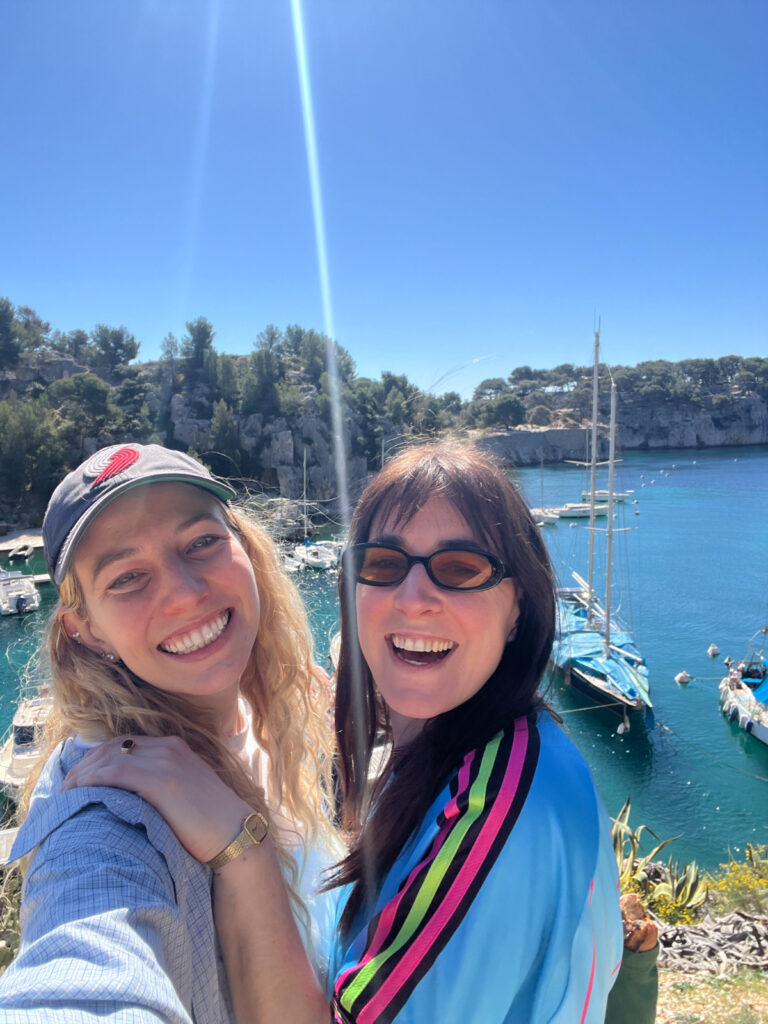
It was time to get back on the road, but before we properly hit the highway, we made a stop at the Calanques National Park. And what a treat it was. The only real trial we faced that day was finding parking, and maybe navigating a few people who weren’t so dog-friendly, but beyond that, the Calanques felt like a dream. The Mediterranean coast is one of the most striking landscapes I’ve seen. Rocky cliffs lined with pine trees and pristine turquoise water.
After a short hike down to a secluded cove, we were back in the car on our way back to the Costa Brava. On one hand, vacation was over, but given the two-day journey, there was still more beach time in our cards.
Back to Spain
The first leg of the trip was about five hours. Knowing that, we put together a France-inspired playlist featuring queer icon Christine and the Queens and podcasts dissecting The L Word episodes from start to finish.
We spent our final day of spring break in Palafrugell, a small Catalonian town near the coast. We took a short break from the dog and left her at the hotel for some much-needed time to ourselves. Once again, we headed to the beach, muscled our way into a parking spot, and spent the afternoon reading on the sand and chatting on our beach towels.
We talked about how well Marseille had worked as a destination. It has all the things we like in a city: it’s inclusive, with a strong food culture, access to nature, people with a strong political awareness, and who are out in the streets whenever they can. We even started debating which siblings or friends we might convince to move there so we’d have a reason to visit more often.
The Journey Home
We woke early the next day and got back on the road. Dotty reluctantly took her place in the backseat, and we found ourselves already thinking about a home-cooked meal. Exhausted, sun-kissed, and carrying new perspectives on what we value in a city, we felt ready to return to our own.
Marseille was special, and the trip unfolded with ease. People were welcoming, the streets were full, and queer life existed as part of the broader social fabric of a diverse port city. We returned to Madrid having survived our hero’s journey, my Spanish driver’s license finally inaugurated, and a new rhythm established as co-pilots. We’re already certain we’ll be back.