

Judith Kasen-Windsor on Edie Windsor, Marriage Equality, and the Fight Ahead
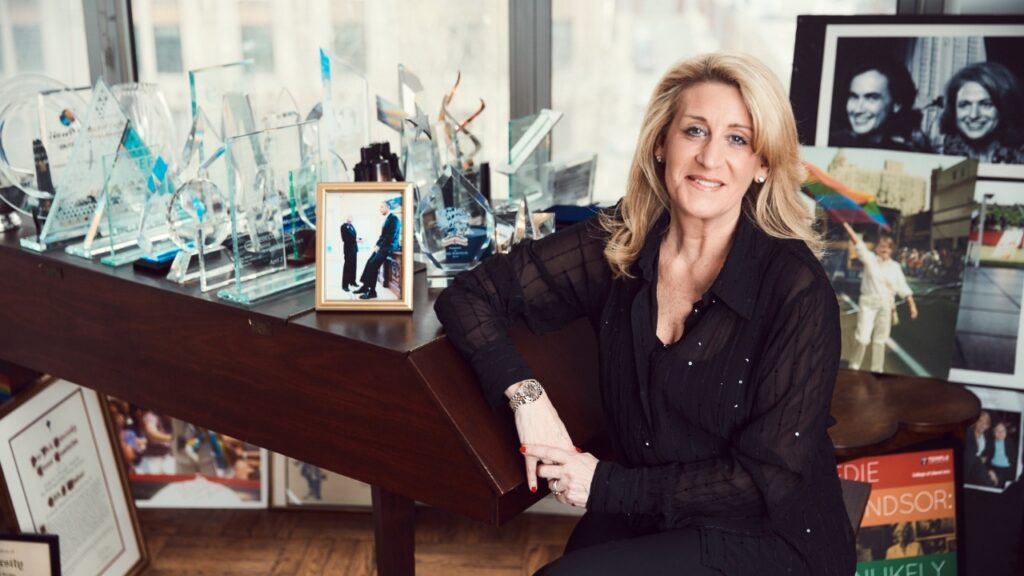
The wife of LGBTQ+ rights icon Edie Windsor reflects on the landmark Supreme Court case that helped pave the way for marriage equality, the rights still under threat today, and why she’ll never stop telling her wife’s story.
Judith Kasen-Windsor remembers her late wife, Edie Windsor, as a superhero of the LGBTQ+ rights movement.
“I always say Edie was Batman,” Kasen-Windsor tells GO. “I’m Robin.”
Windsor, whom Kasen-Windsor married in 2016, was the woman whose court case brought down the primary part of the Defense of Marriage Act (DOMA), the law that barred the federal government from recognizing same-sex marriages and therefore denied many benefits to queer couples. The Supreme Court’s 2013 ruling in Windsor v. U.S. paved the way for its ruling for nationwide marriage equality in Obergefell v. Hodges in 2015.
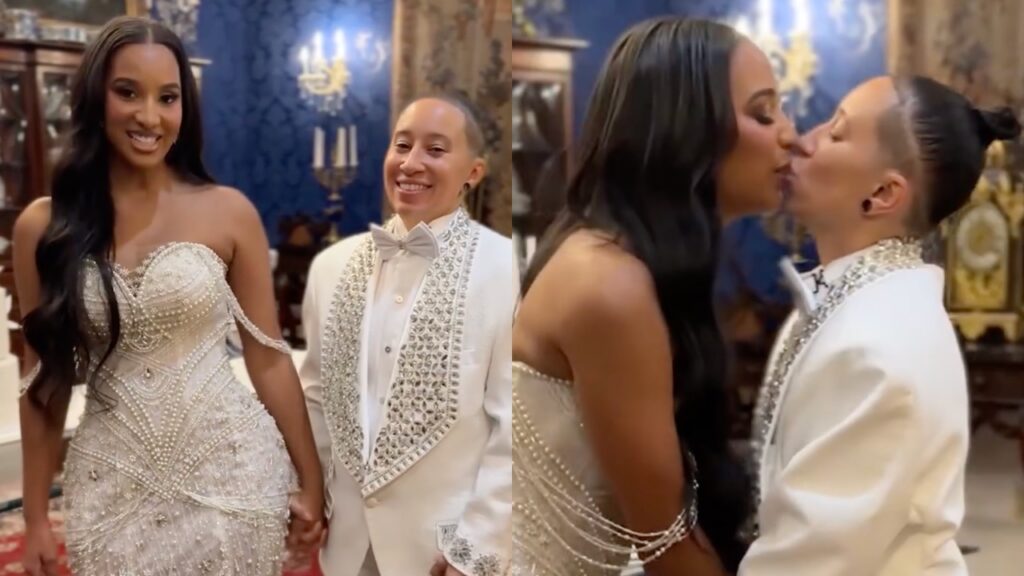
Windsor died in 2018 at age 88. So their marriage was a brief but significant period in Kasen-Windsor’s life—and Windsor was hugely significant to the LGBTQ+ rights movement.
“Even 15 years ago you did not walk through Washington Square Park holding hands,” says Kasen-Windsor, a New York City resident. “You just didn’t. And I really think Edie was a huge catalyst in that change.” Upon returning to the city after a lengthy absence, Kasen-Windsor says, “One thing I have noticed that has really stuck out to me is there are a lot more lesbians in Washington Square Park, snuggled up, holding hands, where it used to be just the guys. You didn’t see the women at all.”
Edie Windsor had sued the federal government over DOMA because, after the death of her first wife, Thea Spyer, in 2009, Windsor owed $363,000 in estate taxes, which she would not have owed if she had been married to a man—a marriage the government would have recognized. And while the high court’s decision assured certain rights, it also promoted visibility, although Windsor, having endured a homophobic era, still had some fears.
“It wasn’t until really after Edie’s case that you really saw more visibility of lesbians and gays,” Kasen-Windsor says. “We also live in a bubble in New York. But even in New York, I remember walking to Bed Bath & Beyond with Edie, and I would hold her hand at the corner of 14th Street or whatever, and we would kind of cross the street, and then she would slowly drop my hand and not hold my hand. She was terrified.”
Now some of the rights of LGBTQ+ people are under threat, including the right to marry the person one loves. Some states still have bans on same-sex marriage on the books, even though they are unenforceable. In the November 3 election, Virginians will vote on Ballot Measure 2, which, if approved, would repeal the state’s constitutional amendment banning same-sex marriage and replace it with a provision assuring equal marriage rights in the state.
“Through the course of the couple years, or you know, the several years that Edie and I were together, she said to me, ‘Promise me they will never overturn Windsor,’” Kasen-Windsor recalls. “She goes, ‘If they overturn Obergefell, that’ll just go back to the states, and some, you know, we can name the states off the top of our heads. They’re going to be a pain in the ass and whatever, and they’re going to try to overturn it and do whatever. But it’ll just be like, you know what? If you live in Texas, you’ll just come to New York. You’ll get married, and you’ll have to go back, and you’ll have the few homophobes at the hospital or here or there. But you’ll have to file your taxes federally joint, and state individually. I mean, that’s really what it comes down to. Or you’ll have the one holy roller at the hospital or principal at a school where they have gay parents, and they won’t acknowledge the other mother or whatever. There’s always going to be those people out there.”
Kasen-Windsor is nonetheless upset about the level of hate in the U.S. now, including the hate directed at transgender people. For instance, there are few trans athletes in the nation, yet right-wing politicians use them as a talking point, supposedly about “fairness” in women’s sports.
“If you look at the numbers of how many high school trans kids there are, I mean, I know like two, and I know a lot of people,” she says. “It’s ridiculous.”
“I think this is a horrible moment in time,” she says, but adds,” I don’t think we’ve gone back to like the 1950s, ’60s, where [being LGBTQ+] was like a mental illness.” But Donald Trump’s administration and others are using homophobia and transphobia to distract from the administration’s misdeeds, she says.
“I refuse to accept that we are the problems,” Kasen-Windsor says. “We’re not raising gas prices. Trans people aren’t raising gas prices. Gay people aren’t doing anything to your kids. It’s just a distraction.” Despite all this, she says, “I’m a perpetual optimist, and so was Edie.”
She says she hasn’t experienced homophobia, however, in her work on Wall Street. She doesn’t present as stereotypically lesbian, she notes, although she allows that colleagues may have talked about her behind her back. One place she has found to be totally free of homophobia, though, is Dollywood, the theme park established by the late Dolly Parton—a major LGBTQ+ ally—in Pigeon Forge, Tennessee. Kasen-Windsor visited Dollywood a year and a half ago; she also has a passion for the Disney theme parks.
“I was [at Dollywood] with three lesbians, two gay guys,” she says. “Couldn’t have been more obvious as far as I’m concerned. Everybody was perfectly nice. The only thing was my voice [which marked her as a Northerner] and one of the other girls’ haircut. … I didn’t see one MAGA hat.”
But her friends Braunwyn and Jennifer Spinner, who live in Tennessee and were part of the Dollywood group, have experienced homophobia in other sites in the state, such as when shopping at Walmart, Kasen-Windsor says. Jennifer has a short wedge haircut, like many straight moms, but to some people, it marks her as lesbian.
“She gets yelled at in Walmart,” Kasen-Windsor says. People are like, ‘You’re disgusting. I can’t believe you’re exposing these children.’ Because Braunwyn has … 12-year-old and 8-year-old kids, and [Jennifer will] go to Walmart with them, and people scream at her.”
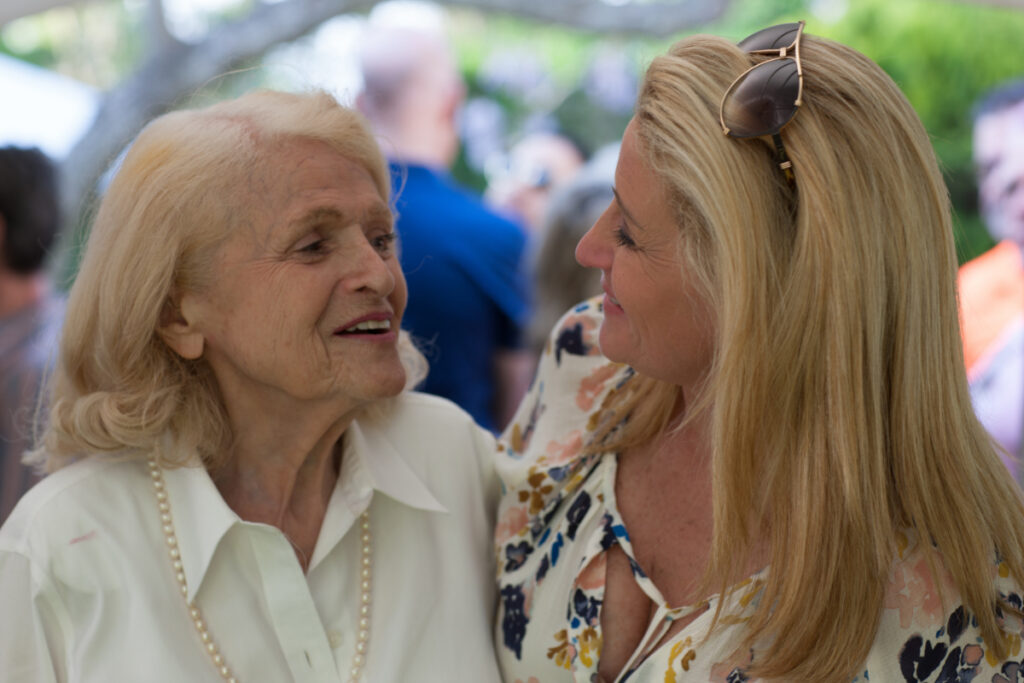
Kasen-Windsor remains committed to supporting LGBTQ+ rights and making sure Edie’s legacy is recognized. She often talks to people in Washington Square Park, where one intersection is marked as Edie Windsor and Thea Spyer Way. “I always tell them who Edie is because Edie’s street sign is right there,” she says. “And whether they’re gay or not, the women really love to hear the story. They love to hear of a woman who did what she did.”
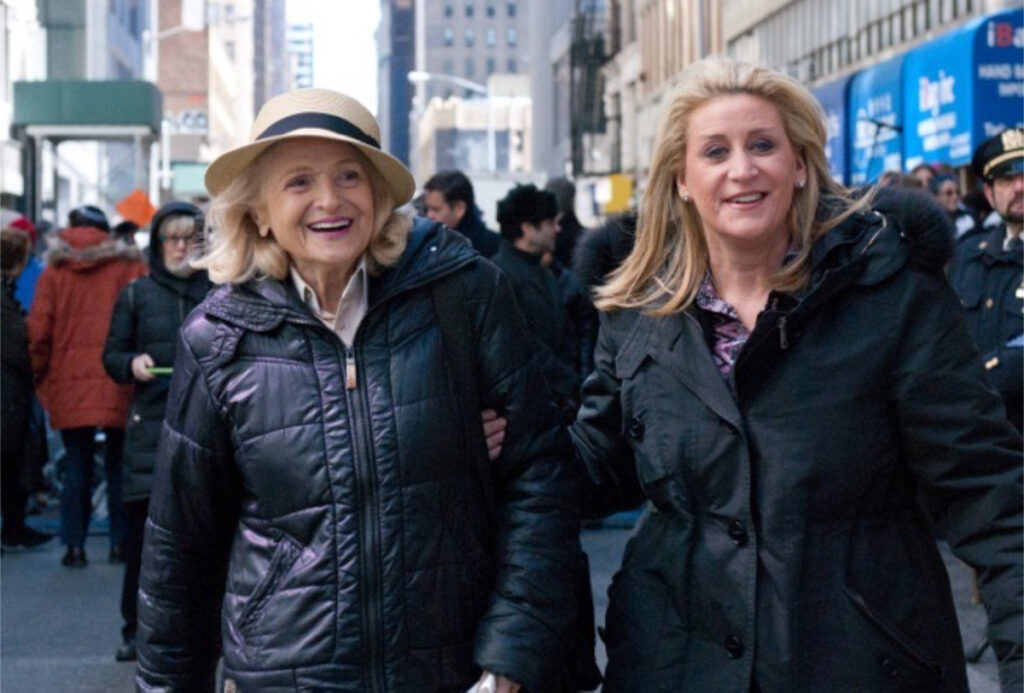
She notes Edie’s other accomplishments, such her work as a technology pioneer; there is now an Edie Windsor Coding Scholarship at Lesbians Who Tech. “Edie is my little diamond with many facets,” Kasen-Windsor says.
She also recalls meeting a pre-law student while making a return at Staples. “There was a girl behind me, and she loved my dog, and we started talking, and she said she’s in pre-law at [New York University], and I’m like, ‘Oh, if you’re in pre-law, have you done the civil rights class? And she’s like, ‘No, that’s next year, I’m only a junior.’ And I said, ‘Well, you’ll discuss the Windsor case. And she goes, ‘Oh my God, the Windsor case! And she knew all about it. And I said, ‘Will you tell them when you were doing your return at Staples last year, you met Edie Windsor’s wife? And she’s like, ‘Oh my God! And of course, she started following me on Instagram, and I showed her some pictures of Edie in her Time magazine Person of the Year.”
“I talk to everyone, and if they don’t know who Edie Windsor is, by the time I leave the store, they know who Edie Windsor is,” she adds.
Windsor helped to counter stereotypes of LGBTQ+ people, showing that “we were doctors and we were lawyers and we were Indian chiefs and we were this and we were that,” Kasen-Windsor notes. “I really feel very strongly about how Edie changed the game.”