

37 Years Later and the Ohio Lesbian Archives Is Still Saving Queer History
The organization is looking to grow its monthly donors and raise $12,000 by December 31.
On a cold winter morning in 1989, more than 100 people lined up outside Crazy Ladies Bookstore in Cincinnati and formed a human chain, passing the feminist bookstore’s contents hand to hand to its new location nearby.
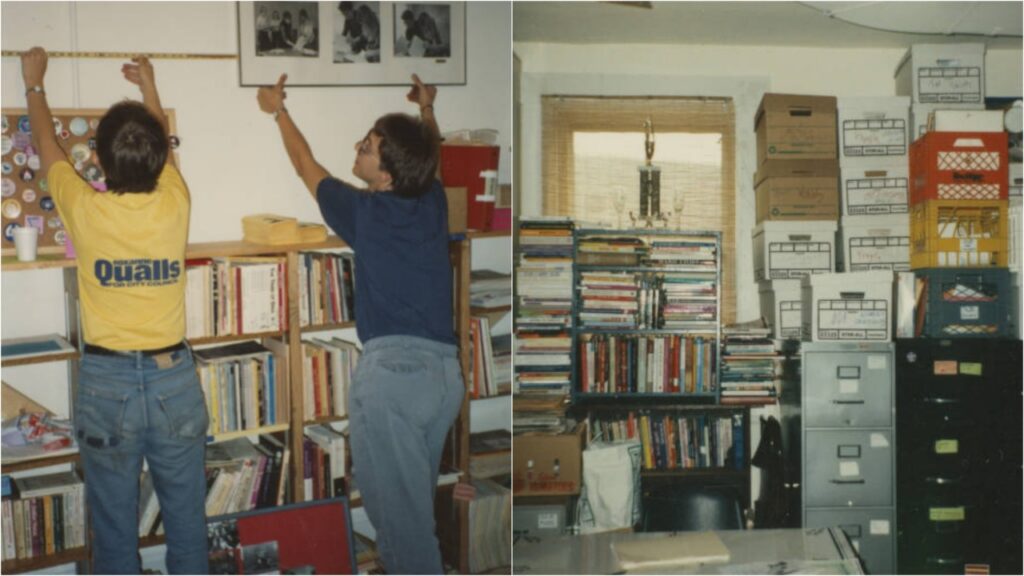
Someone caught it on video, and today that footage is part of the Ohio Lesbian Archives (OLA), an archive founded that same year by lesbian friends Phebe Bizer and Vic Ramstetter in a space above the bookstore.
From books to zines to flyers, the Ohio Lesbian Archives’ collection ranges in media and time.
“It does have a really big focus on lesbian feminism, specifically from the ’70s, ’80s and ’90s, just because that’s very much the time and the demographic it was founded within. But in recent years we’ve expanded, and we collect LGBTQ+ material from all across Ohio,” says Avery Plummer, director of development and community engagement at OLA.
One of the treasures in the collection is the extensive run of Dinah magazines, a lesbian community magazine that ran in Cincinnati for decades, Plummer says. “I think it’s a very cool and long-running example of how LGBTQ+ people found one another before the internet and made networks of support and care,” she explains.
While the archives no longer sit on one of the top floors of Crazy Ladies — the bookstore closed in 2002 — the community-focused nature of the archives is still very much alive. For 17 years, the archives were housed in the basement of a local church, and then, thanks to grant funding, the archives moved to its current location in Cincinnati.
Now, the archives has its own space in downtown Cincinnati and continues not only to be a place to keep pieces of Ohio’s LGBTQ+ history safe and available, but also a community space for history to be made.
Why Archiving Matters Now
Plummer says the same reasons apply now that applied almost 40 years ago when it comes to the importance of archiving.
“It really goes back to what Phebe and Vic were doing, which is that they started saving this material because nobody else was. A lot of that is because it’s LGBTQ+ material that mainstream institutions just are not prioritizing,” she says.
While universities and government institutions may have queer collections, Plummer warns that that can be a fragile arrangement. Plummer notes the example of the University of North Texas, which took down its webpage about its LGBTQ+ collection after a conservative politician blasted it. Eventually, the university put it back up.
For the Ohio Lesbian Archives, Plummer says they don’t have to worry about those same pressures and threats of legislative attacks. Plummer says the organization doesn’t take federal funding and relies on more grassroots funds to do its work.
“The importance of LGBTQ+ archiving for me personally is that I think learning about our history can serve as a blueprint for how we can move forward, in whatever times we find ourselves in,” Plummer says. “Right now, it’s a difficult time in some respects, so I think it’s really great to have material that shows how generations before us got through similar times.”
Continuing to Preserve History
Right now, OLA is raising money to continue their preservation and archival work.
During this end-of-year giving season, Plummer says they are trying to expand their Founders Club, which is made up of monthly donors and those who give $500 or more to OLA.
“The big reason for that is that monthly giving especially, but also those larger gifts, really help us plan and budget for the future,” Plummer says. “That way we can think about what programs we want to take across Ohio in 2027, or how many archival boxes or acid-free folders we can purchase throughout 2027 based on our needs. It really helps us plan for the work that we do.”
OLA is trying to get to 60 members of its Founders Club. They are also aiming to raise $12,000.
“If you do join the Founders Club, you get a quarterly newsletter with behind-the-scenes stuff we do at the archives: preservation projects we’ve done, events we’ve had, all the things we have happening,” Plummer says.
Stop On By
While archiving is the heart of OLA, it’s also a space for queer people to feel welcome and to find community.
“Well, if anybody is local, we’re open to the public,” Plummer says.
She explains that the archive is open twice a week for browsing, for volunteering, but also literally for just hanging out.
“I think that’s something that’s really cool about the Ohio Lesbian Archives: It’s stepped beyond being just a repository for information, and it really is a place where people come together and are in community,” Plummer says.
She continues, “I would definitely recommend that people come visit us. Or if they’re interested in learning about our collection or doing research with us, they’re more than welcome to reach out. We always love to talk to people about Ohio LGBTQ+ history.”
Learn more about OLA and find out how to donate here.