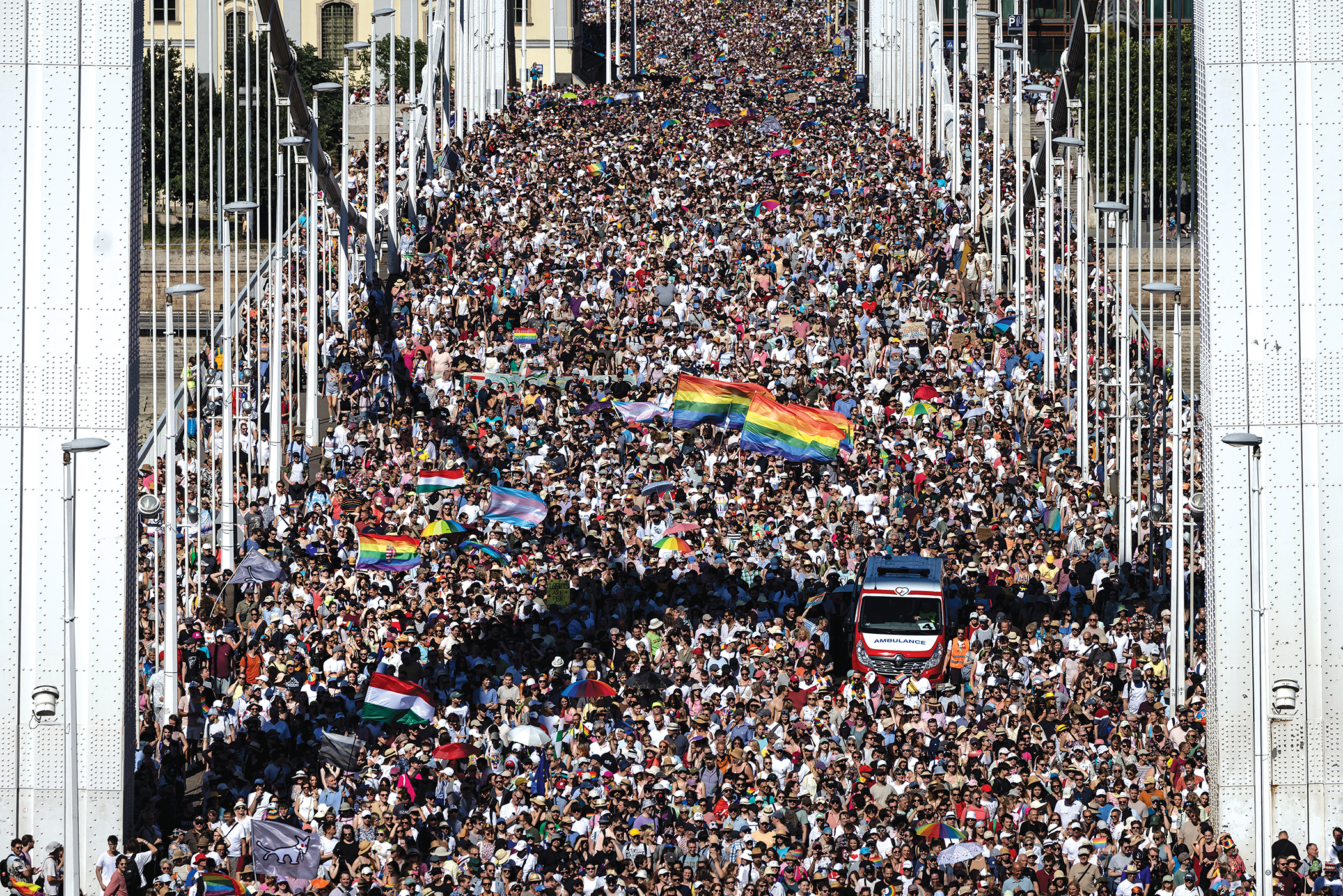
BUDAPEST, HUNGARY – JULY 24: Demonstrators march through the Liberty Bridge during the annual Pride parade on July 24, 2021 in Budapest, Hungary. Pride organisers say that the march is as much a rally in defiance of the anti-gay campaign being waged by the Hungarian government as it is a celebration of LGBT rights. (Photo by Janos Kummer/Getty Images)
GO sat down with activist Rain Dove, who stepped off among the marchers at Budapest Pride, and Budapest Pride President Viktória Radványi.
Featured Image: Demonstrators march across Liberty Bridge during Budapest Pride. Photo by Janos Kummer/Getty Images
When Viktória Radványi became president of Budapest Pride three years ago, she inherited both a celebration and a battlefield. Pride in Hungary has always been contested, but under Prime Minister Viktor Orbán’s government, hostility escalated into law. In 2021, legislation was passed banning the “promotion or mention” of LGBTQ+ identities. Overnight, simple acts—a rainbow poster, an educational workshop, even certain kinds of media representation—carried the risk of punishment.
The fine for attending a banned demonstration could equal a full month’s wages; organizers could face a year in jail, Radványi explains. For individuals, that threat is devastating; for organizations like Pride, it could mean ruin. And the police’s use of facial recognition technology only made things more dystopian.
Instead of deterring marchers, the threat of fines only brought more boots on the ground. Organizers knew there would be strength in numbers. “The more of us there are,” Radványi says, “the less likely the police are to enforce these penalties.”
That became the guiding principle for this year’s march. The strategy was simple: overwhelm the law with numbers. Radványi and the organizers tapped other human rights NGOs for support, calculating that if tens of thousands of marchers showed up, the authorities would struggle to punish anyone at all. Backing their effort, in opposition to Orbán’s government and the police, was Budapest’s own mayor, who helped co-organize the march as a municipal event. The mayor, Gergely Karácsony, is under criminal investigation as a result.
Photo by Janos Kummer/Getty Images
Though the stakes were unbearably high, the gamble paid off. Crowds poured into the streets in unprecedented numbers, a turnout nearly ten times larger than the typical 30,000 to 35,000.
In 2021, legislation was passed banning the “promotion or mention” of LGBTQ+ identities.
“We measured the length of the bridge everyone had to cross and estimated about three people per square meter, which gave us about 25,000 people on the bridge at a time. It took the crowd between 2.5 and 3 hours to fully cross. We concluded the bridge filled and emptied at least 12 times. This means at least 300,000–350,000 people participated,” Radványi says.
To protect every one of them, the behind-the-scenes logistics were daunting. Radványi and her team coordinated legal observers, safety marshals, and support systems for vulnerable marchers. They knew the risks were not equal for everyone. Trans and non-binary people, Roma LGBTQ+ communities, and anyone already marginalized in Hungarian society faced heightened danger. Radványi emphasizes this throughout the planning.
“And it worked,” Radványi says. “The crowd was massive, and in the end, the police didn’t fine anyone. Not a single person.”
A Day of ‘Radical, Everyday Love in Action’
For Rain Dove, the march was unlike anything they had experienced. An activist known for blending performance, protest, and visibility, they arrived in Budapest braced for violence.
“Honestly, I wasn’t sure they’d even let me into the country,” Dove says. “Others on my flight—visibly queer, with rainbow pins and dyed hair—were pulled aside and questioned. I passed through unnoticed, presenting as a conservative young man.”
The streets confirmed their fears at first. Tanks and ambulances lined the route. Police presence was heavy. But as the march unfolded, something shifted. The sheer size of the crowd, its defiance and joy, dissolved the fear, and Dove felt completely connected to everyone around them.
There were so many moments that emphasized that connection: “On the bridge, singing ‘Teenage Dirtbag’ with strangers who had become family. A queer pod I’d joined that included a goth lesbian, a couple in strawberry shortcake pastels, tattooed dykes, and a photographer from Italy. Later that night, we danced together at a nightclub … knowing arrest was still a possibility. Then brunch with elder queers, who made me vodka-heavy Bloody Marys and told stories of loving when it was still illegal. At a trans and neurodivergent picnic—technically illegal—we played Uno in the park. There was even a vote: should we move closer to a lesbian picnic nearby that included some trans-exclusionary folks? The answer was yes—out of solidarity.”
“This work is what keeps us grounded here. It gives us purpose”
-Viktória Radványi
For Dove, those moments were electrifying. A community that could have hidden instead chose to sing, dance, and risk everything together.
The contradictions were everywhere: tanks standing by as families with children carried rainbow flags; organizers using circus music to drown out hecklers; marchers laughing in the face of laws meant to erase them.
Viktória Radványi. Photo by Rain Dove.
Organizers had encouraged people to bring their parents “to counter the lie that queerness isn’t family-friendly. It worked. This was radical, everyday love in action.”
Some moments caught Dove off guard, emotionally. First, they noticed that as they passed the police, no one booed. “Instead, people clapped. Some officers wore lipstick marks on their cheeks, kissed by grandmas and grateful drag queens. Many applauded back. Behind that were campaigns from the mayor and locals who convinced police they didn’t have to act for Orbán.”
And they’ll never forget the grandparent, too frail to walk the full route, who stood on a cliff overlooking the bridge, waving a Pride flag at their grandchild below. “They didn’t know all the language yet—but they knew love,” Dove says. “That mattered.”
As they reached the final lot, filled with huge screens, a stage and speakers, Dove looked back. The bridge was still packed with people. The march had done the impossible. And they understood the true meaning of what was occurring, this powerful experience they’d just been a part of: “Just because something is banned doesn’t mean it can be erased.”
Finding Purpose in Pride
Unlike in cities where Pride has become an annual celebration with corporate sponsorships and glitter-covered floats, Budapest Pride remains firmly rooted in protest.
It isn’t easy being in the middle of it.
“It’s such a suffocating environment—rampant corruption, unpredictable legislation, media takeovers. You never know what the government will come up with next. This work is what keeps us grounded here. It gives us purpose,” Radványi says. “We’re working to build solidarity.”
Photo courtesy of Budapest Pride.
The march was, in fact, filled with small, luminous acts of solidarity. Parents brought children. Older generations marched alongside youth. Celebrities stood shoulder to shoulder with queer communities. Dove noticed these details sharply.
“Legal Prides often feel segmented—some require tickets or VIP status. Some parties only let you in if you have enough Instagram followers. People fight over who gets the mic. At banned Prides, everyone is welcome. Everyone matters. There are no floats, no sponsors. Just bodies, music, and shared purpose,” Dove says.
It’s the purpose that keeps Radványi at the forefront of the movement. She’s been with the organization for a decade, but the fight goes back to 2010, when Orbán’s government came into power. There’s never been a question of which side was the right side of history.
“They tried to block us with bureaucratic excuses, but they didn’t change the law. The police would claim we were blocking traffic too much, but we took them to court and won,” Radványi says. “Many people here remember life under the Soviet regime, when none of those freedoms existed. There’s a collective memory and a commitment to not letting that happen again.”
The Work Continues
Three months later, the question is whether Budapest Pride’s win will have a lasting effect.
For Radványi, the work is far from over. The government’s laws remain intact, and the machinery of repression has not softened. The next test will be whether Hungary’s LGBTQ+ community—and the allies who joined them—can sustain that energy into the future. Whether the world pays attention could make all the difference.
Here at home, as American LGBTQ+ communities witness with trepidation as an overreaching right-wing government threatens our hard-won rights, there are lessons local Pride movements can take away from what happened this summer in Budapest.
“It’s crucial to do the groundwork that needs to be done,” Radványi says. “This means building the community from the inside. A lot of that work can be laid before a crisis hits.” Make sure the administration is in order; have secure communication systems set up; know your allies and have relationships already in place; have a list of actionable tasks ready for the people who want to help. “It’s good to keep people engaged. As they say in the human rights world, seize the crisis.’ Suddenly, you’re on the map, and you can use this opportunity to build a larger volunteer base, raise more funds, and make more connections.”
But the most powerful work of all might just be showing up.
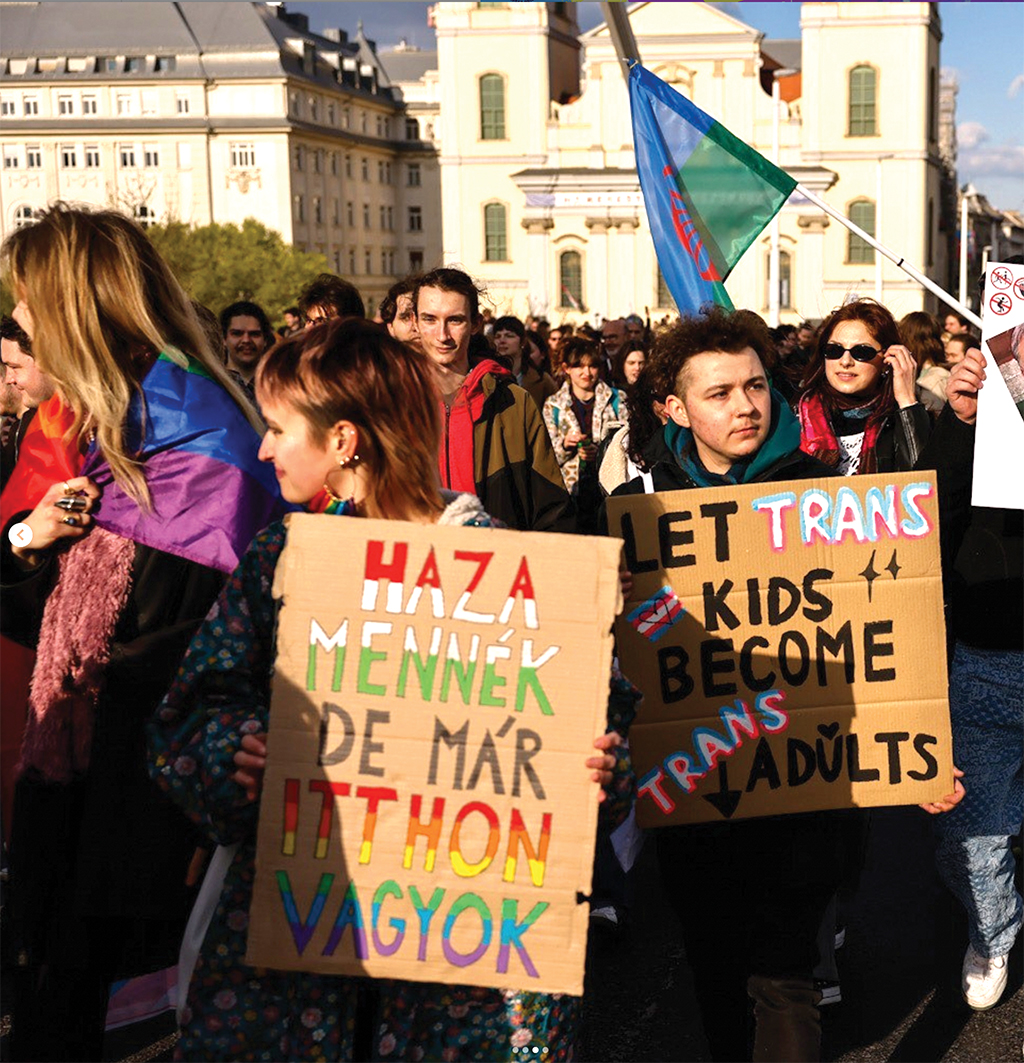
(L) Pride on the Liberty Bridge. Photo courtesy of Budapest Pride. (R) Rain Dove (bottom, right corner) among thousands of demonstrators. Photo by Rain Dove.
“At a banned Pride, you march like it might be your last moment alive as a queer person. And that makes every step matter,” Dove says. “No one is obligated to go beyond their capacity. But if organizers call for international support and you can go—go. These are your siblings. Their fight is your fight. Their freedom is your freedom.”
It’s still a marked difference from what Pride looks like in the U.S. and other western nations. That’s something Dove can’t overlook. “I worry western Prides are becoming too exclusionary—too tied to money, status, celebrity. When you need a wristband to feel seen, the movement loses something essential.”
Pride can still be a party, and for those who go for that, “enjoy it,” Dove says. “But don’t forget what you’re celebrating. And who still can’t celebrate freely.” After all, “Pride is a protest. It’s a refusal to disappear. At Budapest Pride, people risked their lives to say: We’re still here.”
Dan Tracer is a writer and editor with over a decade of experience in queer media. His work has appeared in Queerty, LGBTQ Nation, INTO, and GayCities, covering culture, politics, and the ever-evolving landscape of LGBTQ+ representation.
Rain Dove is a genderless activist, model and author known for their undercover work in places of protest and war. They strive to elevate deeply human stories from within movements, through acts of community service