

Meet Wilma Burgess, Country Music’s First Out Lesbian Singer
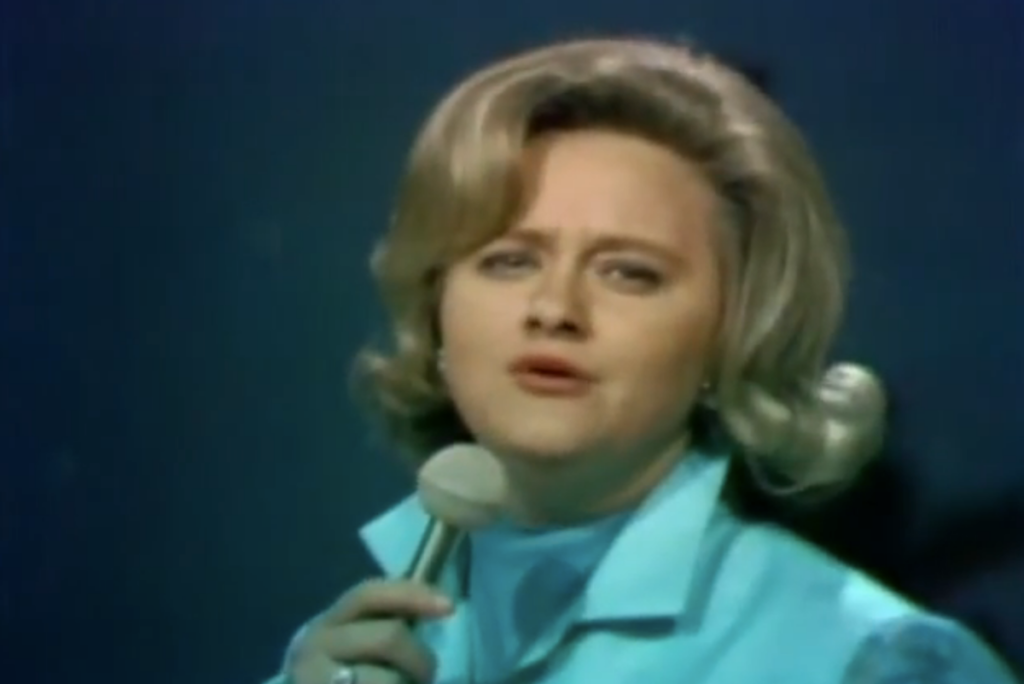
Wilma Burgess climbed the charts in the 1960s while breaking one of Nashville’s biggest taboos. Why is her name still overlooked?
Featured image: Screengrab courtesy of Facebook
If you only know one thing about Wilma Burgess, let it be this: she never pretended to be someone she wasn’t. In the middle of 1960s Nashville, where female country artists were expected to pose with male “dates” for the cameras and lean into songs about standing by their man, Burgess was showing up to industry events with her girlfriend.
And yet, Burgess carved out a career with unforgettable songs like “Baby” and “Misty Blue,” both aching ballads that hold up decades later.
Burgess grew up in Orlando, Florida, born in 1939, and fell in love with country music at an early age. Singing came naturally, but she didn’t dream of making it big. She studied to be a gym teacher, played her ukulele for her sorority sisters, and figured that was that.
But Nashville had other plans. A songwriter friend dragged her along to record some demos, and soon she was cutting singles. Her first, “Something Tells Me,” came out in 1962, and critics noticed immediately. Billboard called her voice “haunting and beguiling,” adding, “This can go.”
Related: Why Queer Representation In Country Music Is So Important
It did. Owen Bradley, the powerhouse producer behind Patsy Cline, signed her to Decca Records. To him, Burgess was a natural heir to Cline’s throne. She had the voice, the presence, and the ability to carry a song until it rattled your bones.
But Burgess didn’t play along with Nashville’s fantasies. She wasn’t interested in pretending to pine for a man in every song. She preferred lyrics that left space for listeners, whoever they were, to hear themselves in the music.
She compromised now and then. She recorded “Ain’t Got No Man,” but only after negotiating with Bradley that she’d get to pick a song of her own for every one she had to grit her teeth through.
Her colleagues knew why. She was gay, and she wasn’t hiding it. Songwriter Bobby Braddock remembers playing Scrabble with her, her mother, and her girlfriend. “She certainly didn’t want to hide [her sexuality] from us, you know. We all became friends,” he told the Have You Heard This One? podcast in 2023.
Burgess had fourteen songs chart between 1965 and 1973. She sang on the Grand Ole Opry, country music’s biggest stage, and even appeared in the campy Jayne Mansfield film The Las Vegas Hillbillies. But she was never invited to become a member of the Opry, something she hoped for but never saw happen.
Her nephew Wayne remembers her as unapologetically herself: “She was always, now that I look back on it, kind of butch, tomboyish, and stuff like that. For the most part, she was always in jeans. She loved golf, which I know is a stereotype. She was kind of rugged; she was not feminine around me. I don’t remember her ever wearing makeup in my presence,” he told Have You Heard This One?
By the late 1970s, Burgess had stepped away from recording. But she didn’t disappear. Instead, she helped carve out space for queer women in Nashville. She owned and performed at Track 9, a bar just across the street from The Women’s Room, which is believed to be the city’s first lesbian bar.
These were not easy spaces to run. Police raids and even Molotov cocktails weren’t unusual at queer venues in that era. Still, Burgess put herself at the center of it all again — not on a country stage this time, but behind the mic at her own club, welcoming a crowd that wasn’t used to having a safe place.
Related: Save A Horse, Ride A Cowgirl: 10 Queer Country Musicians
In her later years, Burgess shifted focus. She built a life with her partner and helped raise two young girls. Megan Davis, one of them, remembers her with love: “She helped raise me and my sister. So from the time I was about three years old, until she passed away when I was 13. So, a pretty good chunk of my upbringing. She was… the friend that you would call on. She was an amazing cook. Everyone still, to this day, like any of my friends who came over to stay the night or our family members…still rant and rave about her cooking. She was definitely one of a kind.”
Wilma Burgess died of a heart attack on August 26, 2003. Nashville’s mainstream press barely noticed. The Tennessean declined to run an obituary. But for those who knew her, or for anyone who listens closely to her recordings today, her presence still lingers.
When we look back now, Burgess is more than just a voice from the Nashville Sound era. She is proof that queer women have always been here, shaping culture even when the spotlight turned away.