


Court Delivers Stunning Setback to RFK Jr.’s Anti-Trans Care Push
A federal judge ruled that the Health and Human Services secretary exceeded his authority in targeting gender-affirming care for transgender minors, offering temporary relief to providers nationwide.
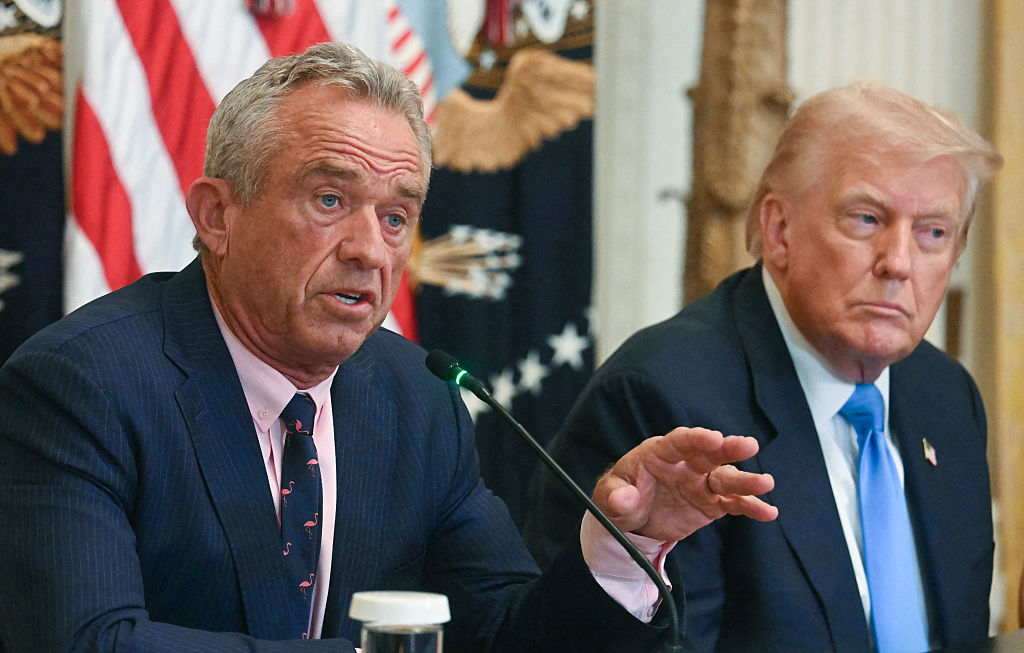
Featured Image: U.S. Secretary of Health and Human Services Robert F. Kennedy Jr. with Donald J. Trump (Photo by JIM WATSON/AFP via Getty Images)
Our trans siblings just can’t catch a break as they’ve been at the center of an ongoing wave of policy decisions and political debate, particularly under the Trump administration.
U.S. District Court Judge Mustafa Kasubhai ruled on Thursday that Health and Human Services Secretary Robert F. Kennedy Jr. overstepped his legal authority when he declared last December that providers of gender-transition medical treatments for minors “do not meet professionally recognized standards.”
According to the ruling, Kennedy attempted to restrict hospitals from providing gender-affirming care to transgender minors without following required administrative procedures. His declaration—now widely referred to as the “Kennedy Declaration”—was issued alongside a broader announcement from the Department of Health and Human Services proposing two rules targeting such care.
Those proposed rules, put forward by the Centers for Medicare and Medicaid Services, aimed to bar federal Medicaid funds from covering transition-related care for transgender youth under 19. They also worked to strip federal funding from hospitals that continue to provide gender-affirming care to minors.
For over a year now, the Trump administration has pushed to limit access to this care, making the same argument that young people will later regret medical interventions—completely ignoring the fact that regret rates are less than 1%. As a result, many clinics and hospitals across the United States rapidly scaled back or stopped offering gender-related treatments to minors altogether, producing uncertainty for patients, families, and providers alike.
Judge Kasubhai did not mince words in his decision. “The notion that ‘I will go forward and issue a declaration and see if we can get away with it’ is not a principle of governance that adheres to the overarching commitment to a democratic republic that requires the rule of law to be regarded and respected and honored as sacred,” he wrote.
He also rejected the federal government’s motion to dismiss the case—a significant move that allows the legal challenge to continue.
Still, the ruling offers only temporary relief. While it represents a setback for the administration, federal officials had already signaled plans to investigate institutions that continued providing gender-affirming care following Kennedy’s declaration. Those investigations included the possibility of cutting off Medicare and Medicaid funding.
In a statement, New York Attorney General Letitia James emphasized the broader impact of the decision, saying it shows that “health care services for transgender young people remain legal, and the federal government cannot intimidate or punish the providers who offer them.”
Court documents also reveal that officials within the Department of Health and Human Services have referred 13 academic medical institutions for investigation since the declaration was released. Those include NYU Langone Health, Seattle Children’s Hospital, Children’s Hospital Colorado, Lurie Children’s Hospital of Chicago, and Boston Children’s Hospital.
Advocacy groups were quick to respond. “Politicians, including RFK Jr., do not get to tell doctors how to do their jobs or families what decisions are best for their children,” said Kelley Robinson, president of the Human Rights Campaign.
Equality California called the ruling a “major victory for health care providers across the country, affirming that they can and should continue providing care to transgender youth.”
For now, the decision reinforces what providers and advocates have been saying: access to gender-affirming care remains legal, even as the larger fight over that care proceeds to play out in courts, hospitals, and policy debates nationwide.