

Lesbian Couple Takes Fight for Marriage Equality to Botswana’s High Court
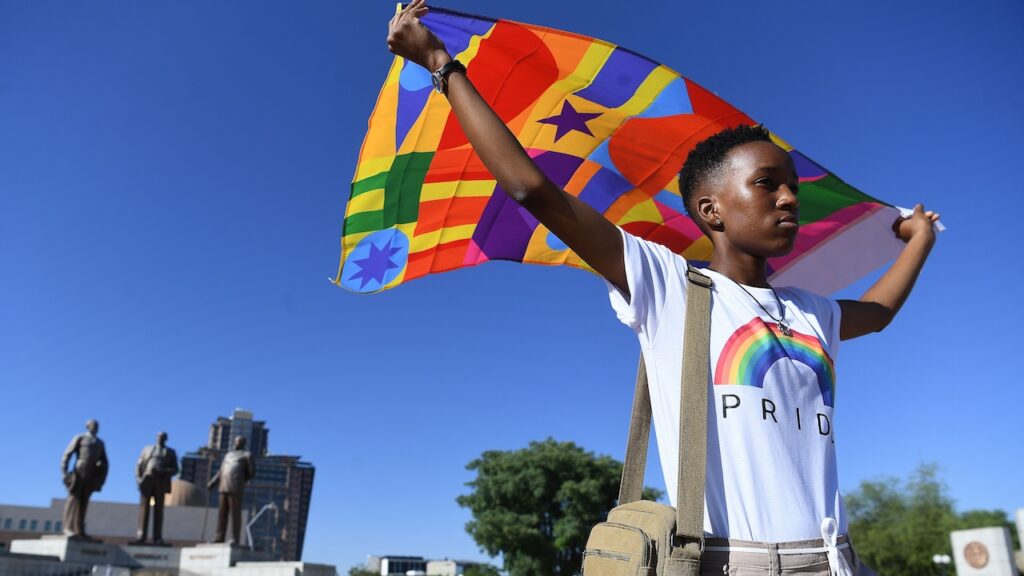
If the two women win their case, Botswana will become the second country in Africa to legalize marriage equality.
Next week, two women will present arguments at Botswana’s High Court to make their marriage legal. If they win, the country will become only the second in Africa with legal same-sex marriage, besides South Africa.
Bonolo Selelo, 41, and Tsholofelo Kumile, 39, met in 2022. They became engaged in 2024, according to an article jointly published by Spanish news outlet El País and the Middle Eastern and African outlet Egab.
“My fiancée and I seek to formally create a family through marriage. We seek to enjoy the same rights, dignity and recognition as heterosexual couples in Botswana, in relation to solemnising our marriage,” Selelo’s submission to the court read, according to the outlets.
The two women tried to register their marriage in 2024, but were turned away. The two are the first Black lesbian couple to legally challenge an African government over its marriage law. The hearing in the case is scheduled for July 14 and 15.
“Every citizen of Botswana deserves to have their personal freedoms respected and protected by law,” Kumile told reporters in March.
In an interview with The Guardian, she said that the rejection wasn’t a surprise. “It was kind of expected. But I don’t think they expected the response,” she said.
She said her wife, who is a lawyer, “does not back down.”
“We did have a frank discussion about it,” Selelo told The Guardian. “I said … I want us to get married, because I love you, but there’s also the practical part.”
Botswana’s government has said it can’t recognize the law, and that it isn’t unconstitutional for it to refuse to do so. Religious groups have also condemned the couple’s attempt.
For Selelo, she wants her wife to be protected if anything happens to her.
“I feel that I would be able to withstand a lot of legal pressure, but I wouldn’t want her to be harassed if I am no longer there to offer that protection. And, for me, marriage would give her that added protection that no other institution would be able to give her,” she explained.
The Southern African country decriminalized same-sex relations in 2019. An Arcus Foundation study from 2018 found that 42% of LGBTQ+ people in the country say they have faced physical violence in their lifetimes.
“Botho does not discriminate; it does not hate those who are different from you, but accepts diversity, which in turn contributes to the development of society as a whole,” Bradley Fortuin, program director at Southern Africa Litigation Center told El País and Egab. The organization has provided legal support for decriminalization and marriage equality in the region.
The case comes as other countries on the continent further restrict the rights of LGBTQ+ people. Last month, Niger’s military government introduced a set of laws criminalizing same-sex relations. Ghana approved a bill in May that will jail LGBTQ+ people. And Senegal strengthened its anti-homosexuality laws this year, as well.
While 32 out of 54 African countries allow same-sex relations, none except South Africa offer legal recognition of same-sex marriage.
After the hearing next week, the ruling will not be announced for several weeks.