

Inside ‘Cape Fear’s Most Unexpected Lesbian Love Story
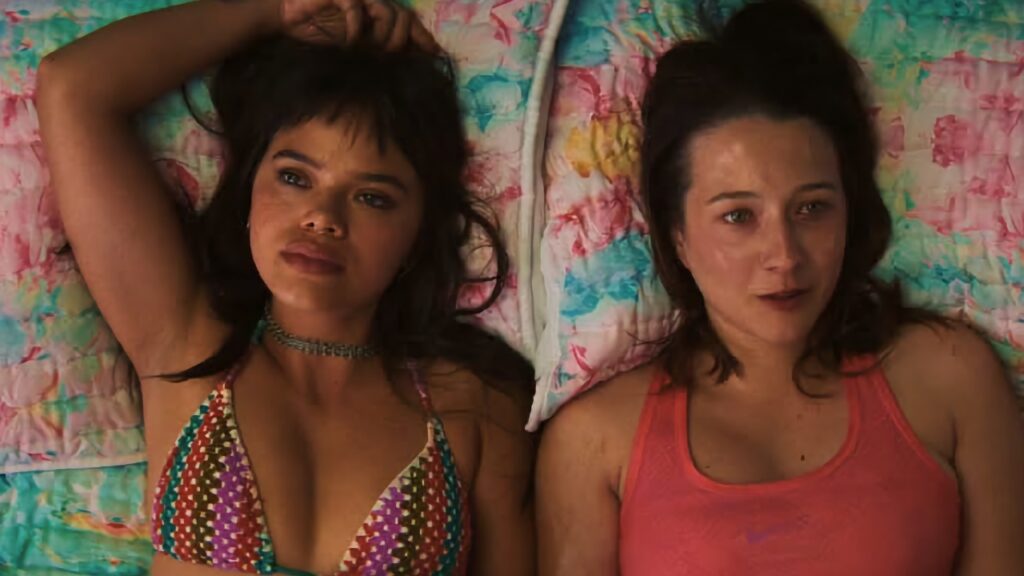
Malia Pyles and Lily Collias reveal how vulnerability, trust, and two “lonely girls” became the beating heart of ‘Cape Fear.’
“We found solace in our characters in a way that, even reflecting back, it’s hard for me to kind of see their relationship as anything but two young girls in love,” Lily Collias tells GO. It’s a beautiful, but somewhat surprising sentiment coming from the actress who stars as Natalie Bowden in the latest adaptation of Cape Fear, a twisty series that, at its dark heart, is about lies, betrayal, obsession, manipulation, and murder. Yet, somehow, it rings true.
The series takes inspiration from the 1991 film directed by Martin Scorsese, which was itself a reimagining of the original 1962 version of Cape Fear. We’re introduced to Anna (Amy Adams) and Tom Bowden (Patrick Wilson), two seemingly happily married attorneys whose stars are on the rise—that is, until Max Cady (Javier Bardem), an infamous murderer whom they were instrumental in putting behind bars, is released from prison.
Rather than quietly disappear to live out his second chance at freedom, Cady is hellbent on revenge against the two people he holds responsible for his incarceration—and his desire for vengeance may be justified. Caught in the crossfire are the Bowden children, Zach (Joe Anders) and Natalie (Collias), the latter of whom, in a departure from previous adaptations, is a lesbian who embarks on a relationship with a troubled young woman named Nevaeh Valentine (Malia Pyles), who has a nefarious agenda of her own.
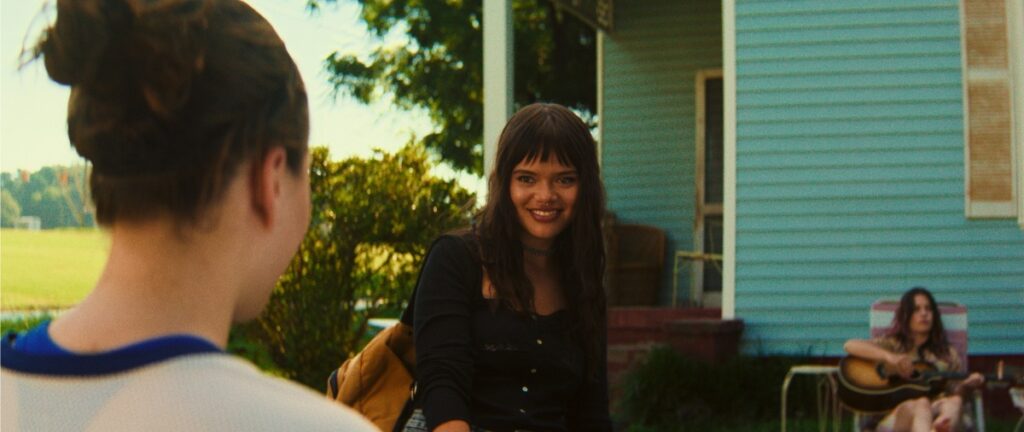
This addition is one of the biggest surprises of the new series, and their romance, rather than being a footnote, becomes one of the show’s emotional anchors. The contradiction at the heart of their love story—along with its level of inclusion and its impact on the plot and themes of the series—is not lost on the actresses themselves.
When GO sat down with Collias and Pyles, the actresses revealed that creating the relationship required enormous trust. “I was nervous about it all until I met her. We do such vulnerable, intimate things together that it really depends on who you’re working with. And I just got extremely lucky,” recalls Collias.
Pyles agrees that the two shared an instant connection, saying there was an “immediacy” to their friendship and relationship that helped them build the trust required to navigate vulnerable, intimate scenes from the very beginning.
“My audition scene, one of them was the pool scene, but it stopped before the iconic thumb moment happens,” Pyles says with a laugh, referring to the moment that has since gone viral, in which her character, Nevaeh, administers party drugs to Natalie by suggestively putting her thumb in her mouth before the two share their first kiss. “That was actually my first day of work, and that was the first time we had to work together—was me sticking my thumb in her mouth,” reveals the actress.
“And jokes aside, but sincerely, it is like this really intimate act and this kind of surrendering of self to each other, and that was only able to function if we had, like, a lot of trust and a lot of conversations around that particular moment,” she says.
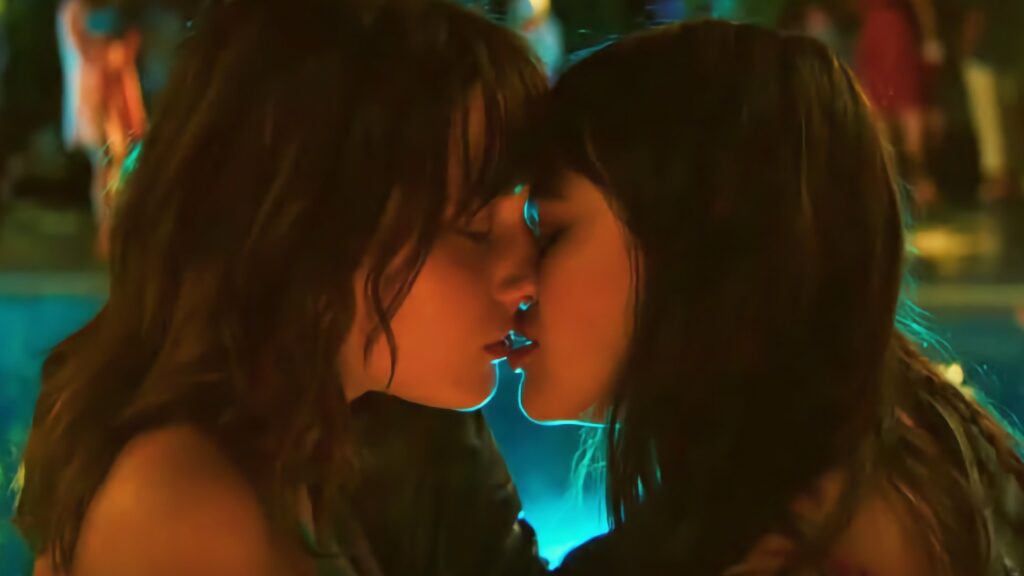
While the duo did have an intimacy coordinator on set, they also had strong communication between them, which Collias said was incredibly helpful in bringing those moments to life on screen.
“To have someone who I know not only cares for me as a person but my artistry, we were just really trying to uplift each other,” she says.
The scene has captured audiences’ imaginations, in part because of the undeniable chemistry between the actresses, but also because of the complicated, unclear layers of betrayal and manipulation at play. How real is the connection? How much of it is machination? For Collias, it’s both. “Navaeh was so manipulative. But to me, they really found each other and held on to each other in whatever way they knew,” she says.
Pyles also sees the dynamic between Natalie and Navaeh as a twisted love story. “There’s a lot unseen between the two girls,” she points out. “What the audience gets to experience—which I think is so important for the show—is kind of like the most heightened moments between the two girls. But, we talked a lot about the respect we mutually had for ourselves as artists, but then also just like the levity between these two young women, [whose] lives are constantly spinning out of control, and they’re so not in charge of their destinies in one way or another, and like how they kind of fall into each other.”
“It’s that fascinating thing of falling in love for the first time,” Collias adds. “I feel so blessed to be representing queer relationships in a way that’s multifaceted and doesn’t feel kind of like it’s put on paper just to be progressive or anything.”
For as complicated as this “love story” may be, the series completely sidesteps the typical complications of coming out or being closeted—common stumbling blocks for queer characters. Natalie and Nevaeh have plenty of secrets, hidden motives, and emotional baggage to puzzle through, but none of them are tied to their queerness.
“I had conversations with Amy and Patrick about Natalie’s development of her sexuality, and it was kind of like we all just were like, ‘No, we don’t think that this was ever anything bad,’” recalls Collias. “This was never something that needed to be a conversation that was intense for this family… It’s just real and honest, and I love seeing something like that being portrayed honestly.”
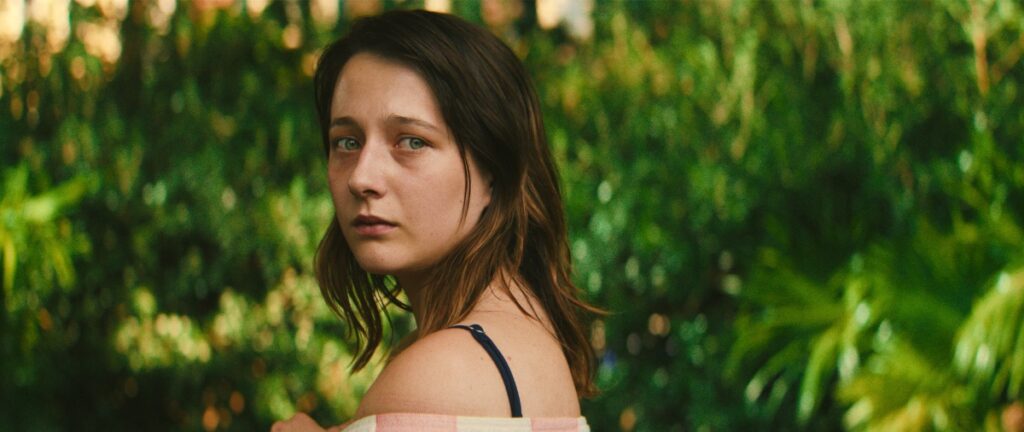
Pyles, who is openly queer herself, appreciated the nuance of her character’s sexuality. “Nevaeh is a character that has used her sexual prowess since she was a very young person to kind of get what she wants, and you see that not only with Natalie, but also with her storyline with Zach. So you see a girl operating in one way, in a way that she knows how to, and then kind of being disarmed by this experience, and then kind of like that creating a tailspin, and a lot of chaos ensues. Of course, when this person that has this one kind of goal in mind gets that goal derailed…”
Collias immediately finishes her thought: “…by honest love, that surprises someone who’s just been traumatized by the environment she’s been founded in.”
“Totally. Lonely girls. Lonely, abandoned girls,” Pyles says wistfully.
That’s not to say Nevaeh isn’t a toxic—or at times deeply destructive—character. But as Pyles puts it: “Everyone has an evil ex.”
While Nevaeh certainly qualifies for that title, the truth is that’s what makes the storyline between Natalie and Nevaeh so compelling. They aren’t aspirational or saccharine; they are achingly flawed and human. Add to that the performances and chemistry created between the actresses, and what could have come across in other hands as simply a toxic romance becomes something far more poignant: a story about first love, loneliness, and finding connection in the darkest and most unlikely of places.
Cape Fear is streaming now on Apple TV.