

HRC’s Kelley Robinson Warns 2026 Election Losses Could Set LGBTQ+ Rights Back ‘Generations’
Ahead of the 2026 midterm elections, the Human Rights Campaign is pouring $15 million to stop anti-LGBTQ+ politicians.
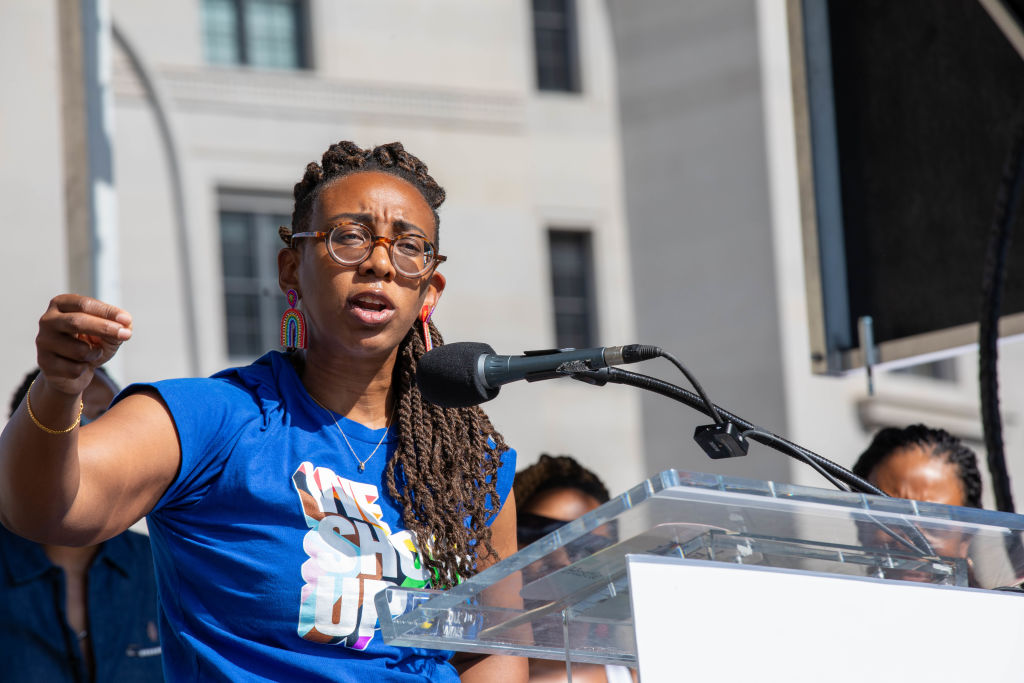
President of the Human Rights Campaign, Kelley Robinson, speaking onstage during the NBJC Equity March. Photo by Brian Stukes/Getty Images.
The Human Rights Campaign is serious about November’s midterm elections. The group, the largest LGBTQ+ rights organization in the U.S., is investing $15 million to try to flip eight battleground House seats currently held by Republican lawmakers.
That will be the most the organization has spent in a non-presidential election, according to Politico.
Failure to flip these seats could mean even more backsliding on LGBTQ+ rights in the U.S. that could take “generations to recover from,” warned HRC’s president, Kelley Robinson, in a recent interview with the political news outlet. The upcoming election, she said, is a “reality-check” in that it’s an opportunity to hold the Trump administration accountable.
“Half of our community is reporting that they have gone back into the closet in some area of their lives,” Robinson said. “This is a crisis that’s in front of us.”
The congressional districts HRC is looking to flip currently belong to GOP U.S. Reps. David Schweikert and Juan Ciscomani (Arizona), David Valadao and Darrell Issa (California), Tom Barrett (Michigan), Mike Lawler (New York), and Ryan Mackenzie and Rob Bresnahan (Pennsylvania).
How does she think HRC can win? Robinson told Politico those districts were won by about 150,000 votes in 2024. However, the organization found that 1.5 million “equality voters” — voters whom HRC identified as prioritizing LGBTQ-friendly candidates — could be mobilized to vote for progressive politicians. Additionally, she says there are already local organizers in those districts who are working for LGBTQ+ equality that the organization plans to collaborate with.
The HRC leader also blasted anti-trans political ads, which dominated the last weeks of the 2024 election and have become commonly used by Republican candidates. She notes that the organization’s research found that while many saw the ads two years ago, only 4 percent said the ads influenced their actual vote. Republicans now use anti-trans ads to distract voters and will appear again in the coming months, she told the outlet.
“These anti-trans attacks will come. They’re not effective in the way that you might believe,” she said. “What they’re not effective at is actually shifting votes to actually change voting behavior.”
“It doesn’t matter what party people subscribe to. It doesn’t matter where they live. Most Americans are concerned about the exact same things,” she added. “The trans issues are just not on the top of any of those lists.”
Robinson pointed to the success of Democrat Gov. Abigail Spanberger of Virginia as an example of how to respond to anti-LGBTQ+ attacks. The first woman governor of the commonwealth, Spanberger directly called out her Republican opponent’s anti-marriage equality history. Robinson also mentioned Omaha, Nebraska, Mayor John Ewing Jr., who ran an ad saying his GOP opponent was “focused on potties” while he was “focused on fixing potholes.”
“There isn’t a message box that you have to use on these issues. You just have to be authentic in speaking clearly from your perspective and to your constituents,” she said.
While the 2026 midterm elections are close at hand, Robinson had some advice for any 2028 presidential hopeful.
“We’re at a time where extremism is getting too much of a megaphone and a stage all across this country,” Robinson said. “What I want to see anyone who’s running for office do is lift up the stories of our community that matter and the things that we’re thinking about every day.”
Any 2028 presidential contender needs to prioritize equality for all, Robinson said.
“As a baseline, anybody that wants to be president in 2028 needs to stand for the civil rights and protections of every person in this country,” she said. “And yes, that includes trans people.”