

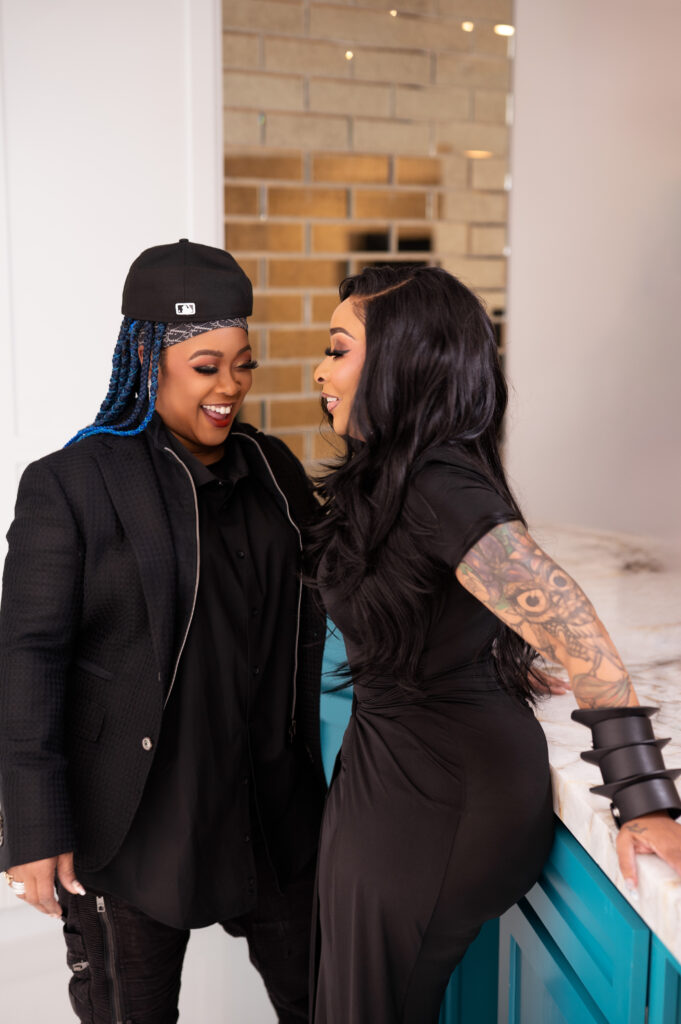
Da Brat and Judy Harris-Dupart Share Their Relationship Story in New Memoir, ‘The Way Love Goes’

The power couple gets candid about communication, dealbreakers, vulnerability, and building a lasting queer relationship.
Featured Image by Charlton Inije, Inije Photography
Every great love story starts somewhere between chaos and intention. Sometimes it’s spilled Hennessy. Sometimes it’s dropping your lit blunt in embarrassment. Sometimes it’s realizing the person you love needs time you don’t yet know how to give, yet you choose patience anyway.
For Da Brat—hip-hop trailblazer, cultural mainstay, and the first solo female rapper to earn a platinum album with her 1994 debut Funkdafied—and Jesseca “Judy” Harris-Dupart—CEO of Kaleidoscope Hair and a self-made multi-million dollar beauty entrepreneur—love didn’t arrive as spectacle. It arrived as a decision.
In their joint memoir, The Way Love Goes, out February 3, the couple isn’t here to convince readers that love fixes everything or that chemistry alone is enough. Instead, they offer something far rarer: a love story that feels lived-in and self-aware. The couple understands that for queer women navigating visibility, faith, timing, and desire, love is less about fireworks and more about fit.
“We’re big on transparency,” Judy tells GO. “Open conversations about conflict [and] resolutions, [because] nothing is all roses and butterflies all the time.” There’s relief in hearing that stated plainly.
“It’s important to stress that this is a regular relationship,” Da Brat underscores. “No relationship is perfect, and you have to work at happiness.” That work starts with abandoning one of the most persistent myths about love: loving someone harder will somehow make everything align. Well, it won’t.
Related: Jerrie Johnson And Dria Brown: The Creative Power Couple Who Are Better Together
“You can love somebody,” Judy says, “but some situations [are] not gonna work.” She describes scenarios that feel uncomfortably familiar—when emotional needs and real-life capacity don’t match. If your love language is quality time, but your partner cannot give it consistently, affection alone doesn’t close that gap. Desire doesn’t override reality. Compatibility requires structure, not just feeling.
This is where The Way Love Goes begins to read less like a celebrity memoir and more like a relationship blueprint. Both women had lived enough life before finding each other to recognize patterns early. They knew what they wanted, and now they’re here to share those lessons with you, through the golden rules they share throughout the book.

One of their essential rules, Determine Your Dealbreakers, explains that non-negotiables shouldn’t be discovered after devastation; they should be named early. Judy recalls a past relationship where a partner refused to attend her favorite R&B artist’s concert because they had nothing to wear. Judy stayed back in solidarity, only to later learn her partner went anyway…with someone else. It was not only betrayal, but it was also inconsiderate. Moments like that allowed Judy to learn that being emotionally careless wasn’t a flaw to negotiate around.
Clarity didn’t make them rigid. It made them prepared. By the time Da Brat and Judy found each other in 2017, both women had language for their needs and boundaries for their peace.
That clarity also helped them understand how each gives and receives love. Judy’s love language is gift-giving. Da Brat’s is acts of service. Simple on paper but surprisingly layered in practice. Da Brat admits she initially struggled with receiving gifts comfortably, especially after watching people take advantage of Judy’s generosity in the past. Her instinct was to refuse rather than receive, to protect rather than accept.
“I had to learn how to start accepting,” she says. “I don’t want her to have to clean, wash dishes, do anything,” she continues, “She creates. She has a company to run. Taking care of her makes me happy.”
Belief, in their telling, is the prerequisite for openness, rather than the reward after it. There is no vulnerability without trust, one of the memoir’s most powerful threads and crucial rules, follows Da Brat’s long journey toward coming out publicly in March of 2020 after decades in the spotlight. At the height of her early career, openness felt dangerous.
Related: Nine Sapphic Reads For The First Half Of 2026
“At that time, same-sex relationships were taboo in both the hip-hop and the Black communities,” she shares in the memoir. “There was no way I could live as an out Black artist despite the fact that there were rumors that I was gay. I knew better than to say anything that would confirm the gossipers. Coming out would have been career suicide.”
She points to the backlash Ellen DeGeneres faced after coming out as proof that fame didn’t guarantee protection. If a white mainstream star could be professionally punished for honesty, she reasoned, the consequences for a Black woman in hip-hop could be devastating.
“There is no vulnerability without trust,” she writes. Finding Judy changed the risk calculation. For Judy, who had long lived openly as a queer CEO, mother, and public figure, honoring Da Brat’s timeline meant restraint.
“I was still transparent with my community,” Judy explains. “But my love life wasn’t a topic of conversation at the time.”
When the moment finally came, it was a series of open conversations between the couple. They chose the photos for their coming out post together and checked comfort levels repeatedly.
“I realized she was ready,” Judy says. “And the only reason I did it was because she said she was okay.”
Da Brat recalls bracing for impact—stepping outside, needing a cigarette, preparing for backlash. What followed instead was affirmation. Relief. A loosening she hadn’t realized she needed.
“It was like a weight off my shoulders.”
Communication—they stress in another golden rule, Listen to each other—is what made that moment possible. Listening, in their framework, is not passive but disciplined. It requires slowing reactions, watching tone, reading body language, and hearing intention beneath imperfect wording. They describe learning when to pause conversations, when to revisit them, and when to simply sit with what the other person is expressing instead of immediately defending their position. Being heard, they suggest, is often more transformative than being agreed with.
Savor the slow burn, another golden rule, makes space for desire, but frames it through patience rather than spectacle. They write about the early stretch of their relationship when attraction was obvious, but physical intimacy was deliberately paced. Sharing a bed without rushing into sex. Noticing one another. Building tension. Letting anticipation mature. Now, their sex life is “so wonderful.” Judy shares in the book. “We both have giving personalities, and that shows up in the bedroom…We are mindful of our body language and take cues from each other before and during sex.”
Faith and synchronicity thread through their story in quieter ways. They call each other twin flames. They chose 2.22.22 as their wedding date—a once-in-a-lifetime numeric alignment. The planning, however, was anything but serene: multiple planners, multiple states, castles that almost worked, and a final venue chosen just a week before.
“It was the most stressful thing of my life,” Judy laughs.
Related: How Cat Disabato Turned Her WNBA Obsession Into a Sapphic Romance Novel
Now, with a memoir, reality television, and shared ventures, their life unfolds partly in public, but with deliberate boundaries. Especially when it comes to their child, True Legend Harris-Dupart, whom they welcomed in July of 2023, privacy is essential.
“I’ve learned to have a degree of separation,” Judy says. “Some things are reserved. Protected.”
That ethos feels like the emotional thesis of The Way Love Goes. Love, as they define it, isn’t loud. It isn’t constant disclosure. It isn’t performance for public consumption. It’s a practice, a discipline, and a daily choice reinforced through listening, trust, patience, and truth-telling.
In a culture that still insists queer love must be either tragic or transcendent, Da Brat and Judy offer a third option—love that is steady, intentional, emotionally literate, and real.
Grab a copy of “The Way Love Goes” here!