

Lesbian Nobel Peace Prize Winner Maria Ressa Warns Tech Bros Are The Biggest Threat to Democracy
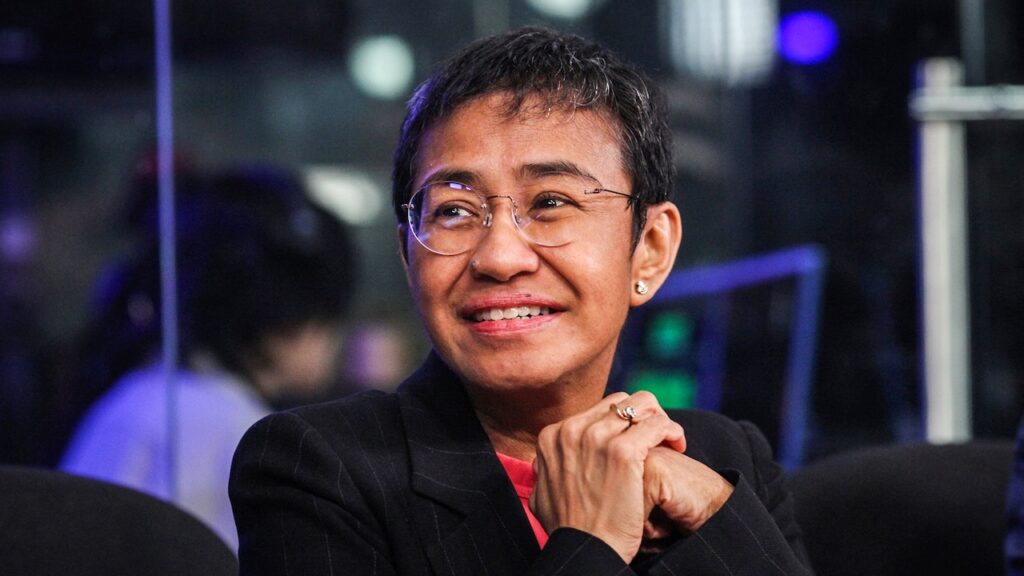
The outspoken queer Filipino-US journalist has a new book on fighting against the ever expanding tyranny of authoritarianism and the tech industry’s influence.
Long-time investigative journalist Maria Ressa has been fighting authoritarianism more closely than most.
The co-founder and CEO of the Filipino independent news outlet Rappler won the Nobel Peace Prize in 2021, sharing it with Russian journalist Dmitry Muratov, “for their efforts to safeguard freedom of expression, which is a precondition for democracy and lasting peace,” according to the Nobel Prize website.
Rappler documented the human rights violations the Philippines’ former President Rodrigo Duterte and his administration committed in its infamous drug war. The outlet specifically covered how social media was used in generating mass amounts of fake news, to target Duterte’s opponents, and influence public opinion.
That made her and her media outlet a frequent target of Duterte and his government. Ressa faced a number of criminal charges that human rights around the world condemned as politically motivated.
“Rather than flee or capitulate, she posted bail 10 times and turned her courtroom battles into an international campaign for press freedom,” the Guardian reports.
And while Duterte has been arrested by the International Criminal Court and awaits trial for crimes against humanity, Ressa is still warning against authoritarianism, saying the threat is now widening.
That’s especially true in the U.S.
“What took Hungary’s Orbán four years, Serbia’s Vučić eight years, India’s Modi and Turkey’s Erdoğan a decade, Trump accomplished in one year. Legislative constraints lost one-third of their value in 2025, the lowest in more than one hundred years. As in the Philippines, Congress has effectively abdicated its oversight role. At least 55% of the 320 objectives set out by the far-right Heritage Foundation’s Project 2025 have already been achieved,” Ressa writes in Fight Back: A Citizen’s Guide to Standing Up to Dictators, her latest book.
According to the Guardian, she writes that technology is largely to blame for eroding democratic values.
“There are two dictators in my story: Duterte and Zuckerberg. This is not hyperbole. This is a statement about power, accountability – and impunity – in the 21st century,” Ressa writes.
She told the outlet that big tech is the biggest threat to democracy.
“Because they themselves, the CEOs, are now saying: stop us. That’s kind of performative. You can stop yourself! You’re the one building this,” she said.
Ressa said that the basis for technology does not rely on facts, but on a “probabilistic” nature.
“It’s a probabilistic machine, which actually discounts facts. When you put that as the operating system of public information you create what we’re living through now. Then they made it worse because they added algorithms that will keep you scrolling longer so that means fear, anger, hate. It is the worst of who we are,” she said.
She went on: “The incentive structure of our world changed with big tech. I always say to my friends who have kids: imagine if you keep telling your child, ‘Lie. I’m going to keep rewarding you, and then keep lying and I’m going to keep rewarding you.’ What kind of adult does your child become? That’s the world we’re creating.”
For her, the new tech bros are dictators.
“They make decisions for us without our inputs, without any accountability, and it impacts all of us,” Ressa said. “This is a public safety issue. It’s like taking the lead out of your water. Every day that governments do not regulate, they lose more and more of their power.”
While she said the response to the killings of Renee Good and Alex Pretti in Minnesota gave her some hope, she warns that things are still a threat.
“I’m going to keep sprinting, and it’s been a decade of sprinting. If we don’t get this right in the next few months, the French elections are in April; we already saw what’s happening in Germany,” Ress said. “If we don’t get this right, the world will fundamentally change and it will be far more difficult to claw back rights. In which case, I’m going to go be a hermit somewhere.”