


Lesbian Filmmakers Spotlight Faith Leaders Resisting ICE in New Documentary

From protesting ICE detention centers to reuniting separated families, Faith on the Front Lines follows clergy members taking their fight for immigrant rights from the pulpit to the streets.
It all started with a Brandi Carlile concert.
Cheryl Griffin-Allison, director of the new documentary Faith on the Front Lines, and her wife, the Rev. Rachel Griffin-Allison, had seen Carlile perform at Red Rocks Amphitheatre in Colorado last year.
“Towards the end of her concert, she premiered her song ‘Church and State,’ which she had never performed live before,” Cheryl recalls. “I would say it’s a protest song. And she challenged all of us in the audience to do something [about the misdeeds of the Trump administration].” She said, ‘I know it feels overwhelming right now, but just do something. Find something you can do.’”
“So on the long drive back to Dallas the next day we started talking, and we were talking about all of the human rights violations, and that you just get hit every day with something else,” she continues. “And we started talking about the pressures that faith leaders feel dealing with all of this, and we started talking through the responsibility of faith leaders, and we started talking about the past. Like, what did faith leaders do in the past during World War II? And I don’t really recall ever reading about that. And throughout that conversation, we just said, you know what, we should document this, and we should find out what’s going on with our own, with Rachel’s colleagues and fellow faith leaders and justice fighters, and that was what planted the seed for the film.”
Faith on the Front Lines, which will premiere Sunday, November 1, in Dallas, shows how faith leaders are standing up to the brutalities of Immigration and Customs Enforcement (ICE) and assisting immigrants around the United States. It documents anti-ICE protests in the Chicago area and Washington, D.C., and how Rachel Griffin-Allison’s church, Oak Lawn United Methodist Church in Dallas, reunited a Venezuelan family after two members were deported.
Early in the film, Rachel, a sixth-generation Methodist pastor (and the first woman and first lesbian among them), goes through some sermons and other papers left by her forebears. Her great-grandfather wrote a sermon during WWII pointing out the challenges the U.S. was facing at the time. Also in her files is a Methodist magazine with an article about missionaries ministering to Japanese Americans in the camps where they were incarcerated during the war because the American government considered them a security threat.
“I hear church members say things like ‘I don’t recognize my country right now. This doesn’t seem like who we are,’” Rachel, who produced the documentary with her wife, says in the film. “And the more I thought about where we have been in history, the more I think, ‘Yeah, this is who we have been, and it’s not the best of who we are called to be, but it’s not the first time we’ve been here.’” What happened to Japanese Americans is not too different from what’s happening to so many immigrants today, she points out.
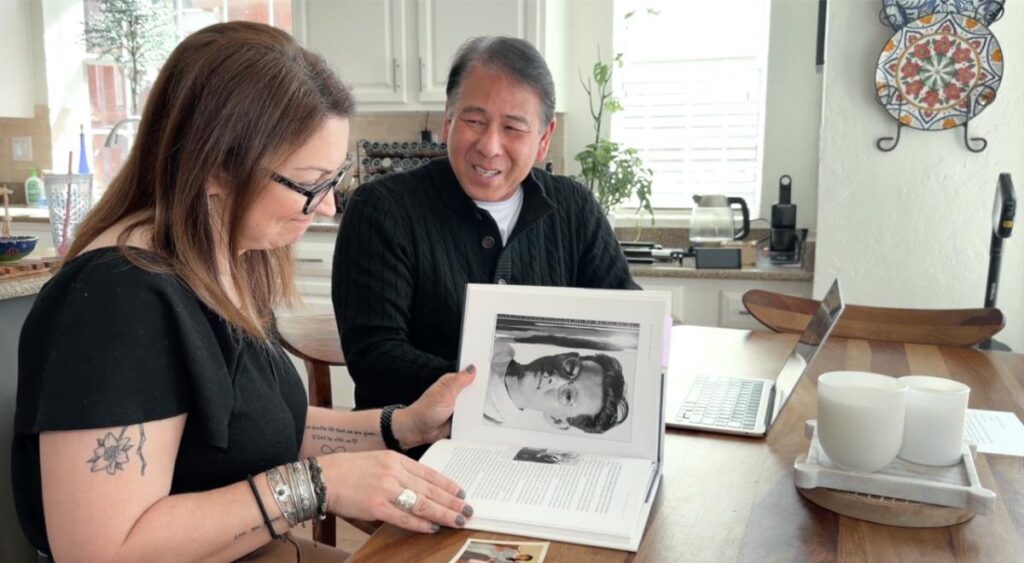
Among the people interviewed in the film is a man whose mother and grandmother were held in the camps—the Rev. Don Lee, a retired Methodist minister in Texas; he was pastor to Cheryl’s parents for a time.
“He was willing to sit down with us, and that became really such a beautiful interview,” Rachel tells GO! “It added so much history and depth and heart to this whole story.”
“These were concentration camps,” Lee says in the movie. “‘Internment’ sounds so soft, but these were prison camps. They were fenced in with barbed wire. In my mother’s case, Heart Mountain, Wyoming, had nine guard towers that were staffed by armed soldiers. And so it was a prison camp.”
His grandmother never talked about the camp, but his mother, who was very young at the time, shared a few stories. She told of the fear she felt boarding the train she would ride to Wyoming from Southern California—the first train she ever saw, and she thought it was a dragon, Lee recalls. She also noted the hardship of going from the warmth of Southern California to a bitterly cold climate without proper clothing. And before going to Wyoming, she and the other Japanese Americans who headed there spent a week at a racetrack in California—in horse stalls. Before his mother and grandmother were taken away from their home, he adds, FBI agents came in and removed any photographs, letters, and other memorabilia related to Japan.
“Knowing the history and what the law allowed our government to do, and then having been through that experience, and then for our sort of national consciousness to say, ‘We’ll never do that again,’ and then to see what surely feels like the same process happening now, it feels so similar to a place we never thought we’d go again,” Lee says.
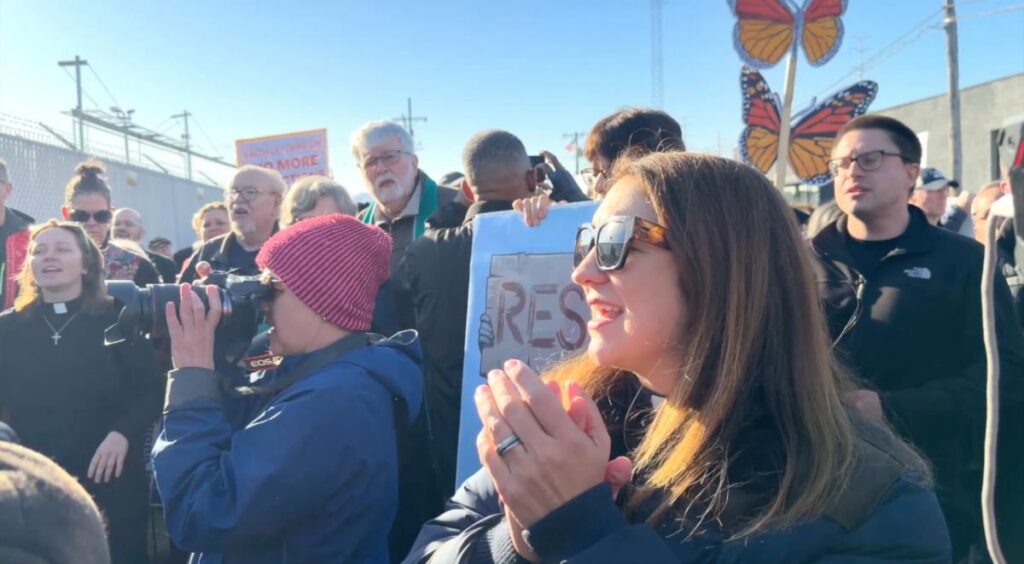
The Griffin-Allisons feature several other clergy members in the film, including the Rev. Britt Cox, a lesbian who’s associate pastor of the First United Methodist Church in Evanston, Illinois, a suburb of Chicago. Cox and the Griffin-Allisons, along with many others of different faiths or none at all, protested at the ICE detention center in Broadview, another Chicago suburb.
A federal judge had declared the conditions at Broadview “deplorable and inhumane,” with the people held there “denied medical care, clean places to sleep, sufficient food and water, access to toilets and translators, and of course, denied pastoral care, which is their right to religious expression,” Cox says in the film.
“My faith tradition is really clear in what to do in moments like this,” she tells GO! “Even though these are really scary times, the Bible and Scripture [are] very clear about how to act and what to do and how to respond. It’s to love our neighbor, welcome the stranger, care for the immigrant and refugee. The Bible doesn’t say anything about kidnapping families. It doesn’t say anything about creating a militia to round up people, about restricting food and medical access.”
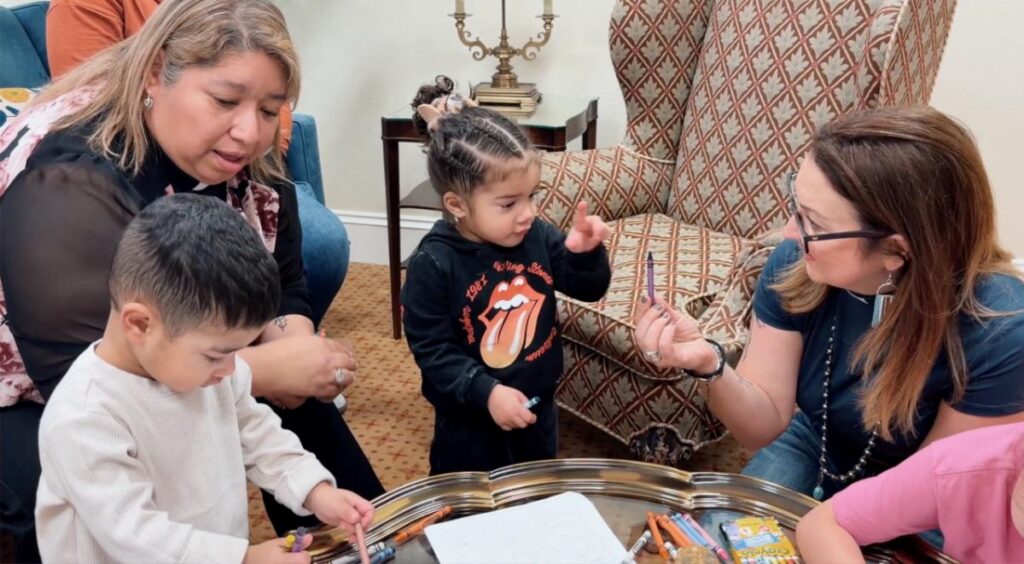
Also playing a large role in the film is Rachel Griffin-Allison’s associate pastor, the Rev. Isabel Marquez-E, who worked with a woman named Yaliska, whose husband and sister had been deported, the husband to Colombia and the sister to Venezuela. The whole family had been seeking asylum in the U.S., going through the proper process, but it had become dangerous to show up for court hearings. Yaliska was left with her sister’s two-year-old twins as well as her own three children.
The church took the family in for 230 days while Marquez-E went through the complicated process of obtaining proper documentation for the children so the family could be reunited. For a while, the Griffin-Allisons were unsure if the family’s story would be included in the film, because they weren’t sure the situation would be resolved. But it was, with a happy ending.
Other clergy members featured in the film are the Rev. Jonathan Grace and the Rev. Abby Holcombe of Urban Village Church in Chicago, Minister Christian Watkins of Asbury United Methodist Church in Washington, D.C., and the Rev. Ginger Gaines-Cirelli of Foundry United Methodist Church, also in Washington.
The filmmakers and ministers emphasize that their work isn’t politicizing religion, although it is the polar opposite of the “Christian nationalism” embraced by the religious right. The film uses images of Donald Trump making anti-immigrant statements, contrasting them with faith leaders’ efforts to aid immigrants, and people may call that political, but it’s not, Cheryl says.
“We can debate policy,” she says. “People can debate that and argue that, but you can’t debate and argue what’s happening in our society and in human rights. That’s what I feel like this film is about. This is not one of our pastors in this film who says, ‘Wow, you know, the right wing is awful. We shouldn’t vote for them.’ They don’t say that. They’re talking about people that are being wounded and hurt, and [being] stripped of their rights and so demeaned, and that’s what it’s about. It’s like Rachel says, there’s a seat for everyone at the table, and it’s about love.”
The Griffin-Allisons and Cox, like the others in their film, have long had sympathy for marginalized communities. “The generations of faith leadership that I come from have taught me to act through a lens of love, and I’m really grateful for that,” Rachel says.
Cheryl notes that all her films are about human or animal rights. They include Shatter the Silence, about sexual violence; Pieces of Us, dealing with hate crimes; and Honk, about an abandoned goose. “That’s my activism, and I think that was sparked from the fact that I’m a gay woman,” she says.
“As a queer person,” Cox says, “I know what it means for my own belonging to be up for debate constantly. And so while my experience is not the same as those who are undocumented in any way, it has taught me that when that rhetoric shows up, the danger is real behind those words. I think about my own lived experience and how in any other situation, this could be queer people. This has been queer people. This has been the Black community. This has been women.”
She also recalls that when ICE descended on Chicago and Evanston, it was during a church service, and she could hear cell phones going off with the news throughout her congregation. “I could see people looking up at me, and like my prayers were just words, right?” she says. “And so if my prayers stopped there and didn’t pull me and my congregation out into the streets, it’s just lip service to what we’re preaching. That was such an impactful moment.”
The clergy members and churches featured in the film are no strangers to activism. Oak Lawn United Methodist Church, located in Dallas’s gayborhood, made national news last year when the Griffin-Allisons and the congregation painted the steps to the church in rainbow colors, clapping back against the Trump administration’s ban on rainbow crosswalks. As a private property, the church wasn’t subject to the ban, but it’s a historic landmark in the city, so it had to get approval from the Dallas Landmark Commission—which it did. And the rainbow steps are an important symbol to the community that all are welcome, Rachel says.
The film offers some optimism that those standing up to the actions of ICE and the entire Trump administration will make a difference. “Rachel and I were very adamant to end it with a feeling of hope,” Cheryl says. It was “an intense weekend” documenting the Broadview protests, she says, but “I was so moved and so full of some kind of warrior hope when I watched Britt and her fellow faith leaders there in the Chicago area, and it made me feel like we’re in this together and we’re going to do this, and I hope that people take that away from the film.” She hopes audiences will leave “with a sense of motivation to get involved.”
After Faith on the Front Lines premieres Sunday in Dallas, the Griffin-Allisons plan to enter it in film festivals and make it available via video on demand. The screening will take place at 6:30 p.m. at Angelika Film Center. Tickets are available here. Powered by People, a Texas-based progressive organization, will be on hand to provide nonpartisan voter resources, including precinct information, voting locations, and more.
Watch the trailer below: