

Who Wants Cops at Pride? New Report Shows It Depends on Who You Ask
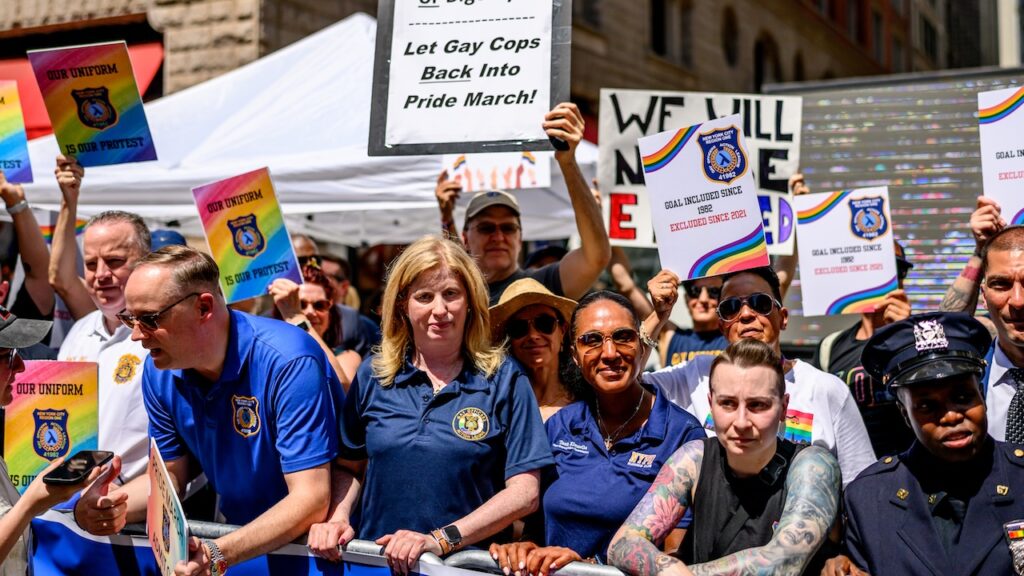
Less than half of LGBTQ+ respondents say they support a police presence at Pride, according to a brief by the Williams Institute.
The Williams Institute at the University of California Los Angeles School of Law published a research brief this week exploring how LGBTQ+ people view police participation at Pride events.
In recent years, police officers at Pride events have brought mixed receptions across the country. In the report, under half of respondents (48%) support police presence at Pride, while 19% opposed their presence. Thirty-three percent said they were ambivalent.
“For much of U.S. history, LGBTQ identities and behaviors were criminalized through laws targeting same-sex intimacy, gender nonconformity, public gathering, and sodomy. Collective memory of police raids on LGBTQ spaces continues to shape tensions surrounding police engagement with LGBTQ communities,” the Williams Institute brief states.
The research group highlighted LGBTQ+ resistance to police harassment, such as Cooper Do-Nuts in L.A. in 1959, which saw queer patrons throw donuts, coffee, and garbage at officers raiding the establishment. They also highlighted the Stonewall Uprising in 1969, which saw queer people protest for several days against a police raid.
“Unlike the police raids that catalyzed early LGBTQ demonstrations, contemporary police presence at Pride events is often formalized through municipal permitting processes or invitations from organizers seeking to promote safety and inclusion. For some LGBTQ people, police participation in Pride represents progress in police-community relations and protects attendees from anti-LGBTQ protesters. Others view police participation as a form of “pinkwashing” that obscures ongoing historical and present-day patterns of police violence and discrimination against LGBTQ communities,” the brief explains.
The institute notes that queer people, overall, view the police more negatively than non-queer people. LGBTQ+ individuals are also less likely to willingly interact with police. Trans people have reported negative experiences with police, including intentional misgendering, assumed criminality, and other forms of gender-based discrimination.
Using data from 2022, the Williams Institute found that support for police participation is most favored by lesbian and gay people at 60%. Queer-identified respondents were not only less supportive at 44%, but they were also the most likely to actively oppose police presence, at 33%, more than twice the opposition rate of lesbian and gay respondents at 14%. The institute found that only 37% of those who identified as trans and nonbinary favored police participation. They were also about three times more likely than cis respondents to oppose it.
The group notes that respondents’ definition of “participation” could vary, since police involvement could mean a security presence at the event or direct participation like marching in a Pride parade.
There are also age and class distinctions within the Williams Institute’s report. One in three LGBTQ+ adults ages 18-29 supported police presence at Pride. For older adults, that number was between 53 to 64%. Meanwhile, 60% of LGBTQ+ people with a high socioeconomic status supported police participation compared to 47% with low socioeconomic status.
“There is a need for continued dialogue and research on LGBTQ people’s perceptions of and experience with police, including police participation in Pride events and broader questions of safety, inclusion, and representation within LGBTQ communities,” the brief states.