

Menaka Guruswamy Poised To Become India’s First Openly Lesbian MP
Her expected election to India’s equivalent of the Senate would mark a historic first for queer representation.
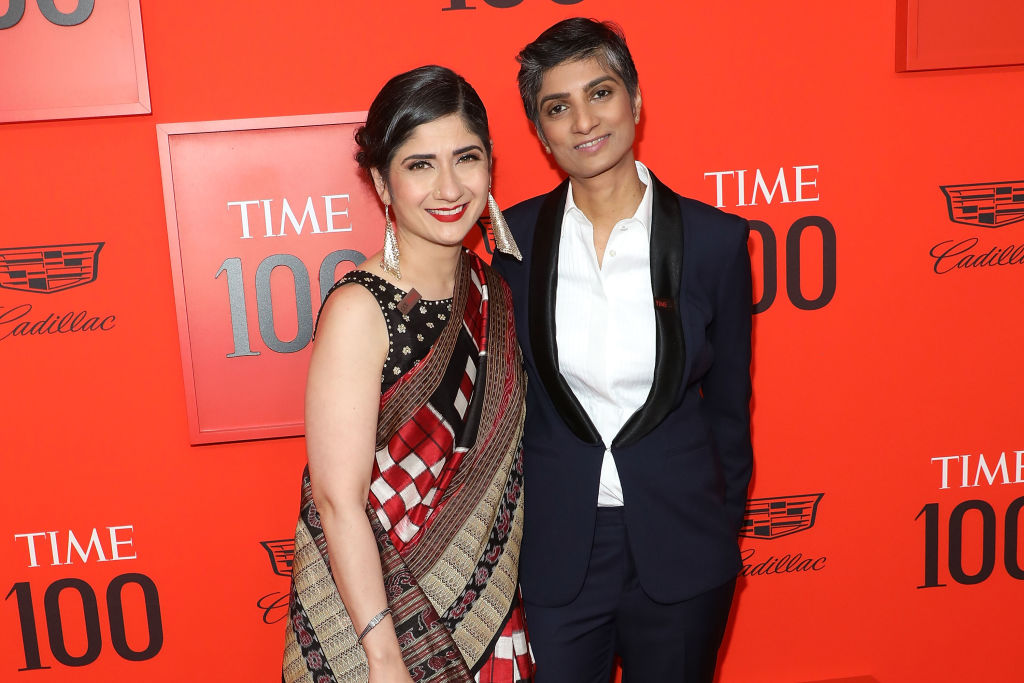
Featured image: Arundhati Katju (L) and Menaka Guruswamy (R) attend the 2019 Time 100 Gala at Lincoln Center in New York City. (Photo by Taylor Hill/FilmMagic)
In India, members of the Rajya Sabha, the upper house of Parliament, are elected by state legislators rather than by direct public vote. And when the All India Trinamool Congress recently announced its candidates for the upcoming Rajya Sabha elections, it was more than routine political news. Among the nominees was Menaka Guruswamy, a senior constitutional lawyer whose election would make her India’s first openly lesbian Member of Parliament.
Guruswamy is not a career politician. She is a senior advocate at the Supreme Court of India, where she has spent decades arguing complex constitutional and human rights cases. Her legal work has ranged widely, from cases addressing state-backed militia violence to bribery to bureaucratic reforms. She has also been involved in litigation affirming the constitutional right to free and compulsory education for children.
Related: Lesbian Lawmaker Angie Craig Kicks Off Groundbreaking Senate Campaign
But it is the Section 377 case that made her a national figure.
For over a century, Section 377 of the Indian Penal Code criminalised what it termed “unnatural offences,” effectively targeting consensual same sex relationships. In 2018, a five-judge Constitution Bench delivered a landmark verdict partially striking down the provision and decriminalising consensual same sex relations between adults. Guruswamy was among the lawyers who framed the case around dignity, privacy and equality, arguing that the Constitution could not tolerate the criminalisation of love.
In court, she told the Bench, “How strongly must we love knowing we are unconvicted felons under Section 377? My Lords, this is love that must be constitutionally recognised, and not just sexual acts.”
Related: India High Court Affirms LGBTQ+ Rights By Recognizing Chosen Families
The line was widely quoted, and the judgment that followed was a defining moment for India’s LGBTQ+ movement.
In the months after the verdict, Guruswamy publicly acknowledged her relationship with fellow advocate Arundhati Katju. And her visibility has also extended beyond India. In 2019, she was named to the Time 100 list of the world’s most influential people. Harvard Law School recognised her in a portrait exhibition celebrating women inspiring change. At Oxford’s Rhodes House, she became the first Indian and the second woman to have her portrait displayed at Milner Hall.
Now, her career may be taking a new turn. If elected, Guruswamy will move from arguing constitutional principles in court to helping shape legislation inside Parliament. And unless an unexpected contest emerges, her election appears almost certain.