

Trailblazing Lesbian Surfer Pauline Menczer Gets Long-Overdue Statue
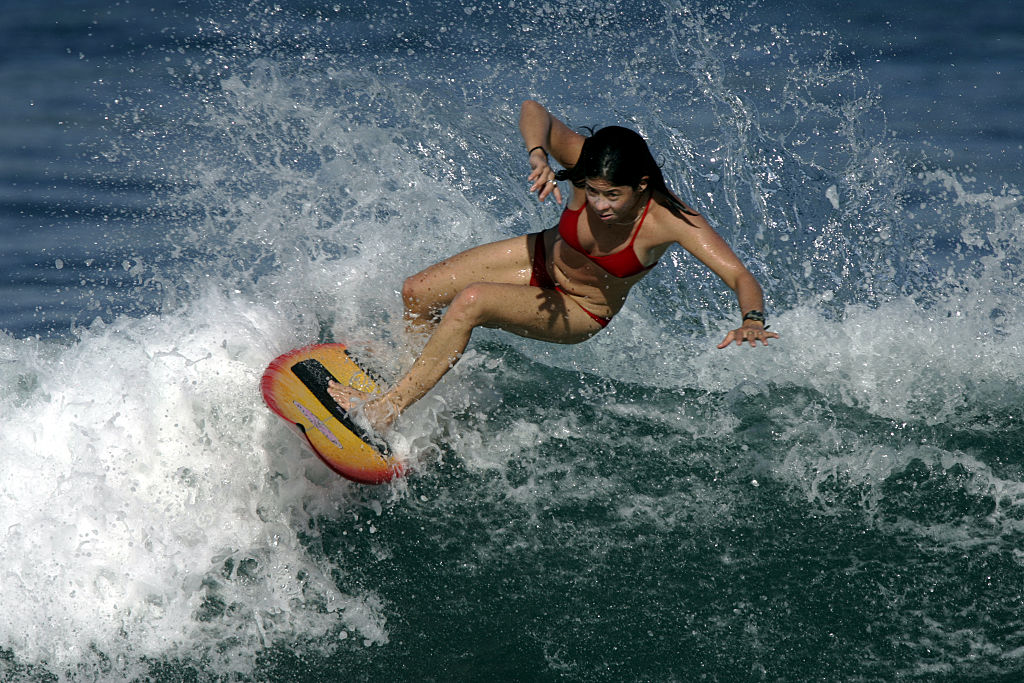
The former world champion, long sidelined by the sport she helped shape, will be immortalized in bronze at Bondi Beach.
Image: Allen J. Schaben via Getty Images
Nearly three decades after winning a world title without prize money, Pauline Menczer is finally getting the recognition she’s long deserved. Waverley Council in eastern Sydney has approved the construction of a bronze statue of Menczer at Bondi Beach, the very place where she learned to surf as a teenager and the only beach in Australia to produce a world champion surfer of any gender.
Of the more than 200 public statues in Sydney, only a small fraction honor women. Menczer, a proud lesbian and former world champion, will soon stand among them. A fundraising campaign, “Pauline in Bronze,” launched by supporters and filmmakers behind the 2021 documentary Girls Can’t Surf, helped bring the project to life. That film, which spotlighted the systemic sexism in surfing during the ’80s and ’90s, renewed public interest in Menczer’s legacy and revealed how little recognition she had received in her hometown.
Related: NYC’s Surprisingly Sapphic Surf Scene
Menczer began surfing at 14, riding waves on half a broken foam Coolite board her brother had snapped. She taught herself in the rough lineup at Bondi, where girls were often unwelcome. “It was really tough when I first started because there wasn’t a lot of women in the water. The guys didn’t really want girls out there. There was a pecking order,” she said during a recent interview on the SWS Audio Podcast. “I got told to go in many times. Any time they’d say that, I was like, ‘Get stuffed, I’m not going in. I love it out here.’”
Her love for surfing quickly evolved into competitive drive. By 1988, she had won the World Amateur Title. Five years later, in 1993, she overcame debilitating pain from rheumatoid arthritis to clinch the ASP World Championship in Hawaii. At the time, she was 23 and walking crooked from joint inflammation so severe she couldn’t turn her neck or straighten her elbows. She surfed the final heat on a borrowed board after days of doing gentle exercises in a hotel pool. “As soon as the hooter went and my heat started I just surfed like there was nothing wrong with me,” she recalled.
Menczer discovered there was no prize money attached to her win, unlike the male competitors who received substantial payouts. “The guys all won prizes at the end of the year. I thought we’d win prize money for winning the world title. There was no prize money for [us],” she said. She had funded much of her tour herself, relying on local friends for accommodation, and hustling every step of the way. The lack of financial support eventually pushed her out of the professional circuit.
As a queer woman in a male-dominated sport, Menczer also faced deep discrimination. She watched close friend and fellow surfer Jodie Cooper lose sponsorships after coming out. “Jodie was out the whole time I travelled with her. I heard so many horrible things and saw how horribly people treated her because she was openly gay. If it was a close call, the judges would never allow the gay girls to get through,” Menczer said. Knowing the stakes, she kept her own identity mostly hidden from the public while on tour.
Related: All Of The Queer Chaos From WNBA All-Star Night One
Her post-competition life took her far from the spotlight. Menczer moved to Byron Bay on the east coast of Australia, worked as a school bus driver, and later became a caregiver. But her resilience remained intact. “My mum always taught me there’s a positive in every negative,” she said. “So, you know, not getting sponsored, righto, I’ll do it myself.”
It wasn’t until 2018 that the surfing world formally acknowledged her legacy. Former surf pro Layne Beachley called to tell her she was being inducted into the Australian Surfing Hall of Fame. “The recognition that came from that was [a feeling] like I’ve won the world title now many, many years later,” Menczer said. And after years away from the surfing community, she began to re-engage. She published her memoir Surf Like A Woman and joined a local surf club. “I’m back in the surfing scene now. Like, I feel part of it. Still surfing, still love it.”
Now, that recognition will take permanent form at the beach where it all began. “Where they plan to put the statue is where I rode past on my skateboard as a little girl,” she said. “If I’d had that to look up to, how amazing would that have been for my generation?”