

Trump Admin Directs Federal Government To Refrain From Promoting World AIDS Day—We Will Not be Silenced
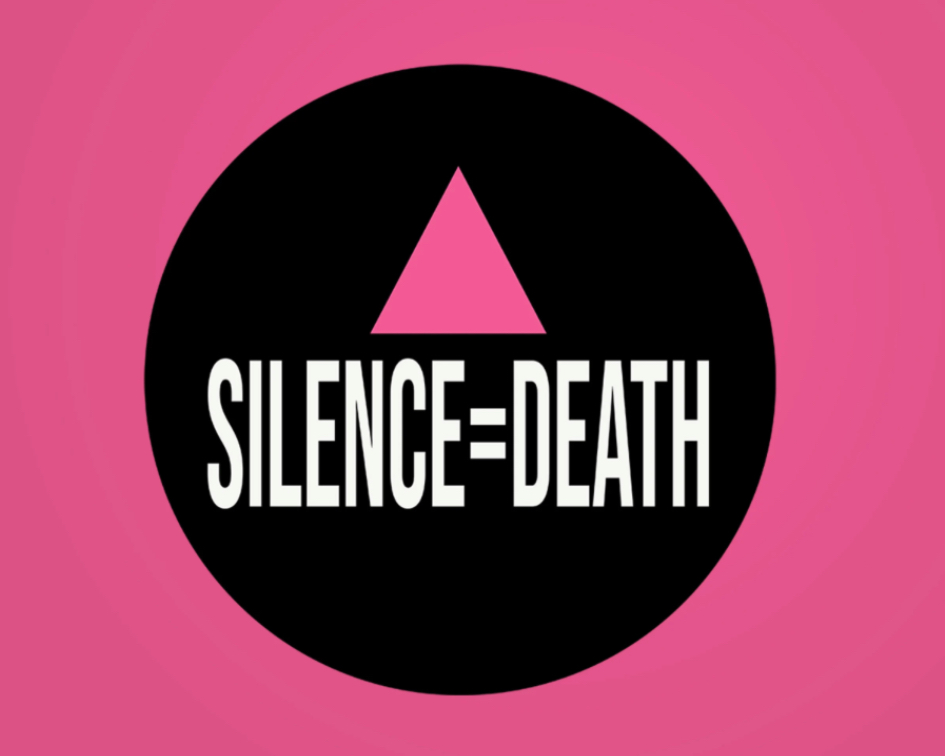
“After decades of progress, the HIV response stands at a crossroads. Life-saving services are being disrupted, and many communities face heightened risks and vulnerabilities.” (WHO)
Featured Image: Silence = Death Project (original poster created by Avram Finkelstein, Brian Howard, Oliver Johnston, Charles Kreloff, Chris Lione, and Jorge Socárras)
Since 1988, governments, organizations and individuals have observed World AIDS Day on December 1st. It has traditionally been a time to raise awareness about the epidemic, and to honor the approximately 44 million lives lost to this terrible disease. This year, according to an email viewed by The New York Times, the State Department has warned federal employees not to use government funds to commemorate the occasion, and to “refrain from publicly promoting World AIDS Day through any communication channels, including social media, media engagements, speeches or other public-facing messaging.”
This proclamation comes after the slashing of USAID funds earlier this year—funds that had propped up public health programs across the world, including those that addressed prevention and treatment of AIDS. Nepal, for instance, lost 100% of U.S. funding when the Trump administration shut down USAID. From the global health perspective, this is both inexusable and nonsensical, given that transmittable diseases know no borders. This sorry state of affairs echoes 1980’s-era negligence with regard to fighting HIV, the virus that attacks the immune system and causes AIDS.
Related: Nepal Turns Out For First Pride Rally Since US Funding Cuts Decimated Services
The slogan, “Silence = Death,” was a response born of the Reagan administration’s inaction around HIV/AIDS. It is an iconic visual: the slogan paired with a pink triangle that referenced the Nazi persecution, torture and murder of gay people during The Holocaust—the triangle having served as an identification patch forced on gay men who were rounded up, just as Jewish people were made to wear the yellow Star of David. It was a time of systematic cleansing by a regime with warped aspirations around purity of race and culture.
In the 1970’s, the LGBTQ community came to embrace that pink triangle, to repurpose it for protest and later, as a representation of our resilience. We turned it right side up instead of upside down, as was used by the Nazis in the 1930s and 1940s. When the AIDS activist group, ACT UP (AIDS Coalition to Unleash Power) took root in 1987, they adopted the symbol, along with this manifesto: “silence about the oppression and annihilation of gay people, then and now, must be broken as a matter of our survival.”
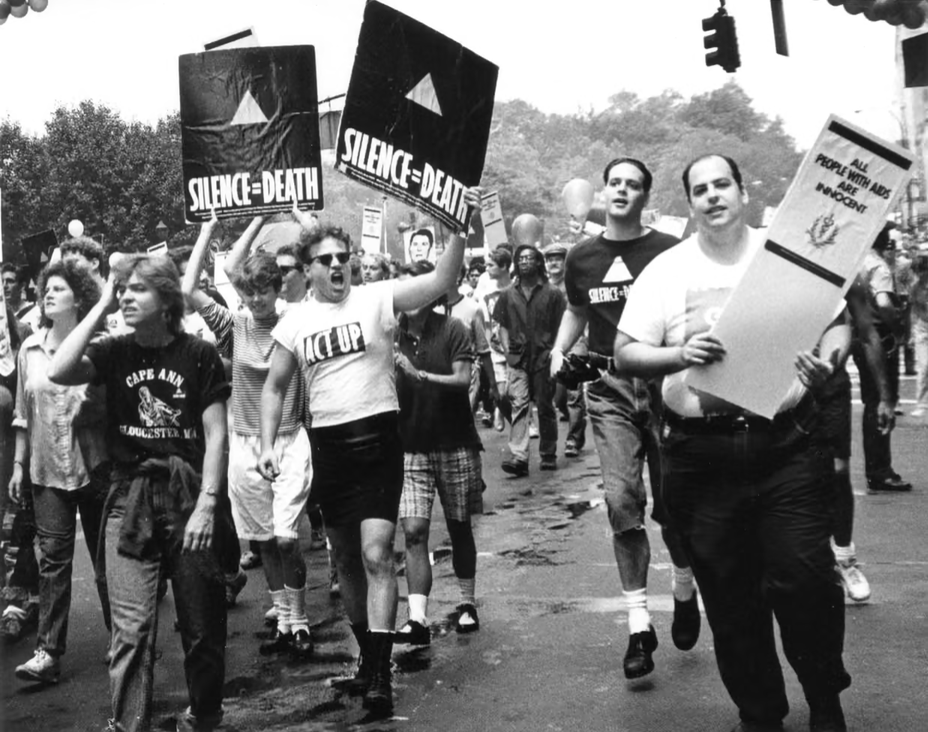
Image: Members of Act Up during the Pride march in New York City on 26 June 1988. Photograph: The New York Historical Society
Related: Remembrance and Love: The NAMES Project AIDS Memorial Quilt, First Displayed Oct. 11, 1987
In October of this year, we honored the anniversary date of The NAMES Project AIDS Memorial Quilt, which was first displayed Oct. 11, 1987. GO spoke with activist Cleve Jones, who initiated the project, and created the first panel to honor his friend who had died of AIDS. The sheer size and weight of the quilt today speaks to the enormity of the loss of life over time: a tapestry too large to be displayed all at once, at 54-tons, 50,000 panels and more than 110,000 names.
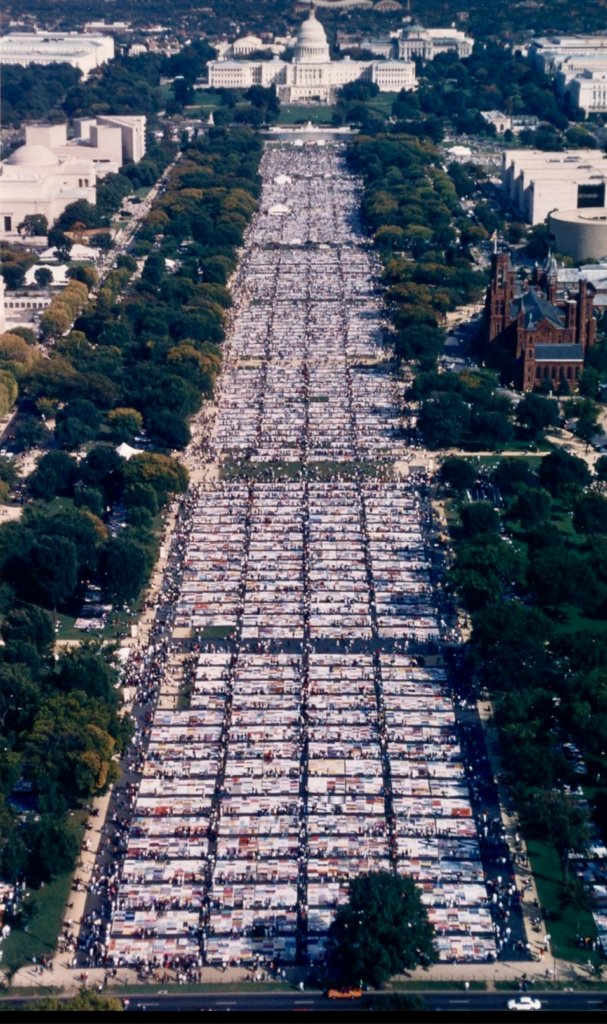
Image: via Facebook, National AIDS Memorial, Oct. 11 1996
“The terrible irony,” as Cleve Jones put it, “we could be on the brink of getting to zero new infections, but instead, we are now on the precipice of an entire new wave of HIV infections because of the Administration’s cutbacks to global health programs and domestic health programs and prevention campaigns.”
Last year, about 41 million people were living with HIV globally. But today, thanks to scientific advancements, the prognosis for HIV/AIDS has improved beyond what we could have imagined four decades past. It is no longer a death sentence. Life-expectancy for people with HIV can be similar to those without HIV.
There is a twice-a-year injection that offers virtually 100% protection, Jones says. “But the agencies that would have been key to rolling that out are finding themselves run out of business by the Trump administration. Meanwhile, the quilt continues to grow.”
There are those who might try to silence voices on World AIDS Day. But that is not the full story. The full story is about community solidarity and a demand for action for a crisis that now has proven preventatives and treatments. The complete story takes inspiration from those who refused to be silenced forty years ago; and farther back still, to the origins of the pink triangle, when extermination and incineration of the marginalized were literal events.
World AIDS Day is supposed to be when our State Department sends data to Congress from PEPFAR (the President’s Emergency Fund for AIDS Relief) which provides money for H.I.V. programs across the world. We are supposed to be measuring our progress. Because in a functional democracy, we save lives, we don’t throw them away.
“I didn’t imagine in 1981,” Jones said, “that we’d still be having to watch people die of AIDS in 2025.”
The World Health Organization joins with communities across the globe to recognize World AIDS Day. This year’s theme: “overcoming disruption, transforming the AIDS response.”
After decades of progress, WHO acknowledges that the HIV response is at a crossroads.
“Life-saving services are being disrupted, and many communities face heightened risks and vulnerabilities. Yet amid these challenges, hope endures in the determination, resilience, and innovation of communities who strive to end AIDS.”