

Three Babies, Three Parents: A Queer Family’s Journey
My wife and I accidentally had pseudo triplets. Now, we’re raising three toddlers with our donor.
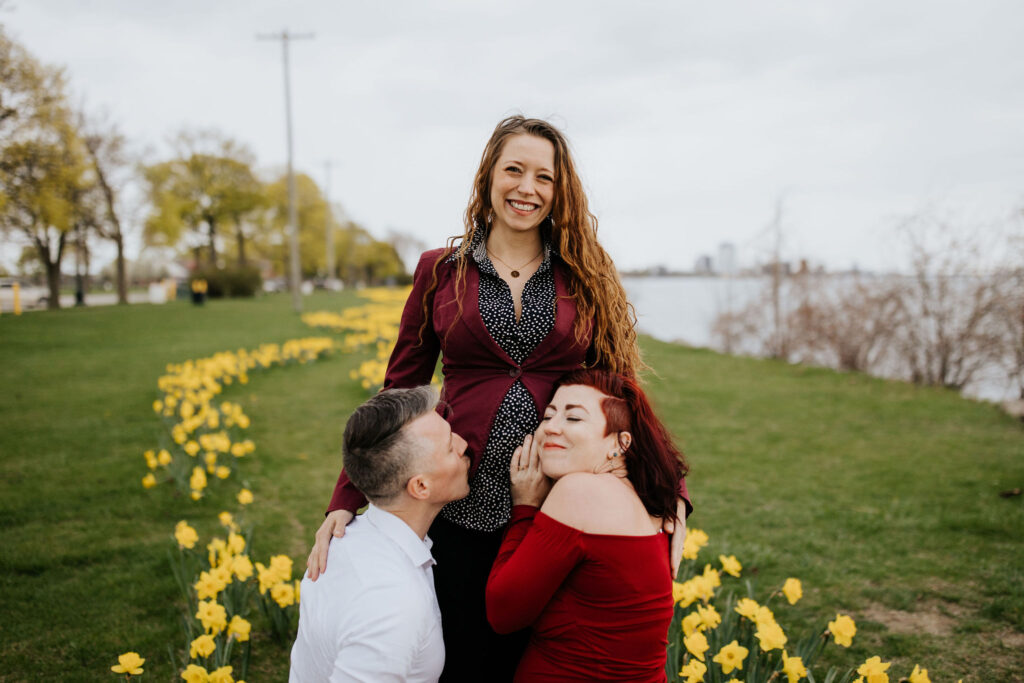
Featured Image: Trow (L) and Chelsea (R) hugging Jess’s pregnant belly. Photo by Caedy Convis Photography.
“I knew we were in deep water,” said my wife, Jess. “The strike of terror that went through my heart when the ultrasound tech said to my wife, ‘I’m just looking to see if there’s more than twins in here,’ was intense.”
“I just stared off into space,” said Trow, the babies’ biological dad.
That moment, looking at our first ultrasounds, is seared into all of our memories. It’s the first time we realized we were having pseudo triplets.
Before even meeting each other, Jess and I had done a lot of living in community spaces. When we met for the first time, it was at a week-long home-based retreat for national fusion dance instructors (we were both instructors and DJs), where we spent the week cooking meals together, creating community events, and dancing every night. Jess was my first serious queer relationship, and we spent our weekends going to poetry readings, binging horror shows, and dancing late into the night.
When we moved in together, we started a community house in Detroit because we both believed so passionately in the importance of a village. Our wedding was a giant dance weekender three years after we first started dating, thrown with all our families and friends.
So when we wanted to start a family, and our known donor and old friend, Trow, was excited to live with us and help out, we were stoked. Neither Jess nor I knew we’d have a full-on dad in the house when we started our family journey, but it was the perfect complement to our beliefs that the modern nuclear family is isolating.
We began preparing ourselves as a three-parent family–consulting with lawyers on how to legally protect everyone’s parental rights and how to entwine and separate finances, completing house projects, and discussing parenting books to get on the same page about parenting styles.
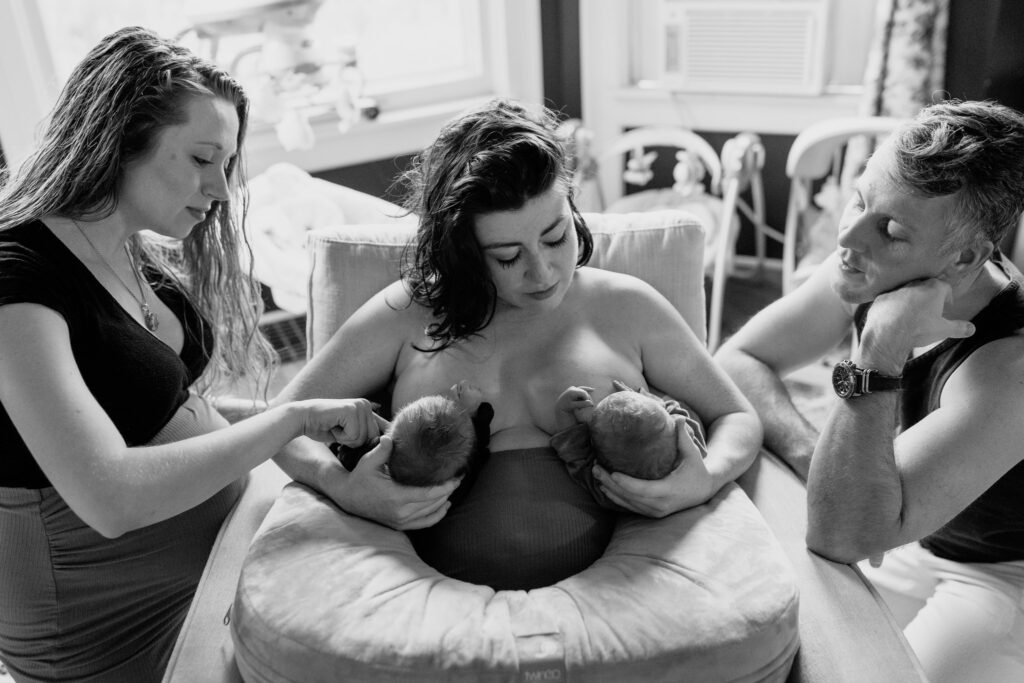
At the beginning of our journey, we decided we wanted Jess and me to start our conception cycles around the same time, with the ideal goal of having the babies several months apart. Get all the diapers and sleepless nights out of the way at once and have the benefits of twinning with little ones that are close in age without the drawbacks of biological twins (tough pregnancies and medical issues). HA.
What we didn’t plan for was having three babies.
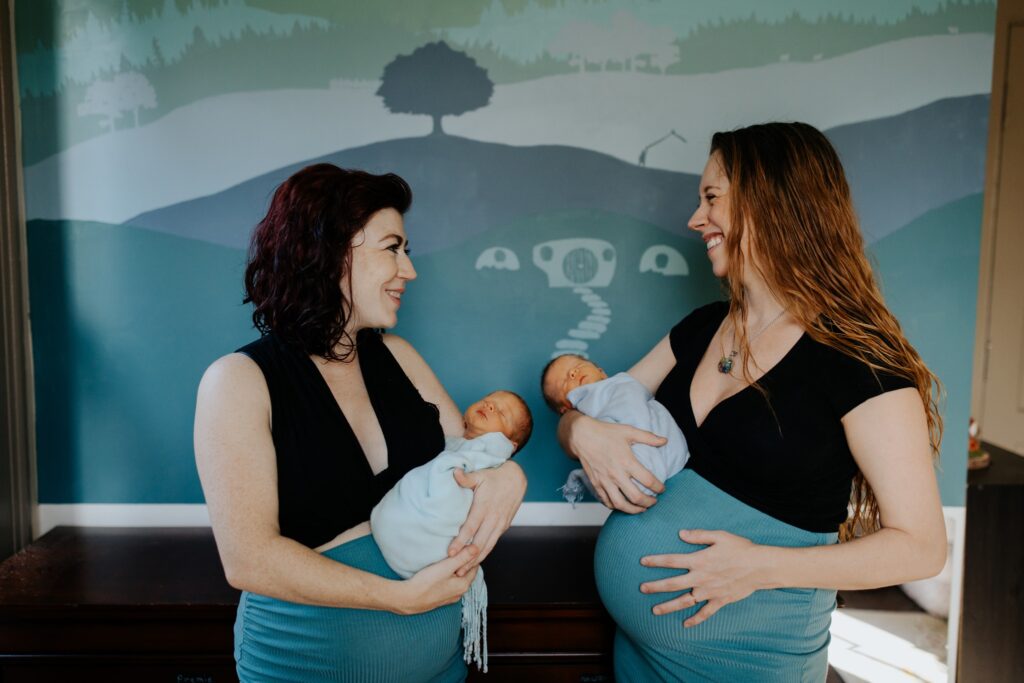
Jess became pregnant with our singleton Miko, due on August 15th, and I was carrying our twins, Arden and Conall, due on August 5th.
The shock that went through all of us on that drive home cannot be overexaggerated. Driven by my anxiety, heightened by pregnancy, I was googling if having twins upped my chances of a miscarriage at 8 weeks. Trow was fretting that one kid was a lot, two kids were a lot, but three kids all at the same time were exponentially more.
One parent was able to care for the twins by themselves, barely, but when Miko came home, adding a third baby required an entire other caregiver on duty at all times. No one had any time off, ever.
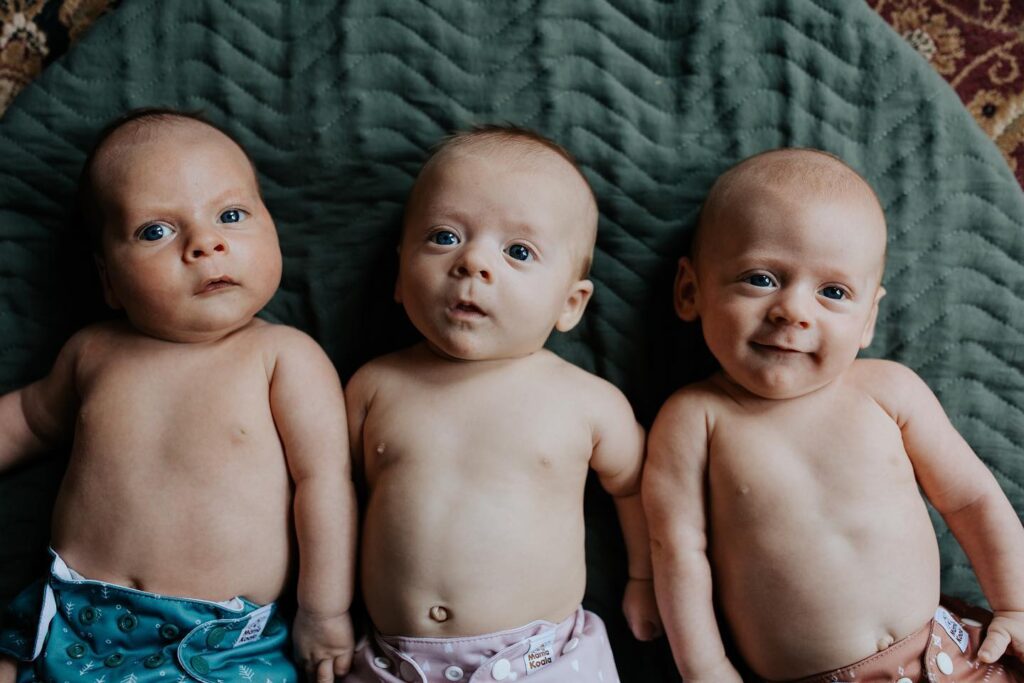
One difference between twins and triplets is the gear. Gadgets targeted toward triplets are a lot fewer and farther between, and vastly more expensive. Jess felt like some of the price tags made her jaw drop, and she quickly became a pro at Facebook Marketplace shopping, scoring strollers for hundreds of dollars off their retail price.
The first year was frankly a nightmare for all of us.
Thinking back on that time period, Trow said, “We were just focused on survival—for us and the kids.”
The twins had colic and weren’t eating enough, with tongue ties and feeding issues. They had multiple ER trips and hospitalizations; we went from one medical crisis to another in that first year.
Jess began that newborn stage with the twins while wildly pregnant with Miko. She had a horrible pregnancy, with gestational diabetes, and was vomiting until the day she gave birth. To this day, she has no idea how she powered through that.
I, too, was wildly sick toward the end of my pregnancy–I had hyperemesis gravidarum throughout all eight months, a disability described as “morning sickness on steroids,” where I underwent multiple ER trips just to stay hydrated and had to go on nausea medication to be able to keep down crackers. I developed preeclampsia (dangerously high blood pressure) during my last two weeks of pregnancy, and suffered a placenta abruption during labor, where Arden’s placenta ripped away from the left side of my uterus, causing lasting hip damage.
Related: Two Decades of Queer Parenting Visibility—A Conversation With Dana Rudolph
Jess and I both experienced severe pre/postpartum anxiety once the twins were born.
“I just woke up many times in the middle of a nightmare, convinced that one of the twins was dead,” said Jess about that time period. “I think my fear about their safety was more difficult than any of the actual care for them.”
I also experienced anxiety so intense that during my desperately needed, rare snatches of sleep, I would wake up crying from nightmares about the twins having died of SIDS, and would sometimes wake them up to make sure they were still alive. It wasn’t great. Owlet socks, a monitor that tracked their breathing and heart rate, gave me some measure of relief, but I still suffered.
Unbeknownst to us, at eight months, our babies were exposed to lead, both in our home and in our neighborhood due to construction. As the more emergent medical crises of the first year waned, a newer long-term medical crisis emerged with their burgeoning symptoms and their lead poisoning diagnosis at twelve months.
All of Jess’s and my coping mechanisms of dancing, social community, and self-care that we had so carefully developed in our pre-parent life were entirely scrapped. When I became a parent, I knew that I wouldn’t be able to go dancing every weekend. But I didn’t know it would be a full year before I could go dancing again.
I knew some of my friends would fade away. But I didn’t know most of them would stop even answering my texts, let alone never drop by to see me and the kiddos. I knew my anxiety would increase as a parent. But I didn’t know it would become so all-consuming that I’d need to start a new medication just to help me function.
Jess and I definitely entered a roommate phase of our marriage. (If I’m being completely honest, we are still 95% in the roommate phase.) We spent every day and night together, yet we rarely had time for just us. With exclusively breastfeeding the triplets and running on five hours of fragmented sleep a night, we were both so exhausted and touched out that the infrequent times we sat down to watch a show together, we sat on opposite sides of the couch.
I think the best part of this is that, unlike heterosexual pairings, Jess and I both understood the all-consuming depletion of constant breastfeeding. There was never any pressure to be intimate or even to cuddle; we never took it personally when the other, sick of being grabbed on all day, wanted as much sensory deprivation as possible during our brief breaks.
The kiddos’ health symptoms—sleeplessness, irritability, impulsive and violent behavior, body pains—were so difficult in that first year, and affected everyone. Yet as we moved into toddlerhood, everything became more manageable.
“Toddlerhood is awesome!” said Jess–a statement you don’t hear every day. “The kids have always been very clearly their own people, but it’s so fun to see their personalities manifest more fully as they gain physical and language mastery.”
Related: What If Same-Sex Marriage Is Overturned? Here Are 7 Legal Steps To Protect Your Family
All of us parents found the ability for two-way communication to be a game-changer in managing the inevitable, “I have to help your brother first, and then I can help you,” moments.

Jess found that as her postpartum anxiety eased, her tolerance for baby tears grew. She could hear them cry and recognize they’re frustrated that a brother has a car they want, but they’re not fighting for their lives right now; they’re safe.
“When we went from one year old to two years old, I went from needing to keep an eye on them every second, to having up to 40 seconds where they can run around a corner where I can’t see them and they can still be safe,” Trow said, explaining how his confidence in handling the kids by himself grew during toddlerhood. “That’s a big difference for me!”
Seeing the triplets’ relationships develop is so unique and beautiful. They’re beginning to have fun roughhousing, not just brother-on-brother smacks and bites. They’re getting play ideas from each other, and they even sing together and have conversations together.
And Jess and I are seeing glimpses of being able to come out of the roommate phase. There are nights where the kids wake up less than ten times; there are entire hours that go by without crying. Jess and I have begun giving each other goodnight kisses again; a tiny bit of romance is creeping its way back in.

Photos by Caedy Convis Photography.
If you find yourself expecting multiples, here are some of our top tips:
Trow suggests, “If you’re by yourself, take something to strap them down, like a stroller. This helps make transitions from one place, like from the car to a park, much easier.” He also recommends building a list of places, like fenced-in parks or toddler playrooms, that are contained, so you can build your confidence as you take them out. And having a “yes” space is necessary: a place in your home where everything is childproofed and you can relax a bit more.
Jess recommends learning from the wisdom of those who’ve gone before. “Using giant carabiners for the third carseat on the handlebars of our double stroller was a lifesaver tip, and that came from a local triplet mom,” she says. “The logistics of getting from point A to point B are the hardest parts, so anything to make that feasible is good.” She notes babywearing is still very helpful, even if you can’t wear all the babies at once.
I personally joined as many Facebook groups for moms of twins and triplets as I could, and found lots of solidarity in reading other parents’ experiences. I wasn’t the only one losing my mind with all the crying; I wasn’t the only one feeling guilty for struggling with certain phases or household jobs; I wasn’t the only one grieving that all I was doing was trying to keep everyone alive, rather than “enjoying every moment.”
Triplets are hard. But as they grow and their bond blossoms, I’m also seeing more and more how blessed I am, too.
A Montessori educator of ten years with her master’s in Children’s Literature, Chelsea delights in exploring the intersection between queerness, parenthood, and the wild things. She’d love to connect with fellow childhood liberators @motownmultiples