

The Government Made Me A Gender Traitor
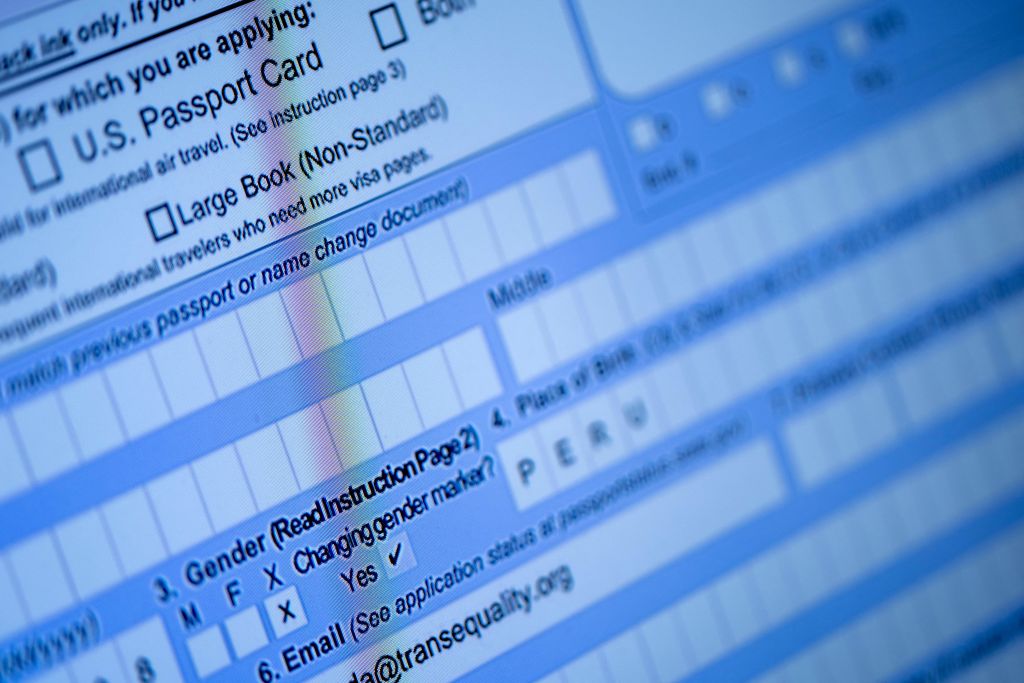
Choosing to surrender my “X” passport before being forced to feels deeply against my nature, but I’m tired, and I’m scared.
Featured Image: Stefani Reynolds via Getty Images
This week, my new passport with a “corrected” gender arrived in the mail, and I felt a combination of profound relief and dysphoric disappointment. Not so much in myself, but in the state of this country. I first came out as transgender/genderqueer/nonbinary in 2002 when I was seventeen. I came out into a world of artists and activists, a universe of queer gender euphoric punks who were architecting our bodies and our world. Back then, I didn’t expect the government to respect, protect, or even understand me or the complexity of my identity, but at the time, they also weren’t actively hostile or legislating against us. In many ways, it feels like we have gone backwards or, more accurately, that we’ve slid into a new dimension, far away from all the progress and the future I thought we were building.
My gender marker has gone from the “F” on my birth certificate to “M” during my teens and early twenties and back to “F” in my thirties. At forty, when I got divorced in the summer of 2024 and needed to update my last name everywhere, I decided to change my Oregon state driver’s license to an “X” gender marker, and my federal gender to “X” on my passport. I was excited that “X” was an option! The “X” felt special, like the gender on my ID actually matched who I am.
I changed my gender to “X” before Trump’s second presidency. Nothing about the political reality we now find ourselves in seemed remotely likely to occur. I’m no stranger to legal gender changes, and I knew there were risks, specifically that there would be countries in the world where it wouldn’t be safe or possible for me to visit if my legal gender was marked as “X.” Never did I imagine that the United States would become the country where my legal gender marker would make me unsafe. Never did I imagine that I would worry whether legal documents issued by the United States would even be valid in my own country.
Related: Donald Trump Can’t Erase Our Gender: Nonbinary Thoughts In MAGA America
When “X” gender passports stopped being issued last January, I felt lucky that I had renewed mine when I did. Under Trump’s executive order, passports that currently had “X” gender marker remained valid. This small, but important, bit of language helped manage my anxiety. Knowing I had more years left on my passport than Trump did in his presidential term, I believed I could wait this out. As the executive order wound its way through the legal process, I was nervous but still confident. Then, in November, when the Supreme Court granted the administration’s request to stay a previous injunction and allow the policy to be enforced, my fears deepened. Still, I reminded myself: I’m an American citizen with a passport valid for another nine years.
In the fall, I loaded my dogs into the car and took a road trip across America, from Portland, Oregon, to Ontario, Canada. During the three weeks I was there, I logged onto the State Department website one day and noticed that the language I had been clinging to had changed.
Now, when you click on the FAQ and read the question, “Is my passport still valid if I have an X marker on it, or if it lists a sex other than my sex at birth?” the answer reads: “All passports are valid for travel until they expire, are replaced by the applicant, or are invalidated pursuant to federal regulations.”
In that moment, I was flooded with anxiety, especially being outside of the country. The only thing that helped me calm down was knowing my dogs were with me, and I was staying with people who loved me. Still, I worried about what might happen if my passport were invalidated before I could get home. During the long cross-Canada drive back, I made up my mind: once I returned to Portland, I would need to do something I never expected. I would surrender my gender, or, more specifically, my gender “X” passport.
I knew what I had to do, but I felt tremendous guilt about “giving up” the passport marker that felt most aligned with who I am. At the same time, I knew that keeping it could risk my ability to travel freely and safely to spend time with the people I love. This felt like the airplane instruction to “put your own oxygen mask on first before helping others” moment. I didn’t want to give up my passport, but if I couldn’t travel to reach the queer and trans people I love most, I wouldn’t emotionally be able to forgive myself. I wouldn’t be able to show up or create books and creative projects that uplift trans love and trans joy, and that didn’t feel worth it. I decided it was okay to prioritize my safety, my ability to cross borders freely, and my ability to get home to my dogs, my house, and my business. Crossing back into the United States at the end of my road trip across Canada was uneventful, but I continued refreshing the passport website. I was spooked. I can’t and would never want to erase my complicated gender history; it’s written all over my body, but I also can’t risk not having a passport. As a visibly queer person, my body is already on the line. I can’t afford for my legal existence to be, if there’s something I can do about it.
Related: 40 & Nonbinary: How Middle Age Set My Gender Free
In the last month, the US government website has been updated with clearer information about how to get a passport reissued with a “corrected” gender. But when I began this process a month and a half ago, that information wasn’t available. I called the National Passport Information Center and explained my situation. The woman who answered was incredibly kind. She apologized that I had to do this, told me I wasn’t the only person dealing with it, and apologized again that the process was unclear and confusing.
I went to my local CVS to get new passport photos taken and felt sick to my stomach. I felt sick following her instructions as I took a piece of paper and wrote a letter explaining that I needed to “correct” my “X” gender marker on my passport to reflect my “sex assigned at birth.” As I wrote, I looked down at my right wrist and saw my twenty-two-year-old rainbow trans symbol tattoo. I got it at nineteen, both as a source of pride and as a promise to myself that I would never go stealth, that I would never hide.
I mailed in all of my legal documents: my birth certificate, both my legal name changes from the early 2000s, and my complete divorce decree restoring my chosen last name. I found myself wondering what the back end of a federal database must look like, holding every version of my legal gender across my adult life. I overnighted the documents, and then I waited.
I had been told I wouldn’t need to pay for the correction, but two weeks later, I received a notice saying I did. Panicked, and without any of my original documents in my possession, I wrote checks and overnighted them to the passport office on Christmas Eve. My new passport arrived in the mail last week, my gender marked as “F.” I was flooded with relief to have a new passport, one that I don’t feel like I could wake up one morning to find has been invalidated. But I was also filled with overwhelming sadness that this is what things have come to. The day after my new passport arrived, I saw news that indicates we could be in the early stages of what researchers are calling genocide of transgender people in the United States.
A few days later, my hole-punched/invalidated “X” passport and all my documents arrived back in the mail. I realized that the gender “X” passport belongs in my personal archive alongside manuscripts from my books, posters from performances with trans artists across the US, Canada, and Europe, which now feels like a lifetime ago, not just for me, but for our community. I keep this archive not only to document my life’s work, but to remind myself of what trans people and trans artists have created and continue to create, no matter what the government says our gender is.
I’m back to having mismatched documents. To the state of Oregon, my gender is “X” on my driver’s license; federally, my passport now says “F.” I feel both sad and safer. I don’t regret reissuing my passport. Nothing about my queer body in public is subtle, and I end up talking about gender almost everywhere I go. Ultimately, even if I feel like a bit of a gender traitor, I believe trans and nonbinary people are doing the best we can to protect ourselves and each other in a country actively trying to erase us. As someone who has always been very out and very visible, choosing to surrender my “X” passport before being forced to feels deeply against my nature, but I’m tired, and I’m scared. And for me, it felt like the only answer.