

Kelli Dunham And Beth Dunham Toner Bring Their Show To The Lower East Side: “We Were Such a Happy Family”
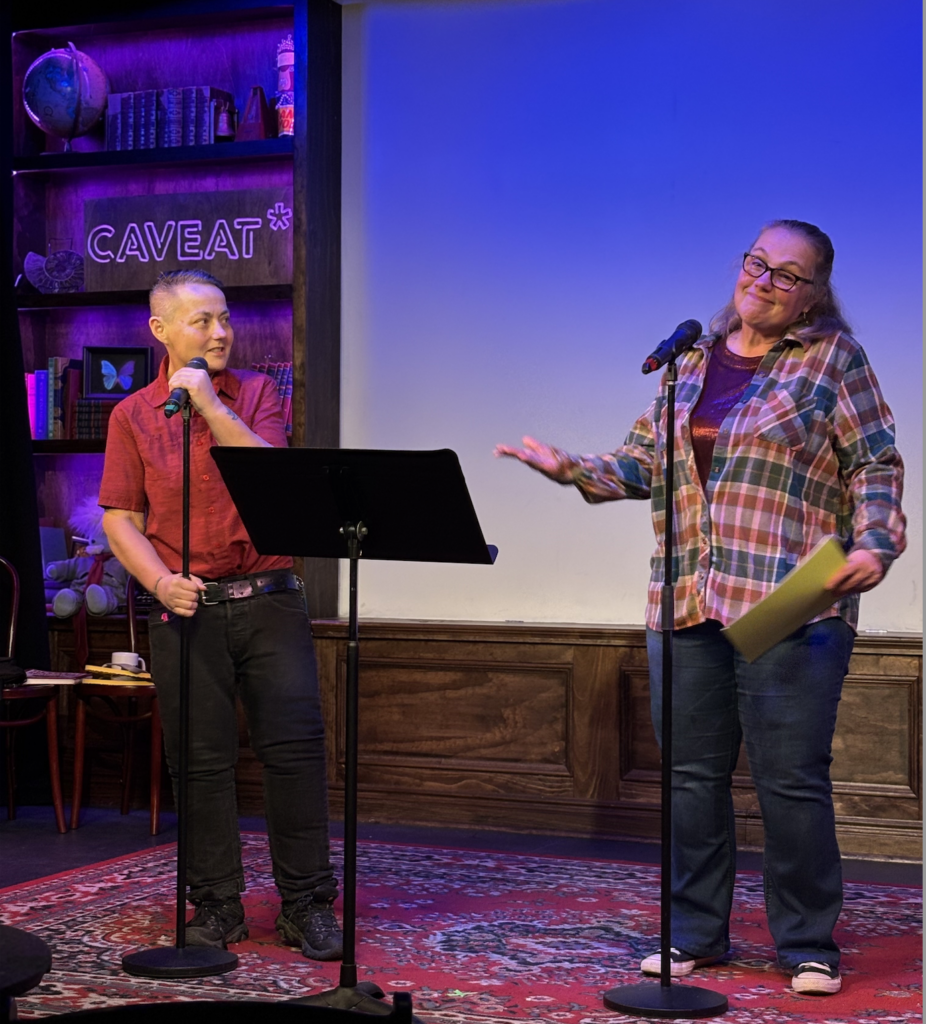
Both writers and nurses, nonbinary ex-nun Kelli Dunham, and sister, Beth Toner Dunham, bring Midwest sensibilities and quirky family stories to the Lower East Side.
Featured Image: Kelli Dunham and Beth Dunham Toner; photos by Liliana Hetherman and Margaret Hetherman
Everyone’s favorite nonbinary ex-nun turned nurse brought her game – and her sister – to a full house at Caveat on Feb 21 for an interactive exploration of truth and fiction. “We Were Such a Happy Family: Adventures in Fact, Fiction, and the Nebulous Nature of Memory” is a two-person show and workshop, conceived by Kelli Dunham and Beth Dunham Toner. It draws on quirky family recollections and conversation to ask:
Who gets to tell the story? What do we keep, what do we edit, and what do we finally get to rewrite?
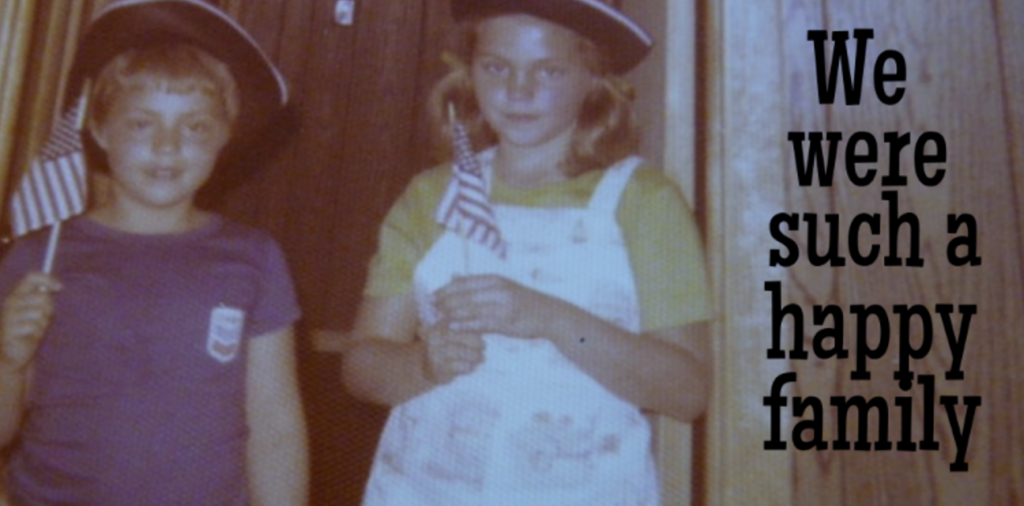
The project draws from the duo’s respective solo works-in-progress, including Kelli’s When Good Christian Girls Grow Up to Be Bois (about learning masculinity from 1970s dads, brothers, television and church) and Beautiful Disasters, by nurse, writer, and erstwhile theater nerd Beth.
The fact that they could collaborate, and with abundant humor and affection, surely stems not only from a deep bond forged by siblings who together endured a father who locked the power windows in the family car while farting, but also from years of sibling therapy which “is basically like having therapy, but with a witness who was there,” Kelli says.
Their mother? An unreliable reporter. And not only because she had accumulated seven husbands (that they know of). For real. It’s a lot to keep track of. Sibling memory, more reliable. Beth describes Kelli as less relentless than their other sibs, “which is incredibly generous, because Daddy tortured her for so many things – for being sensitive, for not being shaped the way he wanted her to be, for hating lima beans.”
Related: Convent Drop-Out Kelli Dunham Is Drop-Dead Funny
Like most kids of the 70’s, television featured prominently. Beth remembers that as kids, they were allowed to watch only one hour of TV per day. “If you wanted to watch a two-hour television premiere, say the September 17, 1978 premiere of “Battlestar Galactica” – not that I know anything about that – you had to save up your TV time, which was why I lost my mind when it was interrupted by the signing of the Israeli Egyptian peace accords.”
By her father’s side, she watched the fall of Saigon, the aftermath of the Jonestown Massacre and the near meltdown of Three Mile Island. But cartoons were forbidden (“too violent”), as was gum except on Tuesdays, Thursdays and Sundays.
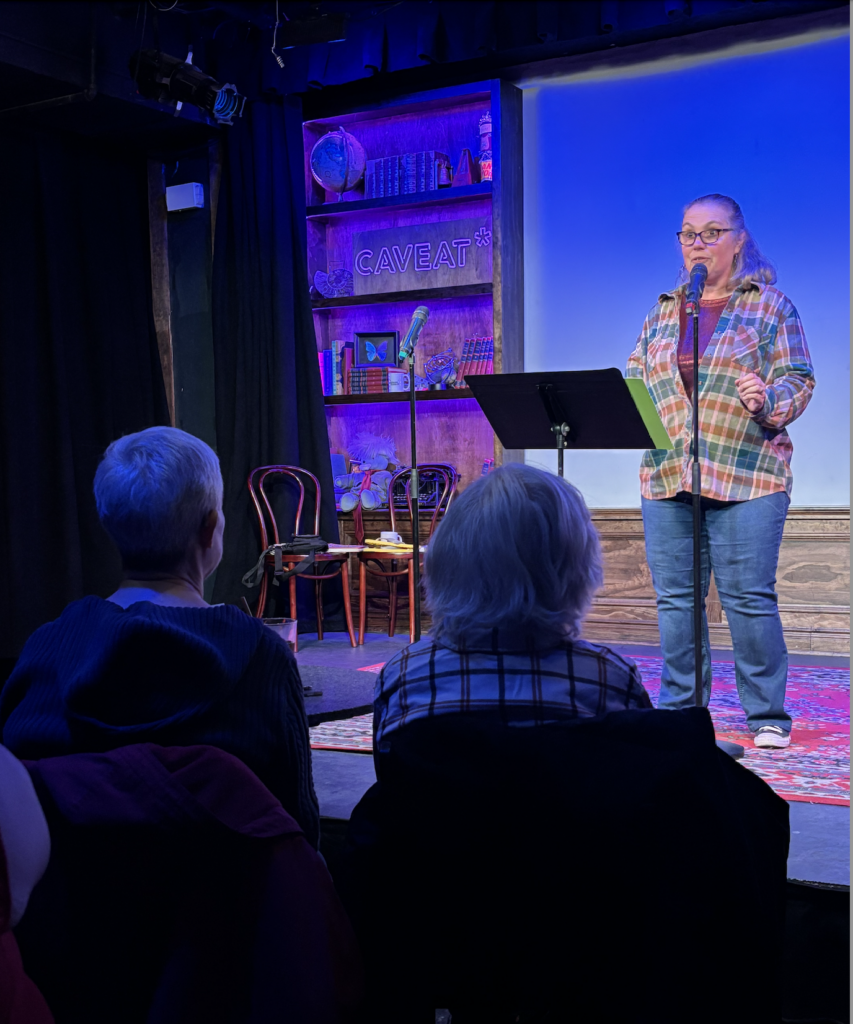
Image: Beth Dunham Toner at Caveat
Kelli Dunham is no stranger to the Caveat. In 2024, the writer and podcaster brought their queer tragicomedy Second Helpings: Two Dead Lovers, Dead Funny to the Manhattan venue – fresh from the Edinburgh Fringe Festival. A self-described “accidental enemy of Mother Teresa,” Kelli explored death, grief, nuns behaving badly, exploding knee replacements and the limitations of bootstraps in the show. It’s not surprising to find elements of caregiving, loss, and love in their most recent work. They are known for their trademark invite: to give, to ask for, and to learn to accept a helping hand.
So yes, death comes knocking again in We Were Such a Happy Family. In Second Helpings, content wraps around the passing of Kelli’s former partners, burlesque performer and activist, Heather MacAllister and writer, Cheryl Burke. In Happy Family, other siblings get bypassed for the honor when Kelli gets the sole dispatch to her mother’s side.
“She told me that not only did she want me at her deathbed, she wanted only me at her deathbed… ,” says Kelli, one of five adult children. Obviously, the off-limits list didn’t include Beth. It’s simply that she didn’t “want a circus” – which makes sense, Kelli says. “I mean, if you don’t want a circus at your deathbed, you don’t have so many f**king kids.”
Kelli notes that their mom could have lived with any of her offspring. “We all had room or would have made room for her. My mom decided to live in assisted living, and the reason she chose it? Because it used to be a fancy hotel where Frank Sinatra once stayed.” This is a choice, Kelli acknowledges, that could only be made by a certain age of white woman. Prepared to take Mom off to hospice, Kelli arrives to find DNR letters painted in nail polish on their Mom’s assisted living door. “I did not want there to be any confusion,” their mom explains.
Then there’s the matter of extracting Mom when there’s a fuss over electronic versus paper versions of discharge papers. In the end, there was only one choice for Kelli, who turned to the Access-A-Ride driver: “I think we might be making a run for it.”
As for their father: “Even the opportunity to witness his body being lowered into the ground, a mark of closure that probably is important to teenagers, was not available to us,” Beth reflects. “There might have been a practical reason. Driving to Michigan in the dead of winter was surely a gamble. Airfare for three people was almost positively prohibitive for a family that had just lost their primary breadwinner… “
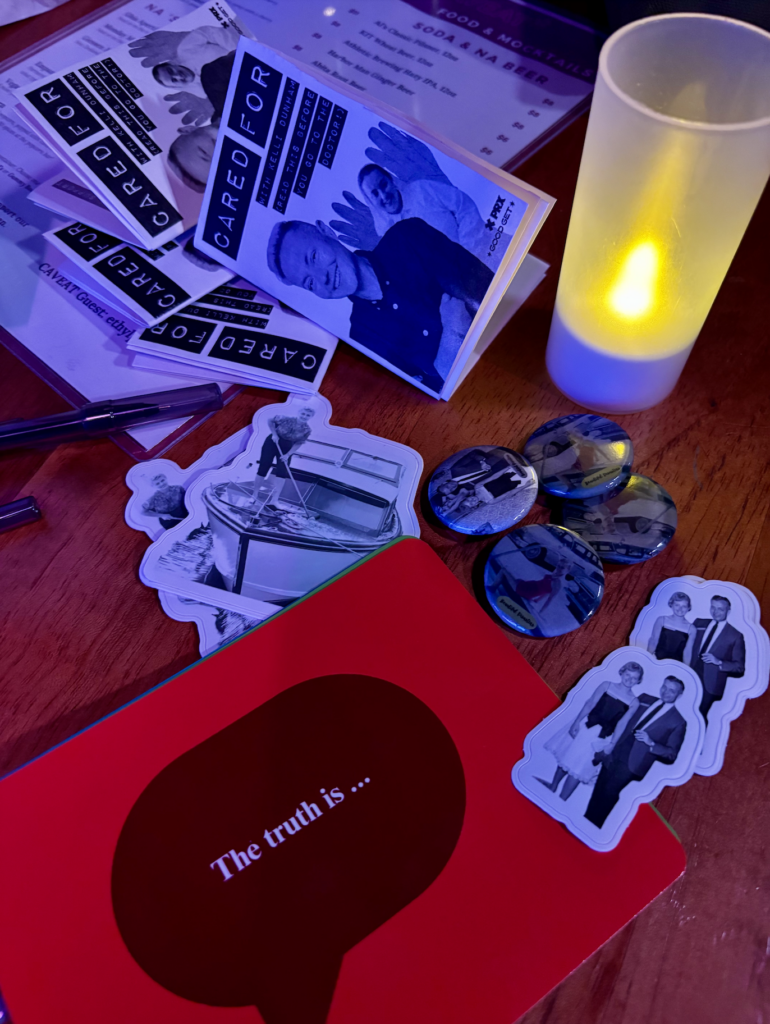
image: takeaway table trinkets for audience members
The two sisters agree that it feels as if their mother’s solo trip to Michigan was “her first move to, at the very least, rewrite, or, at worst, erase the narratives about Daddy.” How to describe their father? Beth says, “To say my dad was complicated is like saying Donald Trump is naughty. It’s just inadequate. He was everything you might expect from the son of a missionary in Michigan, foreign parents who had weathered both World War One and the Depression, extracting a living from the pancake flat land of Michigan’s thumb.”
The sisters describe their show as an exploration of how family narratives are built, revised, protected, and occasionally weaponized. Your arsenal might prove to be howls of laughter on your escape to hospice. You might find your armor in considering: If you remember the fierce hand rendered for breaking the rules, is it okay to cherish the time when your father uncharacteristically snagged tickets for Sean Cassidy, the object of your teeny bopper fandom?
A section of the performance is dedicated to inviting volunteers to the mic to reflect on one of several questions, such as: “What would you tell your younger self?” “What were you afraid of when you were 5-years-old, then 15, 25 and now?” A sobering theme emerges as several contemplate their current fear: the emergence of Nazis.
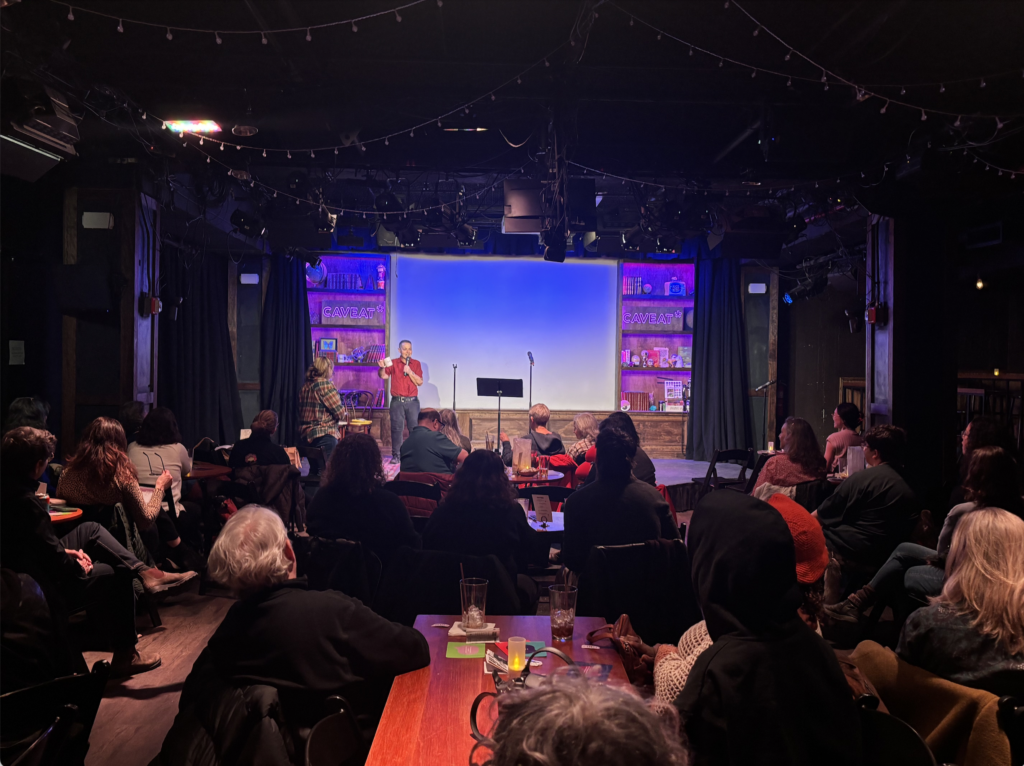
Image: door prize lottery (“because if you’re going to hear two stories about death, you should get a door prize”).
Happy Family is an extravaganza of warm vibes that straddles hilarity and poignancy, crafted by two people who know something about resilience, connection and quite possibly, acceptance. They deliver on the unspoken promise at the opening, when Kelli recounts meeting up with her dying mother who’s waiting in a wheelchair with a duffle bag:
“So here’s the thing, on the surface of it, that is a terrible morning, right? Your mom wants to leave her rehab where she’s been for six weeks, and she can’t. That’s a bad moment. But the fact that we were laughing about it – it’s what made the moment livable. The comedy of the situation is how we got through it, and that’s what we’re going to talk about today – about how humor can be like your PPE, your personal protective equipment in caregiving’s hardest moments, but also in life’s hardest moments.”
Kelli Dunham is the author of seven hilarious books about not-hilarious subjects, including a bestselling kids’ book on puberty and award-winning substack Hoping Intentionally. Kelli has appeared on Showtime, BBC4’S Sunday Religion in Culture Program, the Discovery Channel, the Moth Mainstage and the occasional livestock auction. Check out Kelli’s podcast, Cared For, a show about how we care for ourselves and our communities, and how we can create a world where it’s easier to do both.
Beth Dunham Toner is a nurse and writer, who still hasn’t figured out what she wants to be when she grows up. As a strategic communications professional, she has spent the last 30 years writing other people’s stories—and now she’s writing her own. Her nerd’s heart is particularly proud of having her short story “Homemade” selected for publication in Star Trek: Strange New Worlds VI.