

If You Like A24’s ‘X’ Trilogy, You Need To Read This Queer Thriller
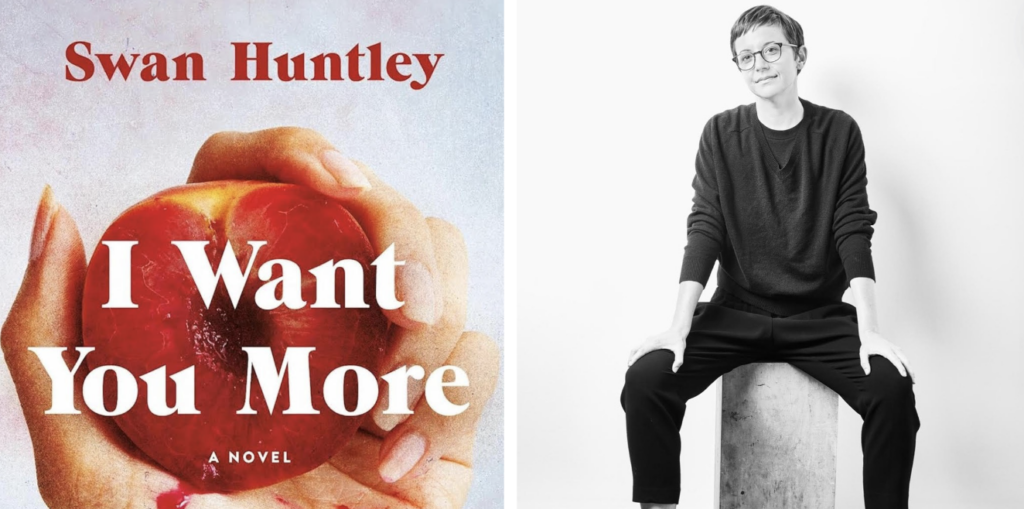
Author Swan Huntley chronicles a relationship between a celebrity chef and her ghostwriter — that slowly but surely descends into chaos.
Thriller queers, are you looking for something to quench your thirst for drama after binge watching the X trilogy? Lucky for us suspense junkies, I Want You More has major A24 vibes. It’s a novel, not a movie, but the cinematic quality, dark humor mixed with bloody suspense, and femme intrigue are positively popping. Swan Huntley’s just-released novel chronicles a relationship between Jane, a magnetic celebrity chef, and Zara, her ghostwriter who is grieving her father’s recent death—that starts as a sweet friendship, gets very sexy very fast, and slowly but surely descends into horrific chaos. (Think a modern sapphic Single White Female, with social media, cancel culture and Cinnamon Toast Crunch addiction, written in short, snackable chapters.) GO sat down with LA-based author Huntley – known for her interactive, illustrated “anti-self help” books The Bad Mood Book and You’re Grounded – to talk toxic codependency, twisty narratives, and why I Want You More will become your next (obsessive) summer read.
GO Magazine: I Want You More is your sixth book overall, and your fourth novel. What inspired you to write it?
Swan Huntley: The seed for this book was planted while I was ghostwriting the memoirs of a Real Housewife of NYC. During the process, she said, and I quote, “You’re coming to my manor October 21.” This was the height of the pandemic, so I never went to the manor, but I did think: “Oh, that’s a good set-up for a book. If I had gone to the manor, what could have happened?”
Emotionally, this book is a very dramatized metaphor for all my bad relationships. When you fall for someone, you also fall into them in a way. It’s easy to lose yourself, and it’s especially easy to get lost when you’re in the vulnerable position of not knowing who you really are, as Zara is in the beginning.
GO: I Want You More takes a hard look at Jane, a TV chef whose warm and happy public persona turns out to be quite different from her private self. You live in Los Angeles, land of celebrity culture. Any experiences that influenced the writing of this book?
SH: Thanks to social media, the divide between who we are and how we portray ourselves is readily available for us all to dive into. Twenty years ago, being a celebrity was special. Now, anyone can be a celebrity. The pressure to present oneself in an appealing way is human. I know that when I post something on Instagram, I’m thinking, “Shit, I hope I look cool.” And then I tell myself not to care–which is always a sign of how much I care.
For Jane, who has a larger following, and whose income relies, to some degree, on her likability, the pressure is greater. In the book, we see how the aspirational self she presents to the public has merged with her real self–so much so that she can’t really tell the difference anymore. This is the danger of creating a persona. It’s easy to forget who you really are.
GO: The novel also explores a romantic relationship between women that gradually turns toxic (I don’t want to spoil too much, so I’ll leave it at that!). Why do you feel that was an important part of the story?
SH: A relationship doesn’t turn toxic in a day. The reason the toxicity has an impact is because by the time it’s fully revealed, you’ve already fallen for the person. From afar, the relationship can be depicted by one down-sloping line, but if you get closer, you’ll see that within that line, there’s a series of peaks and valleys. Toxic moments happen between moments of joy. The confusion of this is what I want the reader to experience and probably relate to. Yes, the stakes in this book are high, but on some level, I think we have all had some version of a toxic relationship.
GO: There’s more than one character in I Want You More who may not be telling the whole truth–when we first meet them, or ever. Tell me what it’s like to write “unreliable narrator” types.
SH: I love writing in the first person because I’m interested in exploring the space between what the reader knows about the character and what the character knows about themselves. In other words, I’m interested in denial. I often write characters who are lying to the reader because they are also lying to themselves. From a craft perspective, figuring out how to show the reader that the character is in denial is very fun.
GO: How does your queerness affect your writing?
SH: I want this to be a mainstream book that happens to contain queer characters. While it’s important to have our own section at the bookstore, it’s probably even more important to be considered along with books about straight people. I think that ten years ago, a lot of work containing queer characters was about their queerness. It was as if we were introducing ourselves to the world. “Hi, we’re queer!” I hope my books are building on that by saying, “We’re all here together.”
GO: What do you like most about writing thrillers/suspense novels? What is the most challenging part?
SH: What’s such a blast for me is figuring out how much information to dole out to the reader and when. So, in other words, I’m a fan of manipulation–literary manipulation, we’ll call it. When I can successfully create a sense of tension and then sustain that throughout the course of a book, I feel I’ve done my job as an entertainer.
GO: You’ve also published two nonfiction books: The Bad Mood Book (subtitle: “Because the world is on fire”) and You’re Grounded, described as an “anti-self help book.” What inspired these books, and how was writing them different from writing your novels?
SH: Years ago, I went to an art residency to write a novel, but I ended up doodling instead. I put a doodle on Instagram and people liked it and I felt immediately gratified, which is also how I feel when I vacuum. So I posted more doodles. Eventually, a friend of mine, who happens to be an agent, told me that I should figure out a way to make my doodles into a book. So I wrote a proposal for “The Bad Mood Book” and it sold.
All my work is obviously in my voice, but different mediums bring out different sides of my voice. The illustrated books are more outwardly funny than the novels, and personal, too, although, upon closer inspection, the novels are actually the most personal because I don’t have my guard up. I think: “They won’t know it’s me. It’s fiction!”
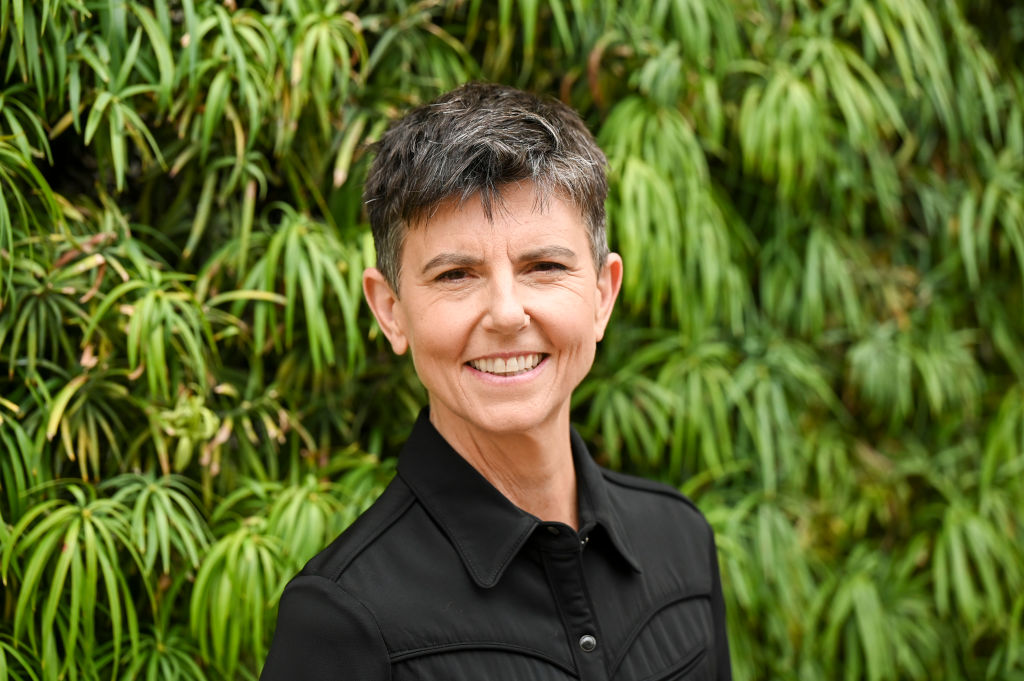
GO: Your website shows three of your earlier author photos, with accompanying caricatures and descriptions: Terry Gross Junior (2021), Local News Anchor (2017), and Heterosexual Mall Goer (2016). How would you describe your current author photo?
SH: Wow, I’m so glad you asked this question. Several people have told me recently that my hair in that photo is too restrained. Also, I don’t generally wear glasses, so I’m presenting somewhat of a false self. (Okay, we’ve looped back to the topic of personae here; how exciting.) This is all to say that I need a new photo in which my hair is crazy and I am not wearing glasses.
GO: Tell us about your writing process. Does it change with each book?
SH: I like to work in a concentrated way. Ideally, I leave home to do this. I have found that I’m a lot more productive when I’m not surrounded by my friends, because they’re always inviting me to do things and it’s hard to say no. If I need to write a lot and I’m home, I practice my boundary setting by saying no a lot. Then I tell my therapist about it and hope that she’s proud of me.
GO: What are you working on now?
SH: A memoir called How To Escape Yourself Or Die Trying: An Addict And A Really Long Bike Ride. It’s about my addiction history and my 500-mile pilgrimage in Spain.
GO: Any advice for aspiring writers and authors?
SH: Finish the thing you want to finish. You don’t know what something is until it’s done.
“I Want You More” is available wherever books are sold. For more about Swan, including tour dates, visit her website at swanhuntley.com.