

“A Cowardly Abuse Of Power”: Florida’s War On Rainbow Crosswalks
Elected officials and advocates in Florida say the erasure of rainbow-colored sidewalks is about so much more. And they’re not done fighting.
In Florida, even the crosswalks are political.
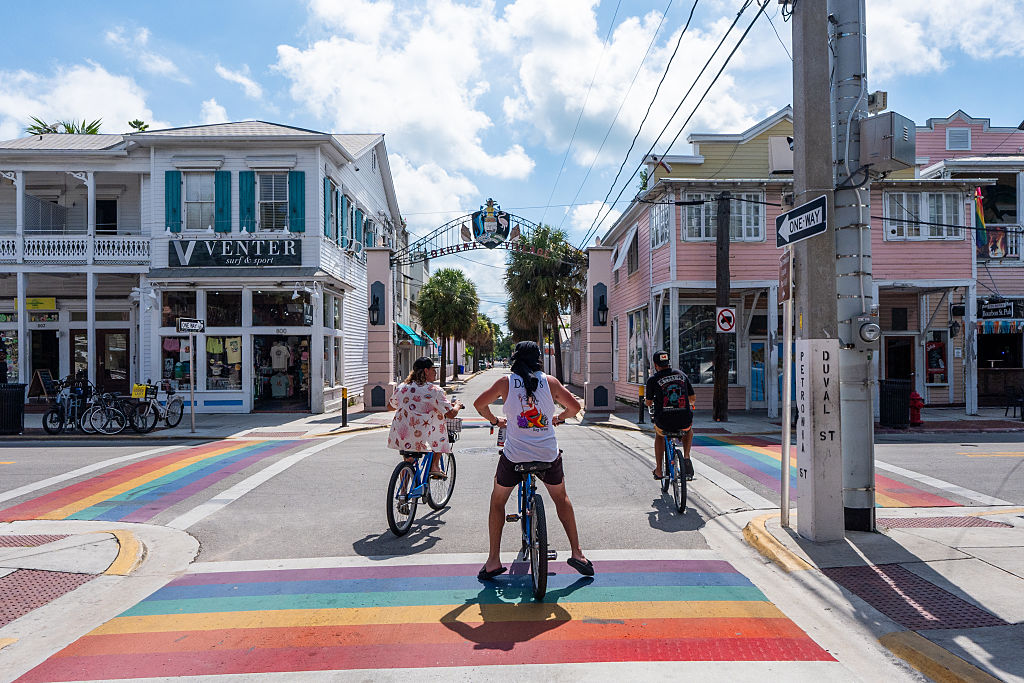
The state has launched a campaign to erase rainbow-colored crosswalks, a once-celebrated symbol of LGBTQ+ visibility in cities like Orlando, Delray Beach, and Fort Lauderdale. Officials now say these murals violate state transportation policy, a claim met with fierce pushback from advocates and local leaders who say the crackdown is less about safety and more about silencing queer visibility.
The rainbow crosswalk at the Pulse memorial in Orlando has become a flashpoint in the state’s broader war on LGBTQ+ symbolism. After FDOT crews first painted over the crosswalk in August, the community responded by filling the space with chalk drawings of hearts and rainbows. Those, too, were scrubbed away. Activists returned with more chalk. Then came the arrests.
Related: Miami Beach’s Pride Crosswalk Torn Up As Florida Expands Crackdown On Street Art
For months, the memorial became a site of quiet defiance and mounting tension. Queer residents and allies showed up, chalk in hand, refusing to let the erasure go unanswered.
Governor Ron DeSantis has cited SB 1662, a sweeping transportation bill passed earlier this year, as the legal basis for the removals.
“The safety and the use of the roads was almost secondary to people being able to appropriate that for different types of messaging,” DeSantis said during an August press conference.
However, critics argue that the justification is flimsy at best. The bill, they point out, never mentions crosswalks.
“It’s all motivated by politics,” said Florida State Sen. Carlos Guillermo Smith, a Democrat who represents District 17 in Orange County, where the 2016 Pulse nightclub shooting claimed the lives of 49 people, most of them queer and Latinx. “The attacks on LGBTQ people became much more intense in the lead-up to Ron DeSantis’s failed campaign for president of the United States.”
Smith pointed to what he called a long list of political stunts.
“He launched an extreme anti-LGBT agenda before his presidential run that included the ‘Don’t Say Gay or Trans’ law, an expansion to that law, making our state the number one state in the country for book banning,” Smith told GO. “He signed into law prohibitions on medically necessary care for transgender people of all ages. He passed laws censoring drag queen performances. The list goes on and on.”
The most recent controversy, Smith said, reveals how depraved right-wing politics have become. He said the campaign hit home in his own community when the Florida Department of Transportation (FDOT) painted over the rainbow crosswalk at the Pulse memorial in August.
“The rainbow crosswalk attached to the Pulse nightclub memorial was intended to honor the 49 people who were murdered there, but it was also intended to enhance the safety of pedestrians who go there every single day to pay their respects,” Smith said.
Smith said that traffic studies have demonstrated that colored crosswalks reduce the number of accidents.
“This effort has not only wasted millions of dollars in taxpayer money from the state that says that they are looking to make sure that we spend public dollars more efficiently, but it has also made our roads less safe,” Smith said.
In the wake of Pulse, rainbow crosswalks became a symbol of healing and resilience. Delray Beach installed Pride-themed crosswalks in 2021 after local LGBTQ+ leaders advocated for greater visibility.
Related: Florida Teacher Put On Leave After Requesting Gender-Neutral Title ‘Mx’
Rob Long, Vice Mayor of Delray Beach and a candidate for Florida House District 90, cast the only vote to continue challenging the state after transportation crews painted over the city’s rainbow Pride crosswalk two separate times.
“It was such a victory when they were installed because it showed that these communities were safe,” Long said. “It showed that the LGBTQ+ community had finally broken through in a new way in these communities where this visibility was universal.”
That visibility has not been without attacks, as the Delray Beach crosswalk has been vandalized by drivers burning out the mural several times.
“Over the last several years, ours was vandalized over and over again,” Long said. “One of them was during a Trump rally, and the people skid across it. The punishment that they got was almost nothing; it was a slap on the wrist. And the second time it happened, the kid who vandalized the symbols, they did a crowdfunding thing for him, and he was touted as this local hero.”
Long said those incidents revealed the rising tide in homophobic sentiment across the state and nationwide. According to the Movement Advancement Project’s equality profile on Florida, 4.6 percent of adults in the state are LGBTQ+, and 886,000 Florida residents aged 13 and older are LGBTQ+. The Trevor Project’s 2024 national survey found that 90 percent of LGBTQ+ young people said their well-being was negatively impacted due to recent politics.
Related: Catholic Church Bans All Gender-Affirming Care At Its Vast Hospital Network
“That showed the shift to this hatred being accepted and normalized,” Long said. “The symbol that was celebrated as a victory is now an afterthought.”
A June memo from FDOT advised staff to begin cracking down on decorative crosswalks. Previously, there had been no such ban on artistic crosswalks.
In Orlando’s LGBTQ+-friendly Milk District, the community didn’t wait for permission to respond. Se7enbites, a queer-owned restaurant known for its Southern fare and rainbow-hued cakes, transformed its private parking lot into a canvas. Local artists filled the spaces with vibrant murals honoring the victims of the Pulse Nightclub shooting.
“We wanted to honor and respect the 49 lives that have passed, and we just happen to have that many parking spaces,” Brandy Ford, the restaurant’s general manager, told GO.
The project, called “Parking Spaces for Pride,” was embraced by the community.
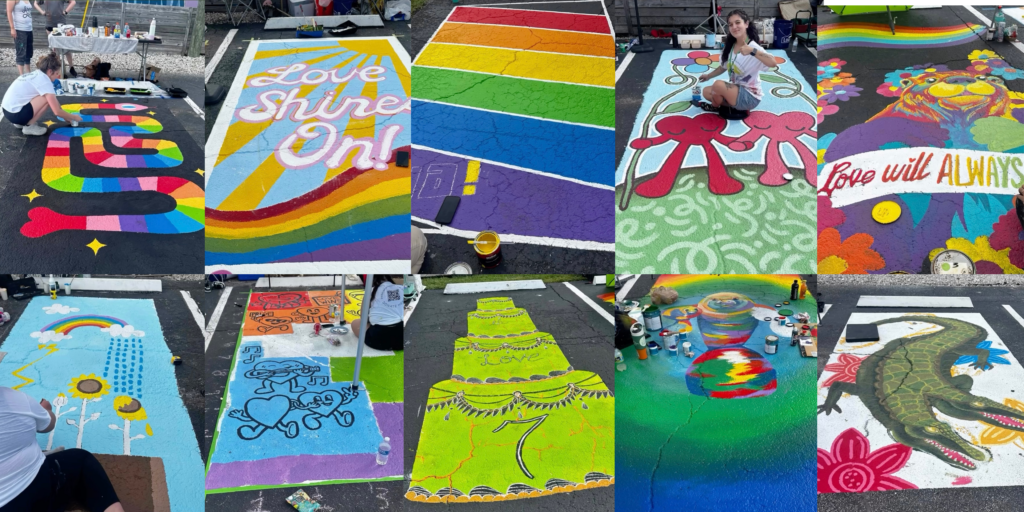
“We put this together relatively quickly, but the outpouring from the community came in very quickly,” Ford said. “People were looking for an outlet to voice how they felt.”
She says the painted parking spaces aren’t going anywhere.
“It’s a beautiful parking space too, I get to drive up every day and park over these spaces,” Ford said. “We’ve actually sealed them with anti-graffiti paint.”
LGBTQ+ advocates from across Florida say these erasures are part of a larger campaign of cultural repression, one that extends from classrooms and healthcare to sidewalks and parking lots.
In Fort Lauderdale, openly gay City Commissioner Steve Glassman is making it clear that rainbow crosswalks aren’t up for debate. Glassman says they are the last city challenging the state in court.
“We are standing up for our values and we’re standing up for ourselves as a city and we’re hoping that the state can understand some of our arguments,” Glassman said.
Glassman says he would rather be working with the state on addressing issues affecting residents’ quality of life, such as the cost of living, insurance premiums, and the threat of sea level rise.
“There [are] just so many things that we could be partnering on that are big projects and big ideas and things that really are of consequence. This is not where our energy should be spent,” Glassman said.
That same urgency is echoing in Palm Beach County, where Julie Seaver, CEO of Compass LGBTQ+ Community Center in Lake Worth Beach, says the LGBTQ+ community in Florida will keep supporting one another.
Related: Atlanta’s Trans Housing Coalition Steps In To Provide Much-Needed Resources
“We don’t want to be erased, and it was the most tangible, visible way of the state trying to erase us by painting over the crosswalks,” Seaver said. “It’s just a cowardly abuse of power.”

and Julie Seaver, CEO of Compass LGBTQ+ Community Center. Photo courtesy of Rand Hoch.
Others are done mincing words. Rand Hoch, president and founder of Palm Beach County Human Rights Council and Florida’s first openly LGBTQ+ judge, called it what it is: state-sponsored homophobia.
“No one’s made it a bigger issue than Ron DeSantis, and for the life of me, I cannot understand why. When people are literally being starved out because of government action and inaction, I don’t think you should be concentrating on things like ripping up street art,” Hoch said. “I don’t think anyone is going to say, ‘Yeah, I lost my SNAP benefits for a while. It was a hard time feeding my family. My car insurance has gone up. It’s difficult to pay for food. But I’m voting for the person who decided to rip up street art.’”
Younger voices are weighing in, too, and they’re thinking about what these actions mean for the next generation. Maxx Fenning, Executive Director of PRISM, a nonprofit serving LGBTQ+ youth in South Florida, pointed to the emotional weight these crosswalks carry. For queer teens growing up in a state where their identities are under attack in schools, clinics, and now sidewalks, Fenning says the message is clear: “You don’t belong here.”
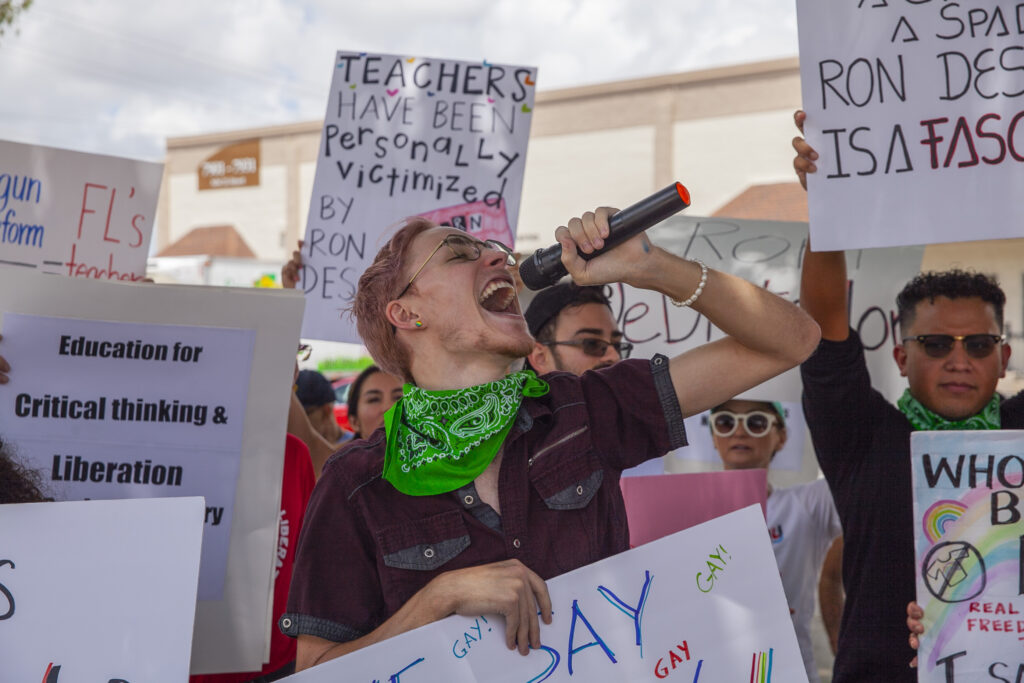
“I often think about the silliness and pettiness of these battles but also the severity that this is an attempt to erase LGBTQ+ people from public life in their entirety,” Fenning said. “Whether that be from our classrooms, from our own driver’s licenses, and in some cases, from the media. This is just another example of that attempt to silence and remove queer people from public view.”
Joe Saunders, senior political director of Equality Florida, says LGBTQ+ Floridians have seen this before.
Related: The Okra Project’s Mutual Aid is Survival, Not Charity
“Our community knows how to fight back and that resilience and spirit of resistance is what we’re seeing in all 13 of the communities that have had their pride street murals or crosswalks attacked by the governor,” Saunders said. “We’re seeing a real commitment to not just resist and call out this attack as bigotry, but to build back even bolder.”

during the mass shooting at Pulse Nightclub in Orlando, FL in 2016. Photo by Ronaldo Silva/NurPhoto via Getty Images.
Advocates are weighing their options in terms of what comes next, including legal action. Hoch said his group is actively reviewing whether FDOT’s actions violate constitutional protections. Glassman echoed that litigation isn’t off the table.
“We don’t want to just fight for the sake of fighting, but we do believe there are some important principles here as a city, as a jurisdiction that should have control over its streets,” Glassman said.
Generations of LGBTQ+ activists in Florida say they are going to continue resisting.
“Where resistance goes from here is to show up anyway,” Fenning said. “You can cover over our crosswalks on asphalt, you can burn every book and every page that mentions the history of our community, but we’re still going to stand tall and be here and be boldly and proudly here.”