

New Affordable Housing To Serve LGBTQ+ Seniors In Rhode Island
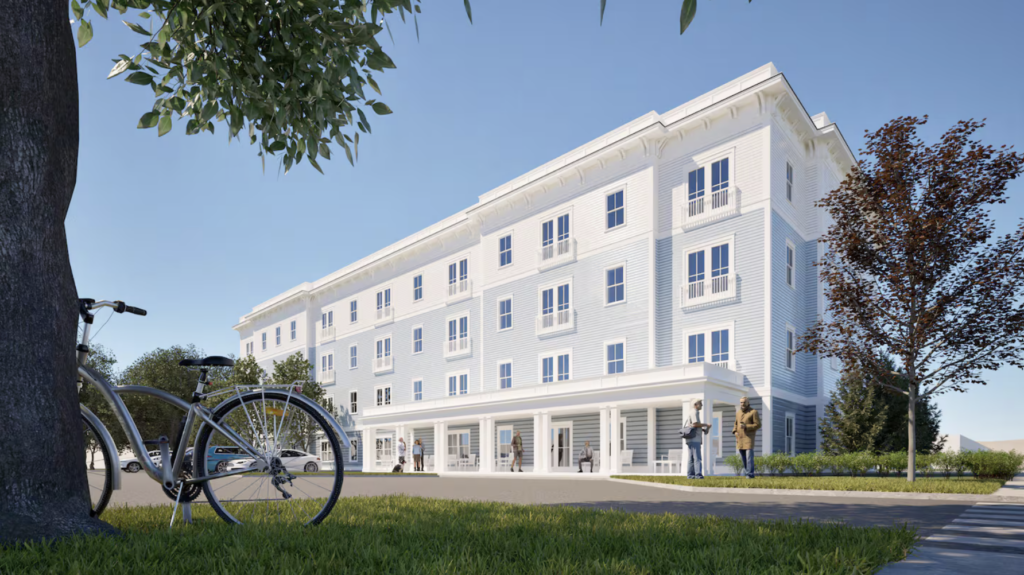
“The Landing at East Point” will be the first affordable housing development in RI for queer seniors and their allies.
Featured Image: Rendering of The Landing at East Point in East Providence, courtesy of Union Studio Architecture & Community Design
Note: This article was updated on Feb. 4, 2026
Rhode Island’s first affordable housing development specifically designed for the LGBTQ+ senior community will be coming to East Providence soon. The Landing at East Point will be a four-story, 39-unit independent living complex. It will be situated on 1.15 acres off of Bourne Avenue and part of the larger 29-acre East Point neighborhood development, replete with trails and parks. Featuring light and airy apartments, the development is designed with both outdoor and indoor spaces for community members to gather—and with the needs of an aging LGBTQ+ community in mind.
“Community spaces are important for all multi-family projects but are especially important in senior housing projects to encourage sociability, reduce loneliness, and improve physical and mental health for seniors,” Carson Smith, Designer with Union Studio Architecture & Community Design, shared with GO. Union’s thoughtful design is the product of the request of Aldersbridge Communities, the not-for-profit visionary behind the ~$18 million project.
Features of the complex include a large front porch and rear patio with seating, a fenced grass yard area for activities, and raised garden beds to encourage residents to spend time outdoors connecting with nature and with one another, Smith notes. Interior community spaces boast a large multi-purpose room with a shared kitchen for activities, bike room, and more intimate sitting and reading rooms on each floor. Other spaces can be used as a library, arts and crafts room, or fitness room depending on what the resident community would like.
And with sustainability in mind, the project team is on track to exceed Rhode Island’s new energy codes with robust insulation, efficient appliances, solar panels and more.
Related: San Francisco To Develop 15-Story Affordable Housing Campus For LGBTQ+ Seniors
Richard Gamache, CEO of Aldersbridge Communities, and Jodi Glass, an Aldersbridge board member, have been the driving force behind the project. Collaborators plan to break ground in the first half of 2026, with an eye toward officially opening in 2027.
To be eligible for the housing, residents must be 55 and older, and earn 80 percent or less of the area median income – or $64,000 a year for an individual .While project managers will not be discriminating, they will be marketing to the LGBTQ+ community. There are already 44 people on the “interest list.”
“LGBTQIA+ seniors often face discrimination and isolation in senior housing, and we hope that The Landing at East Point will be the home of a thriving community of LGBTQIA+ seniors and allies in the first project of it’s kind in Rhode Island,” Carson Smith said.
Jodi Glass shared her thoughts with The Boston Globe about the experiences of older people, who came of age in a time when doing so wasn’t always safe. Echoes of those challenges have often persisted into later years. With that in mind, developers aren’t just creating a building – they are laying the foundation for a supportive culture.
“The need here is the same as the need all over the country. Folks in my generation – I’m 72 – grew up coming out once, of course, which may have been traumatic, and to have to come out again when one moves, if need be, to a congregate living setting, could be traumatic and dangerous,” Glass told the Globe. “Many times, when we go into congregate living settings and we ask if there are LGBTQ folks there, [we] hear “Oh, there’s nobody here.” But that’s because people are too afraid to come out.”
Glass’s thoughtful enthusiasm for the project is echoed by members of the wider project team.
“Personally, as a member of the LGBTQIA+ community, working on this project has been an incredible honor,” said Smith. “I’m so thankful to be giving back to LGBTQIA+ seniors who have made many sacrifices and have fought incredibly hard to secure the rights that the LGBTQIA+ community, and I, enjoy today.”