

Burkina Faso Criminalizes Homosexuality – Now Punishable By Prison And Fines
Under the leadership of the military junta, the country joins many others on the African continent that now punish homosexuality with either prison or with death.
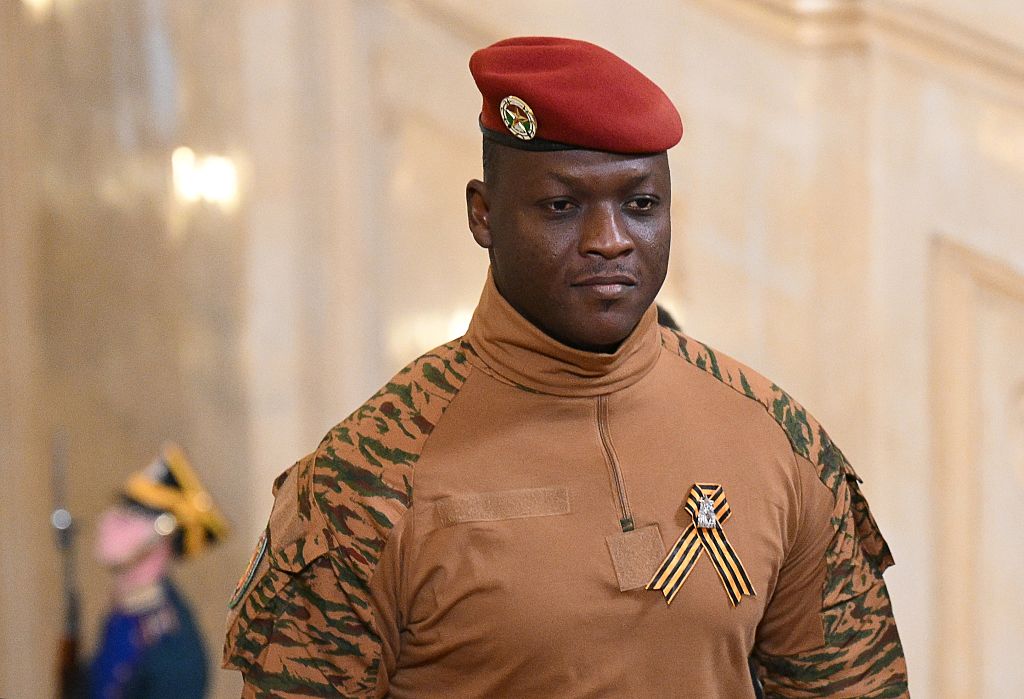
Featured Image: President of Burkina Faso Ibrahim Traore (Photo by Alexandr Kryazhev/RIA Novosti/Pool/Anadolu via Getty Images)
On Monday, the state broadcaster of Burkina Faso announced that the government had passed a law banning homosexuality. The draft law was passed unanimously by 71 unelected members of the country’s transitional government—in place since the military junta took power under now President Ibrahim Traore, following two coups in 2022.
Justice Minister Edasso Rodrigue Bayala announced the news on national broadcaster RTB. “If a person is a perpetrator of homosexual or similar practices, all the bizarre behavior, they will go before the judge,” he said. The Justice Minister added that “in the event of a repeat offense, [you] will be deported if you are not a Burkinabe national.”
Those found guilty could face fines plus two to five years in prison. The law is expected to be officially signed by Ibrahim Traore.
The news is not entirely a surprise given the climate, which has included deadly attacks on civilians and deterioration of human rights. In May of 2024, the junta (led by Ibrahim Traore) announced plans to stay in power. Military authorities were clear about wanting to clamp down on LGBTQ rights. “In July, the junta approved a revised family code criminalizing homosexuality. The revised code did not specify penalties,” HRW notes in World Report 2025.
More than half of African countries currently punish homosexuality with either prison sentences or the death penalty. Last year, Mali (under military rule since 2021) also criminalized homosexuality. At the time, Human Rights Watch predicted, “the new legislation will intensify risks of stigma, discrimination, and violence against lesbian, gay, bisexual, and transgender (LGBT) people throughout the country.” HRW also notes that even before such legislation, vague provisions in the penal code existed, i.e. Article 225 that penalized “public indecency,” making it possible to persecute LGBT and gender nonconforming people.
Such laws are being passed in the name of “tradition and moral values,” and many pre-existing anti-LGBTQ laws can be traced to colonial legacies, particularly British influence.
Last year saw a rise in provisions that serve to entrench LGBTQ discrimination. In Uganda, the court upheld the 2023 Anti-Homosexuality Act, which per Human Rights Watch, criminalizes consensual same-sex conduct with penalties of up to life imprisonment, attempted homosexual acts with penalties of 10 years in prison, and the death penalty for those convicted of “aggravated homosexuality,” which includes repeated same sex acts and intercourse with a person younger than 18, older than 75, or someone with a disability. Also in 2024, the supreme court of Ghana upheld a colonial-era law that criminalizes adult consensual same-sex conduct.
On a positive note, some countries on the African continent have decriminalized LGBTQ practices over the past few years, including Angola, Botswana, and Mauritius.